Sun, Sep 27, 2026
Volume 16 - Special Issue(Exercise Therapy in Action)
PTJ 2026, 16 - Special Issue(Exercise Therapy in Action): 359-368 |
Back to browse issues page



Download citation:
BibTeX | RIS | EndNote | Medlars | ProCite | Reference Manager | RefWorks
Send citation to:


BibTeX | RIS | EndNote | Medlars | ProCite | Reference Manager | RefWorks
Send citation to:
rajabi R. Large Language Models in Corrective Exercise Prescription: Current Evidence, Clinical Challenges, and Future Directions. PTJ 2026; 16 (S1) :359-368
URL: http://ptj.uswr.ac.ir/article-1-957-en.html
URL: http://ptj.uswr.ac.ir/article-1-957-en.html

Department of Sport Medicine and Emerging Technologies, Faculty of Sport Sciences and Health, University of Tehran, Tehran, Iran.
Keywords: Large language models (LLMs), ChatGPT, Corrective exercise, Exercise prescription, Artificial intelligence, Clinical decision support, Rehabilitation
Full-Text [PDF 1030 kb]
(50 Downloads)
| Abstract (HTML) (205 Views)
Full-Text: (22 Views)
Introduction
Corrective exercise is an assessment-driven approach intended to address static and dynamic postural deviations and dysfunctions, neuromuscular impairments, and related functional limitations. Unlike general exercise prescription, corrective exercise requires integration of movement assessment, clinical reasoning, exercise selection, dosage, progression, and repeated reassessment. Therefore, effectiveness depends not simply on identifying an exercise, but on determining whether an observed movement or postural feature is clinically meaningful and whether the selected intervention produces an appropriate response.
The rapid development of large language models (LLMs), particularly ChatGPT, has introduced new possibilities for exercise prescription and rehabilitation. These systems can synthesize large volumes of textual information, generate structured exercise programs, explain scientific concepts, and support patient education and clinical documentation. Studies of exercise prescription indicate that LLMs can generate programs that broadly reflect variables, such as frequency, intensity, time, type, volume, and progression, although the quality of quantitative parameters and individualization may vary between outputs [1, 2].
LLMs are particularly relevant to corrective exercise because corrective programs require translating assessment findings into a sequence of exercise decisions. Recent research suggests that structured prompts containing patient characteristics, symptoms, movement findings, goals, contraindications, available equipment, and exercise parameters can improve the relevance and consistency of artificial intelligence (AI)-generated recommendations [3]. Nevertheless, a coherent program generated by an LLM should not be interpreted as evidence of clinical effectiveness. Current text-based systems do not independently perform physical examination, directly measure movement quality, or reliably determine the clinical significance of individual postural findings.
An important development is the integration of LLMs with other forms of artificial intelligence. Recent work in AI-based postural management shows that computer vision and human pose estimation (HPE) can identify anatomical landmarks and derive variables, such as joint angles, segment relationships, distances, and movement kinematics. Markerless camera systems, depth cameras, and wearable inertial measurement units can provide objective information about posture and exercise performance. AI-guided systems can additionally deliver real-time feedback and support remote monitoring [4]. These technologies may provide the movement information that text-only LLMs currently lack.
This mini-review examines current evidence on LLM-assisted exercise prescription, the specific challenges of applying LLMs to corrective exercise, the contribution of multimodal AI technologies, and the prospects for a human-AI collaborative model.
Current evidence indicates that LLMs can generate exercise programs that broadly follow established principles of exercise prescription. Research in resistance training has shown that ChatGPT can produce generally coherent program structures, while GPT-4 has demonstrated potential for evidence-informed exercise programming [1, 2]. However, expert adjustment may still be necessary for exercise selection, loading, progression, and individualization.
Evidence across broader clinical applications is also encouraging but heterogeneous. A systematic review of ChatGPT in orthopedics found generally acceptable quality, readability, and comprehensiveness, while noting variability in accuracy and reliability as clinical complexity increases [5]. Research in sports rehabilitation similarly suggests that LLMs can provide useful educational information and preliminary rehabilitation recommendations; however, their performance becomes less reliable when decisions require integration of complex patient-specific information and clinical judgment [6].
A 2025 scoping review concluded that LLMs have potential for exercise recommendations in both clinical and healthy populations, although studies differ substantially in methods, populations, prompts, and evaluation criteria [7]. A systematic review of generative AI for exercise and training prescription likewise identified broad potential for program planning but emphasized limited evidence linking AI-generated prescriptions to patient or athlete outcomes [8]. These findings highlight a fundamental distinction between generating an intervention and demonstrating that the intervention works.
Recent primary studies further strengthen the emerging evidence for the practical use of LLM-based systems. Huang et al. [9] conducted a formative randomized controlled trial of an LLM-powered osteoporosis self-management chatbot (OPBot) involving 100 randomized participants, with 88 included in the final analysis. Compared with traditional education, OPBot produced significantly higher post-intervention osteoporosis knowledge scores and substantially reduced nurses’ education time. It also showed a favorable effect on calcium-supplement adherence, while the apparent improvement in calcium-rich food consumption did not remain significant after correction for multiple comparisons. Most evaluated chatbot responses were rated highly reliable (89.4%), with strong interrater agreement (κ=0.83). These findings support the potential of LLMs for patient education and behavioral support, although larger studies are required to establish clinical effectiveness.
In the rehabilitation domain, Wang et al. 2025 [10] developed ReLite, a personalized sport-training rehabilitation framework that combines fine-tuned LLM-based encoding of free-text exercise feedback with sequence modeling of session histories and adaptive alignment of semantic information with ordinal ratings. Experiments on two public datasets showed that integrating language understanding with temporal behavior modeling and text-rating alignment provided a robust and data-efficient foundation for personalized rehabilitation recommendations, particularly under limited-data conditions. This work suggests that LLMs may contribute more effectively to rehabilitation decision support when linguistic feedback is integrated with longitudinal behavioral information rather than used in isolation.
Complementing these findings, Lai et al. (2026) [11] evaluated an AI-assisted adaptive precision Boolean Rubric (adaptive-PBR) for assessing personalized exercise prescriptions. In a pilot validation involving 12 experts and five diverse clinical cases, Adaptive-PBR demonstrated excellent inter-rater reliability (intraclass correlation coefficient [ICC]=0.83), comparable to a full Boolean rubric (ICC=0.82) and superior to a conventional Likert scale (ICC=0.65), while reducing evaluation time by approximately 63%. The framework also reduced experience-related variability in scoring. Although larger-scale validation is needed, these results indicate that AI may support not only exercise recommendation but also standardized quality assurance and evaluation of personalized exercise prescriptions.
Therefore, prompt engineering is a crucial component of LLM-assisted exercise prescription. Structured prompts can reduce ambiguity and encourage the model to consider clinically relevant variables. However, prompt quality cannot compensate for missing or inaccurate clinical information. LLM performance remains dependent on the quality of the information provided and the user’s ability to critically evaluate the output [3].
The most promising development beyond text-only LLMs is multimodal integration. The recent review by Köroglu et al. [4] indicates that AI-based HPE can provide objective and potentially continuous postural assessment. Computer vision can estimate anatomical key points and derive biomechanical variables, while markerless systems may permit assessment in relatively natural environments. Wearable sensors and depth cameras can provide complementary information when camera-based measurement alone is insufficient. Such systems can also support real-time feedback, exercise-quality monitoring, personalization, and remote rehabilitation.
This creates a potentially complementary relationship between movement AI and LLMs. HPE and sensor systems can transform visual or sensor data into structured movement information, while an LLM can organize that information with symptoms, goals, clinical guidelines, exercise constraints, and patient preferences to generate candidate intervention strategies. The resulting system would be substantially different from asking a chatbot to prescribe exercises from a short textual description.
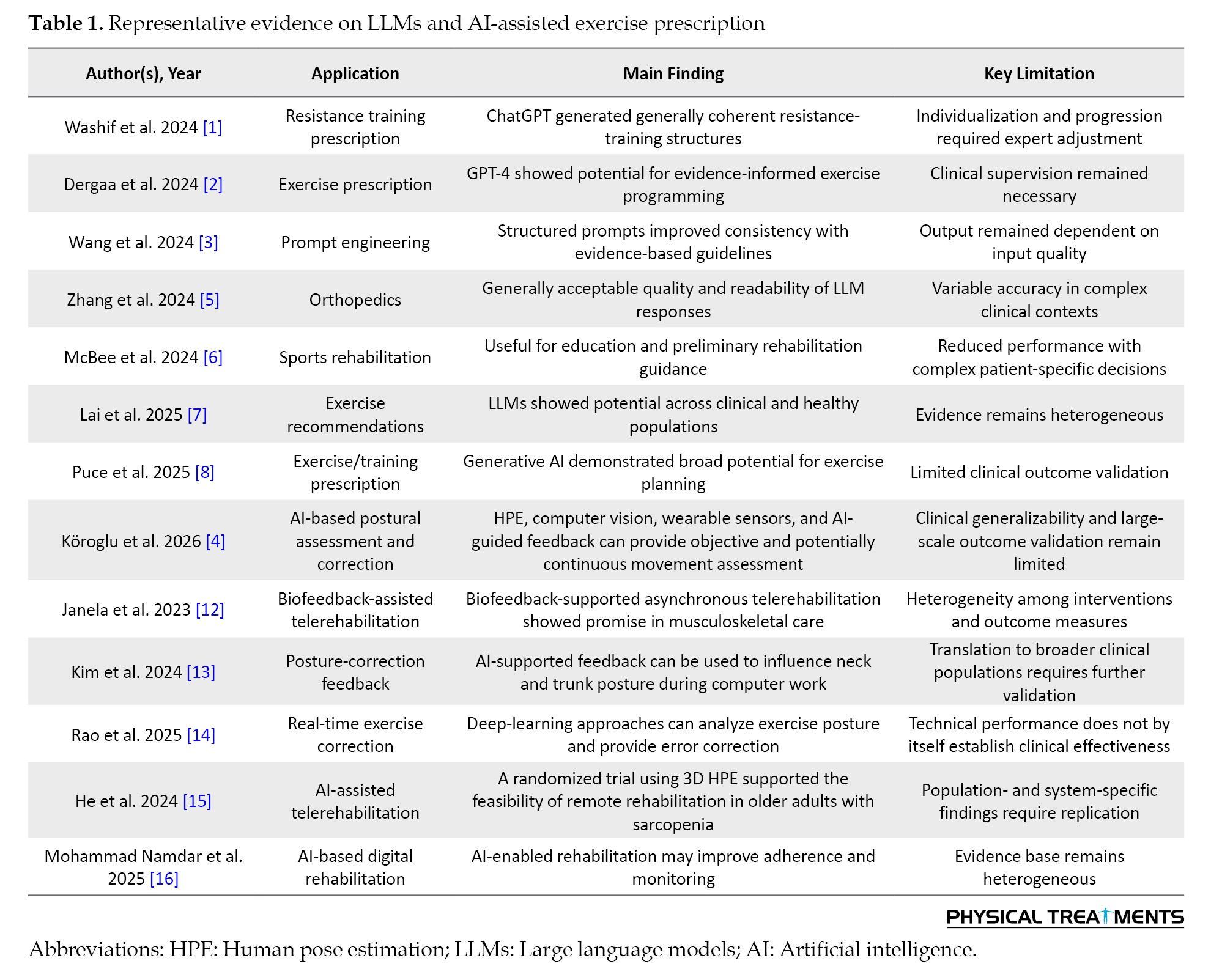
Overall, current evidence supports using LLMs for preliminary exercise planning, evidence synthesis, education, and documentation. However, the evidence does not yet support autonomous corrective exercise prescription or the assumption that a structurally appropriate AI-generated program will necessarily produce favorable clinical outcomes (Table 1).
These findings align with preliminary internal data, where 93 corrective exercise specialists evaluated LLM-generated programs using Janda and National Academy of Sports Medicine (NASM) frameworks [17]. Specialists rated scientific quality and logical structure positively, but identified limited predicted effectiveness, safety concerns, and insufficient personalization and monitoring as major shortcomings. While preliminary, these results support further exploration of multimodal AI systems that integrate evidence-based programming with objective movement assessment and clinical supervision.
Corrective exercise presents a greater challenge than general exercise programming because intervention selection depends on the relationship between assessment findings and exercise response. Similar postural presentations may arise from different combinations of mobility restrictions, muscle performance deficits, motor-control impairments, pain, behavioral factors, or compensatory strategies. Consequently, the same exercise may be appropriate for one person but ineffective or inappropriate for another.
Therefore, the central problem is not simply whether an LLM knows which exercises are commonly recommended. The more difficult question is whether it can determine why a particular exercise should be selected for a particular individual, at what dose, in what sequence, and according to which progression criteria. Current LLMs can reproduce general clinical knowledge and organize plausible interventions; however, they do not independently establish whether the assumptions underlying a recommendation are correct.
This limitation becomes clearer when movement assessment is considered. A language model can generate plausible exercises from descriptions, such as forward head posture or increased thoracic kyphosis; however, these observations do not necessarily indicate a clinical impairment. The same posture may reflect compensation, temporary positioning, or normal individual variation. Without objective movement data and clinical context, AI may confuse observation with diagnosis or assume unproven causal relationships. Therefore, accurate corrective exercise prescription requires multimodal assessment, clinical reasoning, and professional oversight.
AI-based HPE can potentially address part of this limitation. The 2026 review by Köroglu et al. describes systems that can estimate anatomical landmarks and calculate joint angles, distances, segment relationships, and kinematic variables. Such systems can make postural assessment more objective and may permit repeated measurement outside specialized laboratories. However, HPE accuracy can be affected by camera position, lighting, occlusion, clothing, body characteristics, environmental conditions, and the diversity of the training dataset [4].
A critical distinction must therefore be maintained between measurement and interpretation. Detecting a movement deviation does not automatically establish that it is pathological, clinically important, or responsible for symptoms. Technical accuracy must ultimately be linked to clinical reasoning and meaningful outcomes. The AI system may quantify a movement, but the clinician must determine its significance within the broader clinical picture.
Progression represents another major challenge. Corrective exercise is dynamic and requires repeated assessment of symptoms, movement quality, strength, mobility, motor control, function, adherence, and response to intervention. Static AI-generated programs cannot adequately capture these longitudinal changes. Multimodal systems, however, may support continuous exercise monitoring and potentially adapt exercise difficulty according to observed performance. The postural-management literature describes this as a move toward closed-loop intervention, in which assessment, feedback, exercise performance, and progression are connected [4].
Safety remains equally important. LLMs can generate fluent and convincing information while occasionally producing inaccurate or poorly contextualized recommendations. Movement-analysis systems can also produce technically accurate measurements that are clinically misinterpreted. Therefore, high technical performance should not be equated with clinical safety or effectiveness.
Strengths and limitations of large language models
The principal strength of large language models (LLMs) is their capacity to rapidly organize and synthesize large amounts of textual knowledge. For corrective exercise professionals, this may facilitate literature reviews, identify candidate exercises, prepare patient education materials, develop preliminary intervention plans, and clinical documentation. LLMs can also present the same information at different levels of complexity, which may support communication with patients and students.
A second advantage is flexibility. When relevant patient information is incorporated into a structured prompt, an LLM can generate alternative exercise strategies, modify instructions, explain rationale, and organize an intervention according to specified constraints. This makes LLMs potentially valuable as assistants rather than autonomous prescribers.
A third advantage emerges through multimodal integration. Computer vision, HPE, wearable sensors, and other measurement technologies can provide objective movement information, while the LLM can synthesize these data with symptoms, goals, exercise restrictions, and relevant evidence. This division of labor is potentially more appropriate than expecting one system to perform every component of clinical reasoning.
Nevertheless, clinical risk represents a major limitation of AI-assisted corrective exercise prescription. LLM responses may vary with prompt wording, model version, and the completeness of the supplied information. Text-only systems lack direct access to many clinically relevant variables, including dynamic movement quality, tactile findings, real-time response to exercise, and contextual features of physical performance. AI-generated programs may therefore be coherent but insufficiently individualized.
First, misdiagnosis or overinterpretation may occur when an LLM interprets an observed feature, such as forward head posture, as a clinical diagnosis or causal impairment, although such findings may reflect compensation, temporary positioning, or normal individual variation. Second, algorithmic bias may arise when training and validation datasets inadequately represent diverse populations, potentially reducing measurement accuracy and clinical relevance across differences in body characteristics, age, sex, or environmental conditions. The same issue applies to movement-analysis AI; computer-vision systems may achieve high accuracy in landmark detection under controlled conditions but perform differently in real-world environments. The review by Köroglu et al. [4] emphasizes the need for large and diverse datasets, validation across populations, attention to usability, and careful consideration of privacy and ethical issues. Technical performance must ultimately connect to clinically meaningful outcomes rather than evaluate only through computational error metrics.
Third, professional responsibility remains critical because reliance on AI-generated recommendations without adequate clinical supervision may create patient-safety and medico-legal risks. AI outputs should be treated as decision-support information rather than autonomous clinical decisions. Qualified professionals must retain responsibility for assessment, interpretation, exercise selection, dosage, progression, monitoring, and safety. AI can contribute to information processing, program structuring, movement quantification, feedback, and longitudinal data organization without replacing professional accountability.
Future directions: Toward multimodal human-AI collaboration
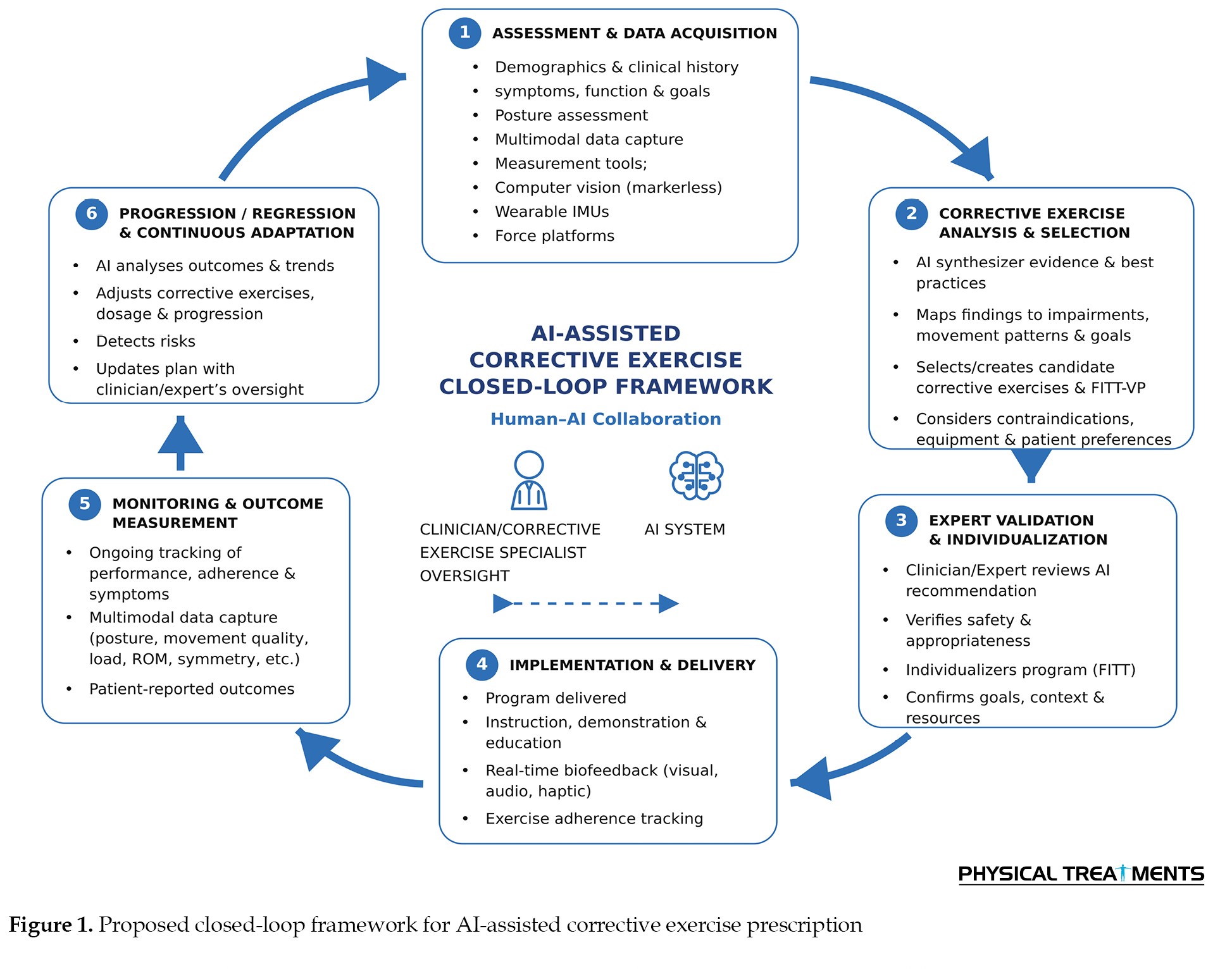
Future developments should move beyond text-only interaction toward multimodal AI systems capable of integrating clinical information with movement and biomechanical data. Computer vision, markerless motion analysis, wearable inertial sensors, force platforms, and other measurement technologies could provide objective information that is currently unavailable to conventional LLMs. A future AI-assisted corrective exercise system could follow a closed-loop process, as illustrated in Figure 1.
Corrective exercise is an assessment-driven approach intended to address static and dynamic postural deviations and dysfunctions, neuromuscular impairments, and related functional limitations. Unlike general exercise prescription, corrective exercise requires integration of movement assessment, clinical reasoning, exercise selection, dosage, progression, and repeated reassessment. Therefore, effectiveness depends not simply on identifying an exercise, but on determining whether an observed movement or postural feature is clinically meaningful and whether the selected intervention produces an appropriate response.
The rapid development of large language models (LLMs), particularly ChatGPT, has introduced new possibilities for exercise prescription and rehabilitation. These systems can synthesize large volumes of textual information, generate structured exercise programs, explain scientific concepts, and support patient education and clinical documentation. Studies of exercise prescription indicate that LLMs can generate programs that broadly reflect variables, such as frequency, intensity, time, type, volume, and progression, although the quality of quantitative parameters and individualization may vary between outputs [1, 2].
LLMs are particularly relevant to corrective exercise because corrective programs require translating assessment findings into a sequence of exercise decisions. Recent research suggests that structured prompts containing patient characteristics, symptoms, movement findings, goals, contraindications, available equipment, and exercise parameters can improve the relevance and consistency of artificial intelligence (AI)-generated recommendations [3]. Nevertheless, a coherent program generated by an LLM should not be interpreted as evidence of clinical effectiveness. Current text-based systems do not independently perform physical examination, directly measure movement quality, or reliably determine the clinical significance of individual postural findings.
An important development is the integration of LLMs with other forms of artificial intelligence. Recent work in AI-based postural management shows that computer vision and human pose estimation (HPE) can identify anatomical landmarks and derive variables, such as joint angles, segment relationships, distances, and movement kinematics. Markerless camera systems, depth cameras, and wearable inertial measurement units can provide objective information about posture and exercise performance. AI-guided systems can additionally deliver real-time feedback and support remote monitoring [4]. These technologies may provide the movement information that text-only LLMs currently lack.
This mini-review examines current evidence on LLM-assisted exercise prescription, the specific challenges of applying LLMs to corrective exercise, the contribution of multimodal AI technologies, and the prospects for a human-AI collaborative model.
Current evidence indicates that LLMs can generate exercise programs that broadly follow established principles of exercise prescription. Research in resistance training has shown that ChatGPT can produce generally coherent program structures, while GPT-4 has demonstrated potential for evidence-informed exercise programming [1, 2]. However, expert adjustment may still be necessary for exercise selection, loading, progression, and individualization.
Evidence across broader clinical applications is also encouraging but heterogeneous. A systematic review of ChatGPT in orthopedics found generally acceptable quality, readability, and comprehensiveness, while noting variability in accuracy and reliability as clinical complexity increases [5]. Research in sports rehabilitation similarly suggests that LLMs can provide useful educational information and preliminary rehabilitation recommendations; however, their performance becomes less reliable when decisions require integration of complex patient-specific information and clinical judgment [6].
A 2025 scoping review concluded that LLMs have potential for exercise recommendations in both clinical and healthy populations, although studies differ substantially in methods, populations, prompts, and evaluation criteria [7]. A systematic review of generative AI for exercise and training prescription likewise identified broad potential for program planning but emphasized limited evidence linking AI-generated prescriptions to patient or athlete outcomes [8]. These findings highlight a fundamental distinction between generating an intervention and demonstrating that the intervention works.
Recent primary studies further strengthen the emerging evidence for the practical use of LLM-based systems. Huang et al. [9] conducted a formative randomized controlled trial of an LLM-powered osteoporosis self-management chatbot (OPBot) involving 100 randomized participants, with 88 included in the final analysis. Compared with traditional education, OPBot produced significantly higher post-intervention osteoporosis knowledge scores and substantially reduced nurses’ education time. It also showed a favorable effect on calcium-supplement adherence, while the apparent improvement in calcium-rich food consumption did not remain significant after correction for multiple comparisons. Most evaluated chatbot responses were rated highly reliable (89.4%), with strong interrater agreement (κ=0.83). These findings support the potential of LLMs for patient education and behavioral support, although larger studies are required to establish clinical effectiveness.
In the rehabilitation domain, Wang et al. 2025 [10] developed ReLite, a personalized sport-training rehabilitation framework that combines fine-tuned LLM-based encoding of free-text exercise feedback with sequence modeling of session histories and adaptive alignment of semantic information with ordinal ratings. Experiments on two public datasets showed that integrating language understanding with temporal behavior modeling and text-rating alignment provided a robust and data-efficient foundation for personalized rehabilitation recommendations, particularly under limited-data conditions. This work suggests that LLMs may contribute more effectively to rehabilitation decision support when linguistic feedback is integrated with longitudinal behavioral information rather than used in isolation.
Complementing these findings, Lai et al. (2026) [11] evaluated an AI-assisted adaptive precision Boolean Rubric (adaptive-PBR) for assessing personalized exercise prescriptions. In a pilot validation involving 12 experts and five diverse clinical cases, Adaptive-PBR demonstrated excellent inter-rater reliability (intraclass correlation coefficient [ICC]=0.83), comparable to a full Boolean rubric (ICC=0.82) and superior to a conventional Likert scale (ICC=0.65), while reducing evaluation time by approximately 63%. The framework also reduced experience-related variability in scoring. Although larger-scale validation is needed, these results indicate that AI may support not only exercise recommendation but also standardized quality assurance and evaluation of personalized exercise prescriptions.
Therefore, prompt engineering is a crucial component of LLM-assisted exercise prescription. Structured prompts can reduce ambiguity and encourage the model to consider clinically relevant variables. However, prompt quality cannot compensate for missing or inaccurate clinical information. LLM performance remains dependent on the quality of the information provided and the user’s ability to critically evaluate the output [3].
The most promising development beyond text-only LLMs is multimodal integration. The recent review by Köroglu et al. [4] indicates that AI-based HPE can provide objective and potentially continuous postural assessment. Computer vision can estimate anatomical key points and derive biomechanical variables, while markerless systems may permit assessment in relatively natural environments. Wearable sensors and depth cameras can provide complementary information when camera-based measurement alone is insufficient. Such systems can also support real-time feedback, exercise-quality monitoring, personalization, and remote rehabilitation.
This creates a potentially complementary relationship between movement AI and LLMs. HPE and sensor systems can transform visual or sensor data into structured movement information, while an LLM can organize that information with symptoms, goals, clinical guidelines, exercise constraints, and patient preferences to generate candidate intervention strategies. The resulting system would be substantially different from asking a chatbot to prescribe exercises from a short textual description.
Overall, current evidence supports using LLMs for preliminary exercise planning, evidence synthesis, education, and documentation. However, the evidence does not yet support autonomous corrective exercise prescription or the assumption that a structurally appropriate AI-generated program will necessarily produce favorable clinical outcomes (Table 1).
These findings align with preliminary internal data, where 93 corrective exercise specialists evaluated LLM-generated programs using Janda and National Academy of Sports Medicine (NASM) frameworks [17]. Specialists rated scientific quality and logical structure positively, but identified limited predicted effectiveness, safety concerns, and insufficient personalization and monitoring as major shortcomings. While preliminary, these results support further exploration of multimodal AI systems that integrate evidence-based programming with objective movement assessment and clinical supervision.
Corrective exercise presents a greater challenge than general exercise programming because intervention selection depends on the relationship between assessment findings and exercise response. Similar postural presentations may arise from different combinations of mobility restrictions, muscle performance deficits, motor-control impairments, pain, behavioral factors, or compensatory strategies. Consequently, the same exercise may be appropriate for one person but ineffective or inappropriate for another.
Therefore, the central problem is not simply whether an LLM knows which exercises are commonly recommended. The more difficult question is whether it can determine why a particular exercise should be selected for a particular individual, at what dose, in what sequence, and according to which progression criteria. Current LLMs can reproduce general clinical knowledge and organize plausible interventions; however, they do not independently establish whether the assumptions underlying a recommendation are correct.
This limitation becomes clearer when movement assessment is considered. A language model can generate plausible exercises from descriptions, such as forward head posture or increased thoracic kyphosis; however, these observations do not necessarily indicate a clinical impairment. The same posture may reflect compensation, temporary positioning, or normal individual variation. Without objective movement data and clinical context, AI may confuse observation with diagnosis or assume unproven causal relationships. Therefore, accurate corrective exercise prescription requires multimodal assessment, clinical reasoning, and professional oversight.
AI-based HPE can potentially address part of this limitation. The 2026 review by Köroglu et al. describes systems that can estimate anatomical landmarks and calculate joint angles, distances, segment relationships, and kinematic variables. Such systems can make postural assessment more objective and may permit repeated measurement outside specialized laboratories. However, HPE accuracy can be affected by camera position, lighting, occlusion, clothing, body characteristics, environmental conditions, and the diversity of the training dataset [4].
A critical distinction must therefore be maintained between measurement and interpretation. Detecting a movement deviation does not automatically establish that it is pathological, clinically important, or responsible for symptoms. Technical accuracy must ultimately be linked to clinical reasoning and meaningful outcomes. The AI system may quantify a movement, but the clinician must determine its significance within the broader clinical picture.
Progression represents another major challenge. Corrective exercise is dynamic and requires repeated assessment of symptoms, movement quality, strength, mobility, motor control, function, adherence, and response to intervention. Static AI-generated programs cannot adequately capture these longitudinal changes. Multimodal systems, however, may support continuous exercise monitoring and potentially adapt exercise difficulty according to observed performance. The postural-management literature describes this as a move toward closed-loop intervention, in which assessment, feedback, exercise performance, and progression are connected [4].
Safety remains equally important. LLMs can generate fluent and convincing information while occasionally producing inaccurate or poorly contextualized recommendations. Movement-analysis systems can also produce technically accurate measurements that are clinically misinterpreted. Therefore, high technical performance should not be equated with clinical safety or effectiveness.
Strengths and limitations of large language models
The principal strength of large language models (LLMs) is their capacity to rapidly organize and synthesize large amounts of textual knowledge. For corrective exercise professionals, this may facilitate literature reviews, identify candidate exercises, prepare patient education materials, develop preliminary intervention plans, and clinical documentation. LLMs can also present the same information at different levels of complexity, which may support communication with patients and students.
A second advantage is flexibility. When relevant patient information is incorporated into a structured prompt, an LLM can generate alternative exercise strategies, modify instructions, explain rationale, and organize an intervention according to specified constraints. This makes LLMs potentially valuable as assistants rather than autonomous prescribers.
A third advantage emerges through multimodal integration. Computer vision, HPE, wearable sensors, and other measurement technologies can provide objective movement information, while the LLM can synthesize these data with symptoms, goals, exercise restrictions, and relevant evidence. This division of labor is potentially more appropriate than expecting one system to perform every component of clinical reasoning.
Nevertheless, clinical risk represents a major limitation of AI-assisted corrective exercise prescription. LLM responses may vary with prompt wording, model version, and the completeness of the supplied information. Text-only systems lack direct access to many clinically relevant variables, including dynamic movement quality, tactile findings, real-time response to exercise, and contextual features of physical performance. AI-generated programs may therefore be coherent but insufficiently individualized.
First, misdiagnosis or overinterpretation may occur when an LLM interprets an observed feature, such as forward head posture, as a clinical diagnosis or causal impairment, although such findings may reflect compensation, temporary positioning, or normal individual variation. Second, algorithmic bias may arise when training and validation datasets inadequately represent diverse populations, potentially reducing measurement accuracy and clinical relevance across differences in body characteristics, age, sex, or environmental conditions. The same issue applies to movement-analysis AI; computer-vision systems may achieve high accuracy in landmark detection under controlled conditions but perform differently in real-world environments. The review by Köroglu et al. [4] emphasizes the need for large and diverse datasets, validation across populations, attention to usability, and careful consideration of privacy and ethical issues. Technical performance must ultimately connect to clinically meaningful outcomes rather than evaluate only through computational error metrics.
Third, professional responsibility remains critical because reliance on AI-generated recommendations without adequate clinical supervision may create patient-safety and medico-legal risks. AI outputs should be treated as decision-support information rather than autonomous clinical decisions. Qualified professionals must retain responsibility for assessment, interpretation, exercise selection, dosage, progression, monitoring, and safety. AI can contribute to information processing, program structuring, movement quantification, feedback, and longitudinal data organization without replacing professional accountability.
Future directions: Toward multimodal human-AI collaboration
Future developments should move beyond text-only interaction toward multimodal AI systems capable of integrating clinical information with movement and biomechanical data. Computer vision, markerless motion analysis, wearable inertial sensors, force platforms, and other measurement technologies could provide objective information that is currently unavailable to conventional LLMs. A future AI-assisted corrective exercise system could follow a closed-loop process, as illustrated in Figure 1.
As shown in Figure 1, this proposed framework comprises six sequential but iterative stages: (1) assessment and data acquisition, in which demographic and clinical history, symptoms, functional goals, posture, movement, and multimodal measurement data are collected; (2) corrective exercise analysis and selection, in which the AI system synthesizes the available evidence and maps the findings to candidate tailored corrective exercises; (3) expert validation and individualization, in which a clinician or corrective exercise specialist reviews the AI-generated corrective exercises recommendations, verifies safety and appropriateness, and adapts the program to the individual; (4) implementation and delivery, in which the validated program is instructed and delivered with appropriate education and real-time biofeedback when available; (5) monitoring and outcome measurement, in which adherence, symptoms, movement quality, and patient-reported or performance-related outcomes are tracked; and (6) progression/regression and continuous adaptation, in which the clinician/corrective exercise specialists and AI system use the accumulated outcomes to adjust exercise selection, dosage, and progression. The cycle then returns to assessment, allowing subsequent decisions to incorporate newly acquired clinical, movement, and outcome data. This explicit feedback loop is intended to distinguish the proposed approach from one-time, text-only exercise generation.
The framework begins with assessment and multimodal data acquisition (1), followed by AI-assisted corrective exercise analysis and selection (2), clinician/expert validation and individualization (3), implementation and delivery (4), monitoring and outcome measurement (5), and progression/regression with continuous adaptation (6). The final stage feeds updated information back to the assessment stage, creating an iterative human-AI feedback loop.
This model offers an important conceptual shift. Instead of asking whether ChatGPT can prescribe a corrective exercise program, research should examine whether an integrated AI system can help a professional make better, safer, more individualized decisions. The language model would function primarily as an evidence-synthesis and communication layer, while computer vision and sensors would contribute objective measurement and monitoring. Within the closed-loop framework, therefore, AI is not positioned as an autonomous decision-maker; rather, it supports a human-led process in which measurement informs analysis, analysis informs expert-validated exercise selection, implementation generates new outcome data, and those data feed back into subsequent clinical decisions.
Standardized prompting should be developed alongside multimodal integration. Prompts should contain relevant demographic and clinical information, movement findings, symptoms, functional limitations, goals, contraindications, equipment, and progression criteria. Where movement data are supplied, their measurement source and reliability should also be specified. Standardization would improve reproducibility and facilitate comparison among models.
Research must also move beyond expert ratings and technical demonstrations toward clinical outcome validation. Randomized controlled trials are needed to determine whether AI-assisted programs improve pain, posture, movement quality, function, adherence, and quality of life compared with conventional clinician-designed interventions. Studies should distinguish the contribution of LLM-based programming from computer-vision assessment, real-time biofeedback, and adaptive telerehabilitation.
Ethical and regulatory issues will become increasingly important as systems collect images, video, sensor data, and health information. Privacy, transparency, accountability, data security, informed use, algorithmic bias, and professional responsibility must be explicitly considered. The objective should not be the rapid creation of an autonomous “AI therapist,” but the development of validated systems in which computational capability enhances professional clinical reasoning.
Conclusion
LLMs, particularly ChatGPT, show promising potential for exercise planning, evidence synthesis, patient education, and clinical documentation. Their ability to generate structured corrective exercise programs is further supported by our preliminary departmental findings, in which 93 corrective exercise specialists evaluated LLM-generated programs based on the Janda and NASM frameworks. Both approaches demonstrated high protocol fidelity and generally favorable expert evaluations, while also highlighting the need for greater personalization, safety consideration, and continuous monitoring.
However, generating a plausible exercise program is not equivalent to demonstrating clinical effectiveness. Current LLMs remain limited in individualized assessment, procedural clinical reasoning, safety evaluation, progression, and adaptation to longitudinal responses. Similarly, movement-analysis AI must be validated across diverse populations and real-world conditions, and technical accuracy must be linked to clinically meaningful outcomes.
Therefore, most promising direction is human-AI collaboration. LLMs can synthesize evidence and structure candidate interventions; multimodal AI can provide objective movement and performance data; and qualified professionals can retain responsibility for assessment, prescription, progression, monitoring, and safety. The future of AI-assisted corrective exercise will depend less on whether AI can generate an exercise list and more on whether integrated systems can help professionals make better, safer, individualized, and evidence-informed decisions.
Key message
LLMs can enhance corrective exercise through evidence synthesis and candidate program generation; however, the uncritical implementation of LLM-generated corrective exercise programs in clinical practice is currently premature and potentially unsafe without objective movement assessment and qualified clinical oversight. Integrating LLMs with computer vision, HPE, wearable sensors, and other multimodal technologies may provide the objective assessment and monitoring required for safer and more individualized decision support. Ultimately, AI should augment rather than replace clinical reasoning, with qualified professionals retaining responsibility for assessment, interpretation, prescription, progression, monitoring, and safety.
Ethical Considerations
Compliance with ethical guidelines
This article is a literature-based mini-review with no human or animal sample.
Funding
This study received no financial support from any governmental, institutional, commercial, or other funding agency.
Conflict of interest
The author declared no conflict of interest.
Acknowledgments
The author gratefully acknowledges the University of Tehran and the Faculty of Sport Sciences and Health for providing the time, facilities, and academic environment that supported the preparation of this manuscript. This work was conducted during the author's regular duties at the University of Tehran, and the institutional support is sincerely appreciated.
The framework begins with assessment and multimodal data acquisition (1), followed by AI-assisted corrective exercise analysis and selection (2), clinician/expert validation and individualization (3), implementation and delivery (4), monitoring and outcome measurement (5), and progression/regression with continuous adaptation (6). The final stage feeds updated information back to the assessment stage, creating an iterative human-AI feedback loop.
This model offers an important conceptual shift. Instead of asking whether ChatGPT can prescribe a corrective exercise program, research should examine whether an integrated AI system can help a professional make better, safer, more individualized decisions. The language model would function primarily as an evidence-synthesis and communication layer, while computer vision and sensors would contribute objective measurement and monitoring. Within the closed-loop framework, therefore, AI is not positioned as an autonomous decision-maker; rather, it supports a human-led process in which measurement informs analysis, analysis informs expert-validated exercise selection, implementation generates new outcome data, and those data feed back into subsequent clinical decisions.
Standardized prompting should be developed alongside multimodal integration. Prompts should contain relevant demographic and clinical information, movement findings, symptoms, functional limitations, goals, contraindications, equipment, and progression criteria. Where movement data are supplied, their measurement source and reliability should also be specified. Standardization would improve reproducibility and facilitate comparison among models.
Research must also move beyond expert ratings and technical demonstrations toward clinical outcome validation. Randomized controlled trials are needed to determine whether AI-assisted programs improve pain, posture, movement quality, function, adherence, and quality of life compared with conventional clinician-designed interventions. Studies should distinguish the contribution of LLM-based programming from computer-vision assessment, real-time biofeedback, and adaptive telerehabilitation.
Ethical and regulatory issues will become increasingly important as systems collect images, video, sensor data, and health information. Privacy, transparency, accountability, data security, informed use, algorithmic bias, and professional responsibility must be explicitly considered. The objective should not be the rapid creation of an autonomous “AI therapist,” but the development of validated systems in which computational capability enhances professional clinical reasoning.
Conclusion
LLMs, particularly ChatGPT, show promising potential for exercise planning, evidence synthesis, patient education, and clinical documentation. Their ability to generate structured corrective exercise programs is further supported by our preliminary departmental findings, in which 93 corrective exercise specialists evaluated LLM-generated programs based on the Janda and NASM frameworks. Both approaches demonstrated high protocol fidelity and generally favorable expert evaluations, while also highlighting the need for greater personalization, safety consideration, and continuous monitoring.
However, generating a plausible exercise program is not equivalent to demonstrating clinical effectiveness. Current LLMs remain limited in individualized assessment, procedural clinical reasoning, safety evaluation, progression, and adaptation to longitudinal responses. Similarly, movement-analysis AI must be validated across diverse populations and real-world conditions, and technical accuracy must be linked to clinically meaningful outcomes.
Therefore, most promising direction is human-AI collaboration. LLMs can synthesize evidence and structure candidate interventions; multimodal AI can provide objective movement and performance data; and qualified professionals can retain responsibility for assessment, prescription, progression, monitoring, and safety. The future of AI-assisted corrective exercise will depend less on whether AI can generate an exercise list and more on whether integrated systems can help professionals make better, safer, individualized, and evidence-informed decisions.
Key message
LLMs can enhance corrective exercise through evidence synthesis and candidate program generation; however, the uncritical implementation of LLM-generated corrective exercise programs in clinical practice is currently premature and potentially unsafe without objective movement assessment and qualified clinical oversight. Integrating LLMs with computer vision, HPE, wearable sensors, and other multimodal technologies may provide the objective assessment and monitoring required for safer and more individualized decision support. Ultimately, AI should augment rather than replace clinical reasoning, with qualified professionals retaining responsibility for assessment, interpretation, prescription, progression, monitoring, and safety.
Ethical Considerations
Compliance with ethical guidelines
This article is a literature-based mini-review with no human or animal sample.
Funding
This study received no financial support from any governmental, institutional, commercial, or other funding agency.
Conflict of interest
The author declared no conflict of interest.
Acknowledgments
The author gratefully acknowledges the University of Tehran and the Faculty of Sport Sciences and Health for providing the time, facilities, and academic environment that supported the preparation of this manuscript. This work was conducted during the author's regular duties at the University of Tehran, and the institutional support is sincerely appreciated.
References
- Washif J, Pagaduan J, James C, Dergaa I, Beaven CM. Artificial intelligence in sport: Exploring the potential of using ChatGPT in resistance training prescription. Biology of Sport. 2024; 41(2):209-20. [DOI:10.5114/biolsport.2024.132987] [PMID]
- Dergaa I, Saad HB, El Omri A, Glenn JM, Clark CCT, Washif JA, et al. Using artificial intelligence for exercise prescription in personalised health promotion: A critical evaluation of OpenAI’s GPT-4 model. Biology of Sport. 2024; 41(2):221-41. [DOI:10.5114/biolsport.2024.133661] [PMID]
- Wang L, Chen X, Deng X, Wen H, You M, Liu W, et al. Prompt engineering in consistency and reliability with the evidence-based guideline for large language models. NPJ Digital Medicine. 2024; 7(1):41. [DOI:10.1038/s41746-024-01029-4] [PMID]
- Köroglu Y, Hosseini E, Bahadır Z, Karakus B, Alimoradi M, Alghosi M, et al. Artificial intelligence in postural management: A critical review of detection, correction, and clinical applicability. Journal of Orthopaedic Surgery and Research. 2026; 21(1):130. [DOI:10.1186/s13018-025-06640-z] [PMID]
- Zhang C, Liu S, Zhou X, Zhou S, Tian Y, Wang S, et al. Examining the role of large language models in orthopedics: Systematic review. Journal of Medical Internet Research. 2024; 26:e59607. [DOI:10.2196/59607] [PMID]
- McBee JC, Han DY, Liu L, Ma L, Adjeroh DA, Xu D, et al. Assessing ChatGPT’s competency in addressing interdisciplinary inquiries on chatbot uses in sports rehabilitation: Simulation study. JMIR Medical Education. 2024; 10:e51157. [DOI:10.2196/51157] [PMID]
- Lai X, Chen J, Lai Y, Huang S, Cai Y, Sun Z, et al. Using large language models to enhance exercise recommendations and physical activity in clinical and healthy populations: A scoping review. JMIR Medical Informatics. 2025; 13:e59309. [DOI:10.2196/59309] [PMID]
- Puce L, Bragazzi NL, Curra A, Trompetto C. Harnessing generative artificial intelligence for exercise and training prescription: Applications and implications in sports and physical activity: A systematic literature review. Applied Sciences. 2025; 15(7):3497. [DOI:10.3390/app15073497]
- Huang J, Xin X, He C, Xiong H, Pang W, Pang S, et al. Preliminary Evaluation of a Large Language Model-Powered Chatbot for Osteoporosis Self-Management Education: Formative Randomized Controlled Trial. JMIR Formative Research. 2026; 10:e85475. [DOI:10.2196/85475] [PMID]
- Wang S, Bai Z, Gai Y. Toward intelligent clinical support for personalized sport training rehabilitation via large language models. Health Information Science and Systems. 2025; 14(1):17. [DOI:10.1007/s13755-025-00416-9] [PMID]
- Lai X, Lai Y, Chen J, Huang S, Gao Q, Huang C. An AI-Assisted Adaptive Boolean Rubric for exercise prescription evaluation: A pilot validation study. International Journal of Medical Informatics. 2026; 207:106202. [DOI:10.1016/j.ijmedinf.2025.106202] [PMID]
- Janela D, Costa F, Weiss B, Areias AC, Molinos M, Scheer JK, et al. Effectiveness of biofeedback-assisted asynchronous telerehabilitation in musculoskeletal care: A systematic review. Digital Health. 2023; 9:20552076231176696. [DOI:10.1177/20552076231176696] [PMID]
- Kim SB, Kim SH, Lim OB, Yi CH, Han GH. Effects of a posture correction feedback system on neck and trunk posture and muscle activity during computer work. International Journal of Industrial Ergonomics. 2024; 99:103540. [DOI:10.1016/j.ergon.2023.103540]
- Rao P, Asha C, Rao PR. Real-time posture correction of squat exercise: A deep learning approach for performance analysis and error correction. IEEE Access. 2025; 13:39557-71. [DOI:10.1109/ACCESS.2025.3545207]
- He S, Meng D, Wei M, Guo H, Yang G, Wang Z. Proposal and validation of a new approach in tele-rehabilitation with 3D human posture estimation: A randomized controlled trial in older individuals with sarcopenia. BMC Geriatrics. 2024; 24(1):586. [DOI:10.1186/s12877-024-05188-7] [PMID]
- MohammadNamdar M, Wilson ML, Murtonen KP, Aartolahti E, Oduor M, Korniloff K. How AI-based digital rehabilitation improves end-user adherence: Rapid review. JMIR Rehabilitation and Assistive Technologies. 2025; 12:e69763. [DOI:10.2196/69763] [PMID]
- Rajabi R. Evaluating protocol fidelity and expert acceptance of a ChatGPT-generated corrective exercise program for upper crossed syndrome based on the NASM Corrective Exercise Continuum [Unpublished]. 2026.
Type of Study: Editorial |
Subject:
Sport injury and corrective exercises
Received: 2026/08/11 | Accepted: 2026/08/23 | Published: 2026/06/22
Received: 2026/08/11 | Accepted: 2026/08/23 | Published: 2026/06/22
Send email to the article author
| Rights and permissions | |
 |
This work is licensed under a Creative Commons Attribution-NonCommercial 4.0 International License. |

This is an open access article distributed under the terms of the Creative Commons Attribution-NonCommercial 4.0 (CC-By-NC 4.0), which permits use, distribution, and reproduction in any medium, provided the original work is properly cited and is not used for commercial purposes.
Contact Information