Thu, Oct 29, 2026
Volume 16, Issue 4 ( Autumn 2026)
PTJ 2026, 16(4): 383-392 |
Back to browse issues page


Ethics code: IR.SSRC.REC.1402.129


Download citation:
BibTeX | RIS | EndNote | Medlars | ProCite | Reference Manager | RefWorks
Send citation to:


BibTeX | RIS | EndNote | Medlars | ProCite | Reference Manager | RefWorks
Send citation to:
Seyedi M, Faraji M, Mirkarimpour S H, Norouzi R. Acute Effects of Massage and Self-myofascial Release on Balance and Gait in Parkinson’s Disease. PTJ 2026; 16 (4) :383-392
URL: http://ptj.uswr.ac.ir/article-1-893-en.html
URL: http://ptj.uswr.ac.ir/article-1-893-en.html

1- Department of Sports Medicine, Sport Sciences Research Institute, Tehran, Iran.
2- Department of Sports Sciences, SRB, Islamic Azad University, Tehran, Iran.
3- Department of Sports Injuries and Biomechanics , Faculty of Sport Sciences and Health , University of Tehran, Tehran, Iran.
2- Department of Sports Sciences, SRB, Islamic Azad University, Tehran, Iran.
3- Department of Sports Injuries and Biomechanics , Faculty of Sport Sciences and Health , University of Tehran, Tehran, Iran.
Full-Text [PDF 907 kb]
(379 Downloads)
| Abstract (HTML) (1188 Views)
Balance assessment
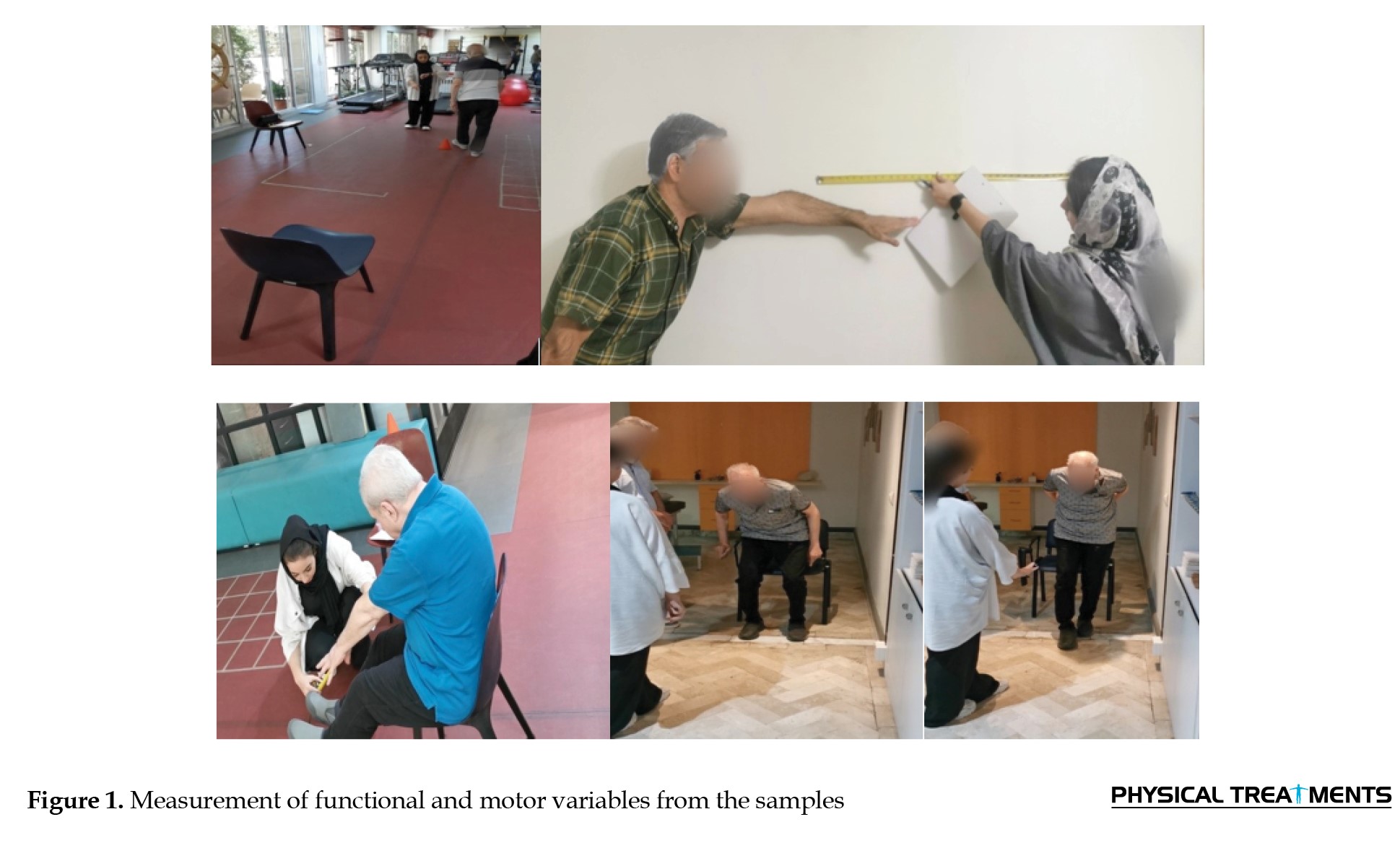
Balance was assessed using the short-form Berg Balance Scale (BBS), which includes 9 items from the original 14-item BBS. This scale has been reported to have high convergent validity and internal consistency in the elderly and patients with PD [19]. The short-form BBS assesses both static balance (single-leg stance [SLS] and tandem stance) and dynamic balance (reaching forward with an outstretched arm, transferring weight, standing up from a seated position, turning 360 degrees, placing the alternate foot on a stool, and picking up an object from the floor) [20].
Gait assessment
The timed up and go (TUG) test measures the time taken to stand up from a chair, walk three meters, turn around, and return to a sitting position [21]. (intraclass correlation coefficient [ICC]=0.87–0.99, r=0.90–0.97) [22].
Motor function assessment
The SLS test was used to assess static balance control in the elderly [23].
The Sit-and-Reach test was employed to measure lower body flexibility and hamstring muscle flexibility. The reliability and validity of this test have been confirmed in numerous studies, showing moderate criterion-related validity for estimating hamstring extensibility (r=0.46–0.67) and excellent test-re-test reliability (ICC>0.85) [24].
Knee proprioception assessment
Knee proprioception was assessed using the joint position sense (JPS) test, specifically measuring the angle reproduction error, with a handheld inclinometer. This method has been reported to have excellent validity and reliability (ICC=0.980–1.00) [25].
Intervention protocol
The massage protocol involved superficial massage of the lower limbs (muscles of the anterior/posterior thigh and calf) for 15 to 20 minutes. The manual pressure intensity during the massage was moderate, ensuring the participant felt mild pressure without pain [25]. The foam rolling protocol involved rolling a soft foam roller on the lower limbs with low intensity for approximately 5 minutes per leg (muscles of the anterior/posterior thigh and calf) in 2 to 3 sets, with short rest periods between sets. The foam rolling pressure intensity was such that the participant felt moderate pressure and stretching in the muscle, without causing severe pain or discomfort [26]. No objective instrument was used to measure the exact applied force, which is acknowledged as a limitation of this study.
To minimize confounding factors and maintain consistent conditions, all assessments and interventions were conducted during the mid-day hours (10:00 AM to 12:00 PM). Participants had consumed breakfast or a light meal at least one hour before the session to reduce the effects of hunger or satiety on motor performance. All tests were performed in a quiet room with constant temperature and adequate lighting. Furthermore, before the intervention began, participants were given full explanations and asked to refrain from any strenuous physical activity or receiving similar interventions (massage or stretching exercises outside the protocol) during the study period.
Statistical methods
All data were first examined for normality using the Shapiro-Wilk test. The homogeneity of the groups before the intervention was assessed using an independent t-test for age, height, weight, and BMI, and no significant differences were observed (P>0.05). To investigate the effects of the interventions, a repeated-measures analysis of variance (ANOVA) was performed with one within-subjects factor (time: Pre- and post-intervention) and one between-subjects factor (group: Massage and foam rolling). The sphericity assumption was checked using Mauchly’s test, and if violated, the Greenhouse-Geisser correction was applied. The significance level was set at 0.05, and all analyses were conducted using SPSS software, version 26.
Results
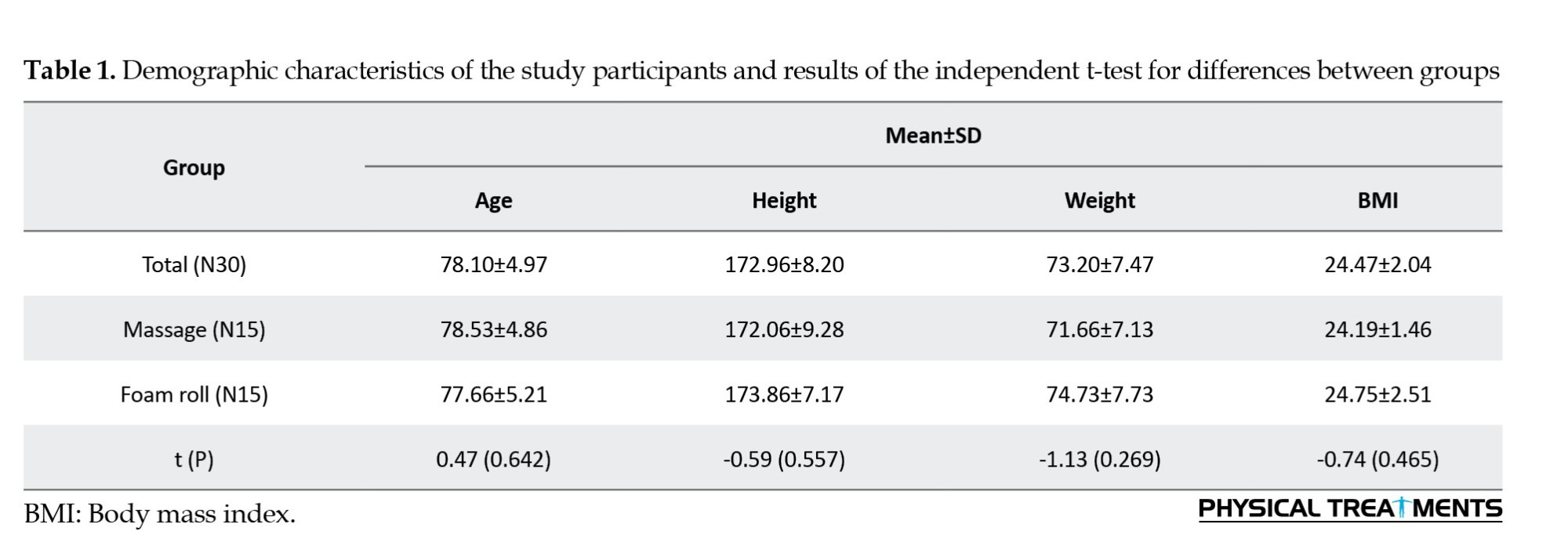
The study was conducted on 30 elderly individuals with PD, who were randomly assigned to two groups: massage (n=15) and foam rolling (n=15). The two groups were homogeneous in terms of demographic characteristics, including age, sex (18 men and 12 women), height, weight, and body mass index, with no significant differences observed between them (P>0.05) (Table 1).
First, the baseline status of the participants in the massage and foam rolling groups was examined. A one-way ANOVA showed that the mean scores of the TUG test (F=2.43, P=0.13), SLS test (F=2.55, P=0.12), sit-and-reach test (F=0.55, P=0.46), and knee JPS test (F=3.16, P =0.086) showed no significant difference between the two groups. Only the BBS (F=6.62, P=0.016) indicated a difference between the groups. Overall, the pre-test results demonstrated relative homogeneity of the groups in most indicators, validating the subsequent comparisons.
In the second stage, which involved the results obtained after applying the intervention for each group, the findings revealed a significant main effect of time in all tests: motor function in the TUG test decreased (F=39.32, P<0.001), SLS time increased (F=77.46, P<0.001), the sit-and-reach test improved (F=17.00, P<0.001), the knee JPS test improved (F=43.45, P<0.001), and the BBS score increased (F=153.12, P<0.001). These results indicate that participants showed significant improvement in all dimensions of motor and balance function in the post-test compared to the pretest (Table 2).
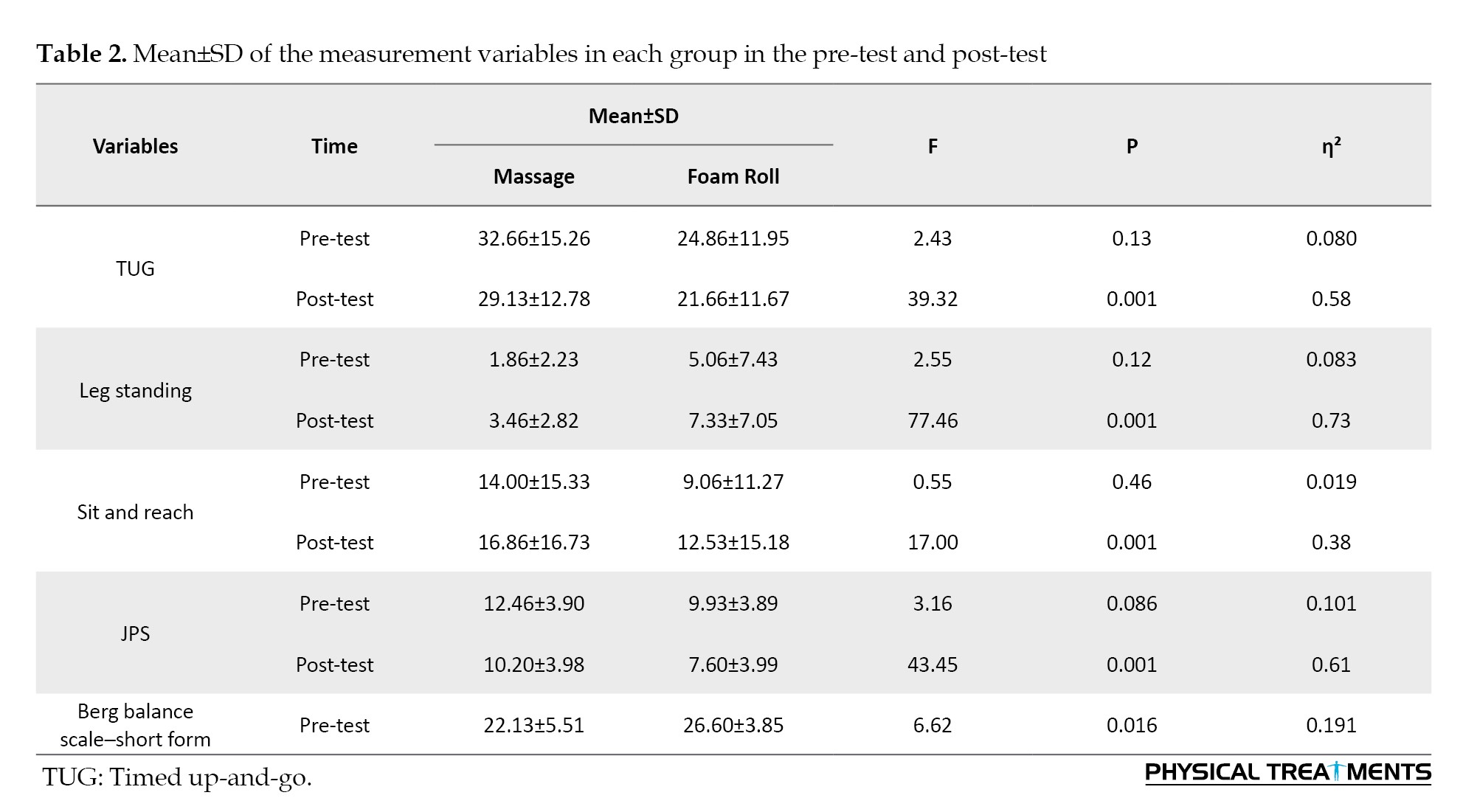
The main effect of group was not significant in most tests: TUG (F=2.62, P=0.117), SLS (F=3.21, P=0.084), sit-and-reach test (F=0.75, P=0.393), knee JPS test (F=3.37, P=0.077), with the exception of the BBS, where the group effect was significant (F=7.22, P=0.012), indicating an overall difference between the groups in this variable, with the massage group showing better performance than the foam rolling group. Furthermore, the time×group interaction effect was not significant in any of the tests (P>0.05), suggesting that both massage and foam rolling interventions had similar impacts on improving balance, gait, and function in the elderly.
Discussion
The results of the present study indicated that both massage and foam rolling interventions led to significant improvements in balance, motor function, and gait in elderly individuals with PD, and their effects were generally similar. However, an overall difference between the groups was observed in the BBS. These findings are consistent with previous studies in the field of rehabilitation interventions for patients with PD [8, 10]. In the pre-test phase, the two groups showed no significant differences in demographic characteristics and baseline test scores (P>0.05), which strengthens the validity of the comparative analyses. The exception was the BBS, where a difference was observed (F=6.62, P=0.016, η²=0.18). This finding is also consistent with the standard principles of clinical trial studies and similar findings in previous research [19].
Following the intervention, the main effect of time was significant in all tests. The BBS (η²=0.85 in the massage group and η²=0.73 in the foam rolling group), the SLS test (η²=0.73 in the massage group and η²=0.69 in the foam rolling group), and the TUG test (η²=0.58 in the massage group and η²=0.61 in the foam rolling group) demonstrated this effect. The main effect of group was only significant for the BBS (F=7.22, P=0.012), and the time×group interaction effect was not significant in any of the tests (P>0.05). These results align with recent studies indicating the positive effects of massage and foam rolling on reducing muscle tension, increasing the range of motion, and improving motor function [10, 27]. Massage modulates hemodynamic and autonomic responses by stimulating mechanoreceptors in the skin, fascia, and muscle. Through the activation of parasympathetic pathways, this intervention leads to a reduction in blood pressure, decreased arterial stiffness, and improved venous return. Furthermore, the increased release of nitric oxide due to massage causes vasodilation and enhances local and systemic blood flow, consequently facilitating oxygen delivery and the removal of accumulated metabolites in the muscles. From a neurophysiological perspective, the stimulation of mechanoreceptors and golgi tendon organs (GTOs) during massage reduces muscle tension, improves neuromuscular coordination, and regulates muscle tone. These changes, mediated by decreased sympathetic activity and increased parasympathetic activity, result in better balance of the autonomic nervous system, improved cardiovascular function, and enhanced muscular efficiency. These hemodynamic and autonomic effects can play a significant role in improving physical performance and motor control in the elderly [28, 29]. The use of foam rolling as a myofascial release technique induces beneficial changes in the autonomic nervous system responses, which lead to improved neuromuscular coordination and facilitate muscle regeneration and recovery processes. The uniform and rhythmic pressure of the foam roller on soft tissues reduces fascial adhesions, increases local blood flow, and enhances the transport of metabolic substances within the muscle. These changes, particularly through the stimulation of mechanoreceptors and increased sensory input to the central nervous system, result in improved motor control and proprioception. Furthermore, foam rolling reduces the stimulation of pain receptors and facilitates inhibitory responses at the spinal level, leading to a decrease in post-activity muscle pain and an improvement in the range of motion [30].
The superiority of massage over foam rolling in the BBS can be attributed to differences in their physiological and neuromuscular mechanisms. Due to the hand contact and targeted pressure, massage more effectively activates cutaneous receptors and GTOs, leading to the inhibition of the stretch reflex and a reduction in muscle tone [31]. In contrast, foam rolling applies more uniform pressure and focuses more on stimulating the fascia and increasing blood flow. However, due to its inability to induce strong neural inhibition and directly reduce muscle tone, its effect is more limited than that of massage [32]. Considering the obtained effect sizes, these interventions were impactful not only statistically but also from a clinical perspective, particularly in reducing the risk of falls and improving activities of daily living, which are critical issues for elderly individuals with PD. This finding is consistent with previous studies [33].
Considering the design and execution of the present study, several notable limitations exist that could affect the generalizability of the results.
First, this research was quasi-experimental and lacked a control group, which may impact internal validity and the ability to make definitive causal inferences about the effects of the interventions. Furthermore, the sample size was limited to 30 individuals, and participants were selected from only one center or geographical area. Therefore, the results may not be generalizable to the entire population of elderly individuals with PD.
Another limitation is the short duration of the interventions and their administration on a single day for each phase, which restricts the ability to investigate the long-term and sustained effects of the interventions. Additionally, some tests, such as SLS, picking up objects from the floor, and performing the TUG test, were dependent on individual skill and the cooperation of the elderly participants. This dependency could be influenced by factors like fatigue, motivation, and the participants’ daily condition, potentially leading to data variability.
Regarding the measurement instruments, although the devices and tests had appropriate reliability and validity, some measurements, such as those taken with the handheld inclinometer for knee proprioception, could be subject to operator error or changes in the subject’s body position. There were also limitations regarding access and the administration of massage, as some elderly participants or their companions did not permit video recording or precise documentation of the procedure, which could affect the uniformity of intervention delivery.
Finally, individual characteristics such as daily activity levels, medications, general health status, and physiological and neuromuscular differences among the elderly could influence the response to the interventions, and fully controlling for these factors in the study design was not feasible. Therefore, it is recommended that future studies employ larger samples, longer intervention durations, and include a control group, alongside the assessment of long-term effects and the investigation of personal and environmental variables, to provide more valid and generalizable results.
The findings of the present study can serve as a key guide for designing short-term, cost-effective rehabilitation programs for elderly individuals with PD and emphasize the importance of incorporating a combination of massage, foam rolling, and static stretching techniques to improve physical function.
Conclusion
The findings of the present study demonstrated that both massage and foam rolling interventions had a significant positive effect on improving balance, motor performance, and gait in elderly individuals with PD, with the overall effects of the two methods being similar. However, in the BBS, the massage group exhibited better performance than the foam rolling group, indicating the superiority of massage in enhancing neuromuscular control, reducing muscle tone, and improving reflexive responses and proprioception.
From a clinical perspective, these findings hold significant importance, as they can contribute to reducing the risk of falls, increasing independence in daily activities, and enhancing the quality of life in elderly individuals with PD. The present results are consistent with recent research in the field of combined rehabilitation interventions and emphasize the importance of implementing multi-faceted approaches, including massage and foam rolling, to improve motor performance in the elderly.
Considering the study’s limitations, including the limited sample size, absence of an independent control group, and short duration of interventions, it is recommended that future research be conducted with larger samples and a controlled trial design. Furthermore, investigating the long-term effects of the interventions and conducting detailed analyses of biomechanical and neuromuscular indicators could provide a better understanding of the physiological and neuromechanical mechanisms underlying improved motor performance in the elderly.
Ethical Considerations
Compliance with ethical guidelines
This study was approved by the Ethics Committee of Sports Sciences Research Institute, Tehran, Iran.(Code: IR.SSRC.REC.1402.129). Prior to their involvement, written informed consent was obtained from all participants. The confidentiality of all personal and medical data was rigorously maintained throughout the study, and information was used exclusively for research objectives.
Funding
This research did not receive any specific grants from funding agencies in the public, commercial, or not-for-profit sectors.
Authors' contributions
Conceptualization and supervision: Mohammadreza Seyedi and Seyed Hossein Mirkarimpour; Project administration, review and editing: Mohammadreza Seyedi; Investigation, data acquisition, protocol implementation, formal analysis, and practical execution of the study: Mahshad Faraji; Methodology, and statistical oversight: Seyed Hossein Mirkarimpour; Writing of the original draft, statistical analysis, result interpretation, and data analysis: Reza Norouzi.
Conflict of interest
The authors declared no conflicts of interest.
Acknowledgments
The authors are deeply grateful to the patients with Parkinson's disease who participated in this study, and to their colleagues for their invaluable support in data collection and recruitment. Their contributions made this research possible.
Full-Text: (17 Views)
Introduction
Parkinson’s disease (PD) is one of the most common progressive neurodegenerative disorders in the elderly. It is caused by a decrease in dopamine levels in the brain and is characterized by symptoms such as tremor, muscle stiffness, bradykinesia, and postural instability [1]. These complications lead to gait abnormalities, reduced speed and step length, and an increased risk of falling [2]. Consequently, they impose a significant burden on the patients’ general health and quality of life [3]. According to the latest results from the Global Burden of Disease Study 2021, the global prevalence of PD in 2021 was approximately 11.77 million people, and the disease burden in terms of Disability-Adjusted Life Years has more than doubled over the past three decades. This increasing trend has been observed in high-income countries and developing countries [4]. In Iran, the consequences of PD have also shown an upward trend in recent years, with significant disparities in prevalence and disease burden based on social development indices [5]. Studies have indicated that balance disorders and motor problems can emerge from the early stages of the disease and can even predict disease progression and the degree of disability [6]. Therefore, rehabilitation interventions, particularly balance and motor training, play a crucial role in managing these complications and improving patients’ quality of life [7].
In addition to pharmacological treatments, various non-pharmacological interventions have been proposed to improve motor function and balance. Massage, as a soft tissue manual therapy, increases blood circulation, reduces inflammation, and stimulates sensory receptors, leading to pain relief, reduced muscle tension, and improved neuromuscular responses [8]. Scientific research has shown that massage, through tissue release, can reduce muscle stiffness and improve the viscoelastic properties of the tissue [9]. Massage therapy is frequently integrated as a complementary intervention alongside conventional treatment for PD, aimed at ameliorating motor impairments and improving overall quality of life [10]. Studies have demonstrated that massage therapy can improve motor symptoms in patients; a systematic meta-analysis involving 363 patients with PD showed that massage therapy had a significant effect on improving motor symptoms compared to the control group. Furthermore, the Unified PD Rating Scale Part III, which is the primary measure for assessing motor function, showed a significant improvement after massage therapy (SMD=-0.46, 95% CI, -0.67% -0.24%, P<0.00001) [10]. In another study conducted at the University of Miami and Duke University, Parkinson’s patients who received two 30-minute massage sessions per week for five weeks exhibited better daily functioning, higher sleep quality, and lower levels of stress hormones (norepinephrine and epinephrine) in urine samples [11]. Massage therapy contributes to pain relief and enhanced range of motion through several mechanisms: It promotes blood flow, alleviates muscle tension, improves flexibility, and reduces joint stiffness [8]. Various massage techniques, including traditional Japanese massage (Anma), Thai massage, neuromuscular therapy, and classic massage techniques, have been reported to be effective in reducing tremor, muscle stiffness, and increasing gait speed [8, 10]. Additionally, massage therapy has positive effects on non-motor symptoms such as anxiety, depression, sleep disorders, and fatigue [11]. However, it is necessary to emphasize that massage therapy alone cannot cure PD and should be used as a complementary method alongside standard pharmacological treatments and physiotherapy.
Another method for myofascial release that has recently gained significant attention is the use of a therapeutic tool called a foam roller. Foam rolling, a form of soft tissue release and self-myofascial release, applies direct and controlled pressure to muscles and tendons, producing effects on the body similar to massage [12]. Studies have shown that regular use of foam rolling can reduce muscle stiffness and improve the viscoelastic properties of tissues, contributing to smoother movement and better muscle function [13]. Furthermore, foam rolling can stimulate mechanoreceptors, accelerate the recovery process after physical activity, and induce a sense of relaxation in limbs [14]. Recent systematic reviews and meta-analyses indicate that foam rolling can increase the range of motion and reduce pressure pain threshold and pain [15]. From a physiological perspective, there is evidence that foam rolling improves pain perception and function by altering pain thresholds, reducing local muscle tension, and exerting neuromodulatory effects, likely through spinal and central tracts [16]. Therefore, this method is considered highly beneficial as a simple, cost-effective, and accessible tool, especially for the elderly and patients with movement disorders, such as Parkinson’s, who can use it independently without assistance.
Both massage and foam rolling activate similar physiological mechanisms by applying mechanical pressure to soft tissues. These mechanisms include stimulating sensory receptors, improving local blood flow, and altering the viscoelastic properties of muscles. Studies have shown that both methods can reduce muscle stiffness and similarly influence the mechanical behavior of tissue [17]. Despite the well-documented positive effects of massage and foam rolling, no study to date has directly compared the impact of both methods on elderly individuals with PD and investigated their effects. Therefore, the present study aimed to fill this scientific gap by evaluating the immediate effects of massage and foam rolling on selected muscles of the lower limbs and their impact on balance, function, and gait in elderly patients with PD. The results of this study are expected to pave the way for designing short-term, effective, and cost-effective rehabilitation programs to reduce the risk of falls and enhance the quality of daily life in this population.
Materials and Methods
This quasi-experimental study employed a pre-test, post-test design without a control group. Based on calculations using G*Power software, version 3.1.9.4 (statistical power of 0.80, effect size of 0.60, and significance level of 0.05), 30 elderly individuals with PD were randomly assigned to two equal groups: Massage (n=15) and foam rolling (n=15). Randomization was performed using a computer-generated random number table (Microsoft Excel). Group allocation was concealed in sealed envelopes that were opened sequentially by an independent researcher. Participants (nine males and nine females in each group) were recruited from elderly individuals with PD who were under the care of rehabilitation centers and specialized geriatric clinics in Tehran Province, Iran. The participants were invited to participate through public announcements and direct invitations. After assessing the inclusion criteria, patients were enrolled in the study. Due to the acute nature of the interventions and the challenges associated with homogenizing older adult samples with PD according to inclusion criteria, a separate control group was not considered. Additionally, to eliminate the interactive and residual effects of the first-phase intervention, a one-week interval between the two interventions (massage and foam rolling) was observed.
The inclusion and exclusion criteria for this study were defined similarly to previous research on non-pharmacological interventions in patients with PD [8, 18]. The inclusion criteria included age over 60 years, ability to perform stretching movements, absence of contraindications for massage and myofascial release, relative ability to walk independently, absence of acute cardiovascular diseases or hypertension, absence of acute injury or surgery in the lower limbs, and provision of informed consent. The exclusion criteria included: Occurrence of severe pain, intolerance to pressure, expression of dissatisfaction with the interventions and tests, new injury or acute medical problems during the study process. All participants signed an informed consent form after the procedures were fully explained.
Research instruments and procedure
Following the selection process, training sessions, and obtaining consent from participants, the initial phase began. Prior to the intervention, the participants’ demographic information was recorded. Subsequently, all participants underwent the aforementioned assessments, and the results of each test were accurately recorded to enable a precise examination of pre- and post-intervention changes.
The intervention was conducted in a single session. Each group received only one type of intervention (massage or foam rolling), ensuring that the acute effects of each modality were examined. Given the acute nature of the intervention, the study focused on immediate effects; however, it is acknowledged that a single session may not be sufficient to produce sustained changes in outcomes such as balance or proprioception.
Upon completion of the interventions, the participants were re-evaluated using the same initial assessments, and the test results were meticulously recorded to allow for pre- and post-intervention comparisons. This phase not only enabled us to accurately examine the effects of massage and foam rolling on motor function and the scores of each test but also provided a reliable basis for analyzing the results and offering practical recommendations for designing short-term, targeted rehabilitation programs for elderly individuals with PD (Figure 1).
Balance assessment
Balance was assessed using the short-form Berg Balance Scale (BBS), which includes 9 items from the original 14-item BBS. This scale has been reported to have high convergent validity and internal consistency in the elderly and patients with PD [19]. The short-form BBS assesses both static balance (single-leg stance [SLS] and tandem stance) and dynamic balance (reaching forward with an outstretched arm, transferring weight, standing up from a seated position, turning 360 degrees, placing the alternate foot on a stool, and picking up an object from the floor) [20].
Gait assessment
The timed up and go (TUG) test measures the time taken to stand up from a chair, walk three meters, turn around, and return to a sitting position [21]. (intraclass correlation coefficient [ICC]=0.87–0.99, r=0.90–0.97) [22].
Motor function assessment
The SLS test was used to assess static balance control in the elderly [23].
The Sit-and-Reach test was employed to measure lower body flexibility and hamstring muscle flexibility. The reliability and validity of this test have been confirmed in numerous studies, showing moderate criterion-related validity for estimating hamstring extensibility (r=0.46–0.67) and excellent test-re-test reliability (ICC>0.85) [24].
Knee proprioception assessment
Knee proprioception was assessed using the joint position sense (JPS) test, specifically measuring the angle reproduction error, with a handheld inclinometer. This method has been reported to have excellent validity and reliability (ICC=0.980–1.00) [25].
Intervention protocol
The massage protocol involved superficial massage of the lower limbs (muscles of the anterior/posterior thigh and calf) for 15 to 20 minutes. The manual pressure intensity during the massage was moderate, ensuring the participant felt mild pressure without pain [25]. The foam rolling protocol involved rolling a soft foam roller on the lower limbs with low intensity for approximately 5 minutes per leg (muscles of the anterior/posterior thigh and calf) in 2 to 3 sets, with short rest periods between sets. The foam rolling pressure intensity was such that the participant felt moderate pressure and stretching in the muscle, without causing severe pain or discomfort [26]. No objective instrument was used to measure the exact applied force, which is acknowledged as a limitation of this study.
To minimize confounding factors and maintain consistent conditions, all assessments and interventions were conducted during the mid-day hours (10:00 AM to 12:00 PM). Participants had consumed breakfast or a light meal at least one hour before the session to reduce the effects of hunger or satiety on motor performance. All tests were performed in a quiet room with constant temperature and adequate lighting. Furthermore, before the intervention began, participants were given full explanations and asked to refrain from any strenuous physical activity or receiving similar interventions (massage or stretching exercises outside the protocol) during the study period.
Statistical methods
All data were first examined for normality using the Shapiro-Wilk test. The homogeneity of the groups before the intervention was assessed using an independent t-test for age, height, weight, and BMI, and no significant differences were observed (P>0.05). To investigate the effects of the interventions, a repeated-measures analysis of variance (ANOVA) was performed with one within-subjects factor (time: Pre- and post-intervention) and one between-subjects factor (group: Massage and foam rolling). The sphericity assumption was checked using Mauchly’s test, and if violated, the Greenhouse-Geisser correction was applied. The significance level was set at 0.05, and all analyses were conducted using SPSS software, version 26.
Results
The study was conducted on 30 elderly individuals with PD, who were randomly assigned to two groups: massage (n=15) and foam rolling (n=15). The two groups were homogeneous in terms of demographic characteristics, including age, sex (18 men and 12 women), height, weight, and body mass index, with no significant differences observed between them (P>0.05) (Table 1).
First, the baseline status of the participants in the massage and foam rolling groups was examined. A one-way ANOVA showed that the mean scores of the TUG test (F=2.43, P=0.13), SLS test (F=2.55, P=0.12), sit-and-reach test (F=0.55, P=0.46), and knee JPS test (F=3.16, P =0.086) showed no significant difference between the two groups. Only the BBS (F=6.62, P=0.016) indicated a difference between the groups. Overall, the pre-test results demonstrated relative homogeneity of the groups in most indicators, validating the subsequent comparisons.
In the second stage, which involved the results obtained after applying the intervention for each group, the findings revealed a significant main effect of time in all tests: motor function in the TUG test decreased (F=39.32, P<0.001), SLS time increased (F=77.46, P<0.001), the sit-and-reach test improved (F=17.00, P<0.001), the knee JPS test improved (F=43.45, P<0.001), and the BBS score increased (F=153.12, P<0.001). These results indicate that participants showed significant improvement in all dimensions of motor and balance function in the post-test compared to the pretest (Table 2).
The main effect of group was not significant in most tests: TUG (F=2.62, P=0.117), SLS (F=3.21, P=0.084), sit-and-reach test (F=0.75, P=0.393), knee JPS test (F=3.37, P=0.077), with the exception of the BBS, where the group effect was significant (F=7.22, P=0.012), indicating an overall difference between the groups in this variable, with the massage group showing better performance than the foam rolling group. Furthermore, the time×group interaction effect was not significant in any of the tests (P>0.05), suggesting that both massage and foam rolling interventions had similar impacts on improving balance, gait, and function in the elderly.
Discussion
The results of the present study indicated that both massage and foam rolling interventions led to significant improvements in balance, motor function, and gait in elderly individuals with PD, and their effects were generally similar. However, an overall difference between the groups was observed in the BBS. These findings are consistent with previous studies in the field of rehabilitation interventions for patients with PD [8, 10]. In the pre-test phase, the two groups showed no significant differences in demographic characteristics and baseline test scores (P>0.05), which strengthens the validity of the comparative analyses. The exception was the BBS, where a difference was observed (F=6.62, P=0.016, η²=0.18). This finding is also consistent with the standard principles of clinical trial studies and similar findings in previous research [19].
Following the intervention, the main effect of time was significant in all tests. The BBS (η²=0.85 in the massage group and η²=0.73 in the foam rolling group), the SLS test (η²=0.73 in the massage group and η²=0.69 in the foam rolling group), and the TUG test (η²=0.58 in the massage group and η²=0.61 in the foam rolling group) demonstrated this effect. The main effect of group was only significant for the BBS (F=7.22, P=0.012), and the time×group interaction effect was not significant in any of the tests (P>0.05). These results align with recent studies indicating the positive effects of massage and foam rolling on reducing muscle tension, increasing the range of motion, and improving motor function [10, 27]. Massage modulates hemodynamic and autonomic responses by stimulating mechanoreceptors in the skin, fascia, and muscle. Through the activation of parasympathetic pathways, this intervention leads to a reduction in blood pressure, decreased arterial stiffness, and improved venous return. Furthermore, the increased release of nitric oxide due to massage causes vasodilation and enhances local and systemic blood flow, consequently facilitating oxygen delivery and the removal of accumulated metabolites in the muscles. From a neurophysiological perspective, the stimulation of mechanoreceptors and golgi tendon organs (GTOs) during massage reduces muscle tension, improves neuromuscular coordination, and regulates muscle tone. These changes, mediated by decreased sympathetic activity and increased parasympathetic activity, result in better balance of the autonomic nervous system, improved cardiovascular function, and enhanced muscular efficiency. These hemodynamic and autonomic effects can play a significant role in improving physical performance and motor control in the elderly [28, 29]. The use of foam rolling as a myofascial release technique induces beneficial changes in the autonomic nervous system responses, which lead to improved neuromuscular coordination and facilitate muscle regeneration and recovery processes. The uniform and rhythmic pressure of the foam roller on soft tissues reduces fascial adhesions, increases local blood flow, and enhances the transport of metabolic substances within the muscle. These changes, particularly through the stimulation of mechanoreceptors and increased sensory input to the central nervous system, result in improved motor control and proprioception. Furthermore, foam rolling reduces the stimulation of pain receptors and facilitates inhibitory responses at the spinal level, leading to a decrease in post-activity muscle pain and an improvement in the range of motion [30].
The superiority of massage over foam rolling in the BBS can be attributed to differences in their physiological and neuromuscular mechanisms. Due to the hand contact and targeted pressure, massage more effectively activates cutaneous receptors and GTOs, leading to the inhibition of the stretch reflex and a reduction in muscle tone [31]. In contrast, foam rolling applies more uniform pressure and focuses more on stimulating the fascia and increasing blood flow. However, due to its inability to induce strong neural inhibition and directly reduce muscle tone, its effect is more limited than that of massage [32]. Considering the obtained effect sizes, these interventions were impactful not only statistically but also from a clinical perspective, particularly in reducing the risk of falls and improving activities of daily living, which are critical issues for elderly individuals with PD. This finding is consistent with previous studies [33].
Considering the design and execution of the present study, several notable limitations exist that could affect the generalizability of the results.
First, this research was quasi-experimental and lacked a control group, which may impact internal validity and the ability to make definitive causal inferences about the effects of the interventions. Furthermore, the sample size was limited to 30 individuals, and participants were selected from only one center or geographical area. Therefore, the results may not be generalizable to the entire population of elderly individuals with PD.
Another limitation is the short duration of the interventions and their administration on a single day for each phase, which restricts the ability to investigate the long-term and sustained effects of the interventions. Additionally, some tests, such as SLS, picking up objects from the floor, and performing the TUG test, were dependent on individual skill and the cooperation of the elderly participants. This dependency could be influenced by factors like fatigue, motivation, and the participants’ daily condition, potentially leading to data variability.
Regarding the measurement instruments, although the devices and tests had appropriate reliability and validity, some measurements, such as those taken with the handheld inclinometer for knee proprioception, could be subject to operator error or changes in the subject’s body position. There were also limitations regarding access and the administration of massage, as some elderly participants or their companions did not permit video recording or precise documentation of the procedure, which could affect the uniformity of intervention delivery.
Finally, individual characteristics such as daily activity levels, medications, general health status, and physiological and neuromuscular differences among the elderly could influence the response to the interventions, and fully controlling for these factors in the study design was not feasible. Therefore, it is recommended that future studies employ larger samples, longer intervention durations, and include a control group, alongside the assessment of long-term effects and the investigation of personal and environmental variables, to provide more valid and generalizable results.
The findings of the present study can serve as a key guide for designing short-term, cost-effective rehabilitation programs for elderly individuals with PD and emphasize the importance of incorporating a combination of massage, foam rolling, and static stretching techniques to improve physical function.
Conclusion
The findings of the present study demonstrated that both massage and foam rolling interventions had a significant positive effect on improving balance, motor performance, and gait in elderly individuals with PD, with the overall effects of the two methods being similar. However, in the BBS, the massage group exhibited better performance than the foam rolling group, indicating the superiority of massage in enhancing neuromuscular control, reducing muscle tone, and improving reflexive responses and proprioception.
From a clinical perspective, these findings hold significant importance, as they can contribute to reducing the risk of falls, increasing independence in daily activities, and enhancing the quality of life in elderly individuals with PD. The present results are consistent with recent research in the field of combined rehabilitation interventions and emphasize the importance of implementing multi-faceted approaches, including massage and foam rolling, to improve motor performance in the elderly.
Considering the study’s limitations, including the limited sample size, absence of an independent control group, and short duration of interventions, it is recommended that future research be conducted with larger samples and a controlled trial design. Furthermore, investigating the long-term effects of the interventions and conducting detailed analyses of biomechanical and neuromuscular indicators could provide a better understanding of the physiological and neuromechanical mechanisms underlying improved motor performance in the elderly.
Ethical Considerations
Compliance with ethical guidelines
This study was approved by the Ethics Committee of Sports Sciences Research Institute, Tehran, Iran.(Code: IR.SSRC.REC.1402.129). Prior to their involvement, written informed consent was obtained from all participants. The confidentiality of all personal and medical data was rigorously maintained throughout the study, and information was used exclusively for research objectives.
Funding
This research did not receive any specific grants from funding agencies in the public, commercial, or not-for-profit sectors.
Authors' contributions
Conceptualization and supervision: Mohammadreza Seyedi and Seyed Hossein Mirkarimpour; Project administration, review and editing: Mohammadreza Seyedi; Investigation, data acquisition, protocol implementation, formal analysis, and practical execution of the study: Mahshad Faraji; Methodology, and statistical oversight: Seyed Hossein Mirkarimpour; Writing of the original draft, statistical analysis, result interpretation, and data analysis: Reza Norouzi.
Conflict of interest
The authors declared no conflicts of interest.
Acknowledgments
The authors are deeply grateful to the patients with Parkinson's disease who participated in this study, and to their colleagues for their invaluable support in data collection and recruitment. Their contributions made this research possible.
References
- Camargo CHF, Ferreira-Peruzzo SA, Ribas DIR, Franklin GL, Teive HA. Imbalance and gait impairment in Parkinson’s disease: Discussing postural instability and ataxia. Neurological Sciences. 2024; 45(4):1377-88. [DOI:10.1007/s10072-023-07205-w] [PMID]
- Creaby MW, Cole MH. Gait characteristics and falls in Parkinson’s disease: A systematic review and meta-analysis. Parkinsonism & Related Disorders. 2018; 57:1-8. [DOI:10.1016/j.parkreldis.2018.07.008] [PMID]
- Bloem BR, Okun MS, Klein C. Parkinson’s disease. The Lancet. 2021; 397(10291):2284-303. [DOI:10.1016/S0140-6736(21)00218-X] [PMID]
- Luo Y, Qiao L, Li M, Wen X, Zhang W, Li X. Global, regional, national epidemiology and trends of Parkinson’s disease from 1990 to 2021: Findings from the global burden of disease study 2021. Frontiers in Aging Neuroscience. 2025; 16:1498756. [DOI:10.3389/fnagi.2024.1498756] [PMID] [PMCID]
- Sarmadi M, Rezaei M, Poursadeghiyan M, Soltaninejad M, Moradi S, Ahangarzadeh M, et al. Burden of Parkinson’s disease in Iran: disparities, trends, and the impact of social development indicators. Neurological Sciences. 2025; 46(8):3651-62. [DOI:10.1007/s10072-025-08206-7] [PMID]
- Herman T, Barer Y, Bitan M, Sobol S, Giladi N, Hausdorff JM. A meta-analysis identifies factors predicting the future development of freezing of gait in Parkinson’s disease. NPJ Parkinson’s Disease. 2023; 9(1):158. [DOI:10.1038/s41531-023-00600-2] [PMID] [PMCID]
- Gilat M, Ginis P, Zoetewei D, De Vleeschhauwer J, Hulzinga F, D’Cruz N, et al. A systematic review on exercise and training-based interventions for freezing of gait in Parkinson’s disease. npj Parkinson’s Disease. 2021; 7(1):81. [DOI:10.1038/s41531-021-00224-4] [PMID] [PMCID]
- Angelopoulou E, Anagnostouli M, Chrousos GP, Bougea A. Massage therapy as a complementary treatment for Parkinson’s disease: A systematic literature review. Complementary Therapies in Medicine. 2020; 49:102340. [DOI:10.1016/j.ctim.2020.102340] [PMID]
- Kablan N, Alaca N, Tatar Y. Comparison of the immediate effect of petrissage massage and manual lymph drainage following exercise on biomechanical and viscoelastic properties of the rectus femoris muscle in women. Journal of Sport Rehabilitation. 2021; 30(5):725-30. [DOI:10.1123/jsr.2020-0276] [PMID]
- Kang Z, Xing H, Lin Q, Meng F, Gong L. Effectiveness of therapeutic massage for improving motor symptoms in Parkinson’s disease: A systematic review and meta-analysis. Frontiers in Neurology. 2022; 13:915232. [DOI:10.3389/fneur.2022.915232] [PMID] [PMCID]
- Hernandez-Reif M, Field T, Largie S, Cullen C, Beutler J, Sanders C, et al. Parkinson’s disease symptoms are differentially affected by massage therapy vs. progressive muscle relaxation: a pilot study. Journal of Bodywork and Movement Therapies. 2002; 6(3):177-82. [DOI:10.1054/jbmt.2002.0282]
- Beardsley C, Škarabot J. Effects of self-myofascial release: A systematic review. Journal of Bodywork and Movement Therapies. 2015; 19(4):747-58. [DOI:10.1016/j.jbmt.2015.08.007] [PMID]
- Chang TT, Li Z, Zhu YC, Wang XQ, Zhang ZJ. Effects of self-myofascial release using a foam roller on the stiffness of the gastrocnemius-achilles tendon complex and ankle dorsiflexion range of motion. Frontiers in Physiology. 2021; 12:718827. [DOI:10.3389/fphys.2021.718827] [PMID] [PMCID]
- Arbiza BCC, da Silva AMV, de Lima KS, Neto LJR, Nunes GS, Jaenisch RB, et al. Effect of foam rolling recovery on pain and physical capacity after resistance exercises: A randomized crossover trial. Journal of Bodywork and Movement Therapies. 2024; 37:226-32. [DOI:10.1016/j.jbmt.2023.11.022] [PMID]
- Konrad A, Nakamura M, Paternoster FK, Tilp M, Behm DG. A comparison of a single bout of stretching or foam rolling on range of motion in healthy adults. European Journal of Applied Physiology. 2022; 122(7):1545-57. [DOI:10.1007/s00421-022-04927-1] [PMID] [PMCID]
- Fijavž J, Frangež M, Vauhnik R. Effects of lower back foam rolling on the pressure pain threshold and the range of motion of the lumbar spine in healthy individuals. Frontiers in Physiology. 2024; 15:1476342. [DOI:10.3389/fphys.2024.1476342] [PMID] [PMCID]
- Szajkowski S, Pasek J, Cieślar G. Foam rolling or percussive massage for muscle recovery: Insights into delayed-onset muscle soreness (DOMS). Journal of Functional Morphology and Kinesiology. 2025; 10(3):249. [DOI:10.3390/jfmk10030249] [PMID] [PMCID]
- Bouça‐Machado R, Rosário A, Caldeira D, Castro Caldas A, Guerreiro D, Venturelli M, et al. Physical activity, exercise, and physiotherapy in Parkinson’s disease: Defining the concepts. Movement Disorders Clinical Practice. 2020; 7(1):7-15. [DOI:10.1002/mdc3.12849] [PMID] [PMCID]
- Babaei-Ghazani A, Mohammadi H, Shahidi GA, Habibi SAH, Forogh B, Ahadi T, et al. Reliability and validity of the Persian translation of Berg Balance Scale in Parkinson disease. Aging Clinical and Experimental Research. 2017; 29(5):857-62. [DOI:10.1007/s40520-016-0682-7] [PMID]
- Berg K. Measuring balance in the elderly: Development and validation of an instrument. Montreal: McGill University; 1992. [Link]
- Podsiadlo D, Richardson S. The timed “up & go”: A test of basic functional mobility for frail elderly persons. Journal of the American Geriatrics Society. 1991; 39(2):142-8. [DOI:10.1111/j.1532-5415.1991.tb01616.x] [PMID] [PMCID]
- Morris S, Morris ME, Iansek R. Reliability of measurements obtained with the Timed “up & go” test in people with Parkinson disease. Physical Therapy. 2001; 81(2):810-8. [DOI:10.1093/ptj/81.2.810] [PMID]
- Springer BA, Marin R, Cyhan T, Roberts H, Gill NW. Normative values for the unipedal stance test with eyes open and closed. Journal of Geriatric Physical Therapy. 2007; 30(1):8-15. [DOI:10.1519/00139143-200704000-00003] [PMID]
- Mayorga-Vega D, Merino-Marban R, Viciana J. Criterion-related validity of sit-and-reach tests for estimating hamstring and lumbar extensibility: A meta-analysis. Journal of Sports Science & Medicine. 2014; 13(1):1. [DOI:10.4100/jhse.2014.91.18]
- Hertling D, Kessler RM. Management of common musculoskeletal disorders: physical therapy principles and methods. Philadelphia: Lippincott Williams & Wilkins; 2006. [Link]
- Pathania T, Muragod AR. Comparative effect of foam roller and M2 T blade on hamstring flexibility in elderly population: A randomized control trial. Indian Journal of Health Sciences and Biomedical Research kleu. 2019; 12(2):160-5. [DOI:10.4103/kleuhsj.kleuhsj_118_18]
- Ryu HR, Kim MJ, Yoon ES, Kim DY. Effects of foam roller-based combined exercise on functional fitness, balance, and gait in older women. Journal of Exercise Rehabilitation. 2024; 20(6):240. [DOI:10.12965/jer.2448640.320] [PMID] [PMCID]
- Monteiro ER, Aguilera LM, Ruá-Alonso M, Araújo GD, Corrêa Neto VG, Bentes CM, et al. Effect of manual massage, foam rolling, and strength training on hemodynamic and autonomic responses in adults: A scoping review. Healthcare 2025; 13(12):1371. [DOI:10.20944/preprints202502.1932.v1]
- Darvish B, Piri H, Rahimi M, Shadi E. Acute effect of massage, static stretching, and foam rolling on hamstring muscle flexibility. Physical Treatments-Specific Physical Therapy Journal. 2026; 16(3):273-82. [DOI:10.32598/ptj.2026.626.1]
- Konrad A, Nakamura M, Tilp M, Donti O, Behm DG. Foam rolling training effects on range of motion: A systematic review and meta-analysis. Sports Medicine. 2022; 52(10):2523-35. [DOI:10.1007/s40279-022-01699-8] [PMID] [PMCID]
- Dakić M, Ilić V, Toskić L, Duric S, Šimenko J, Marković M, et al. Acute effects of short-term massage procedures on neuromechanical contractile properties of rectus femoris muscle. Medicina. 2024; 60(1):125. [DOI:10.3390/medicina60010125] [PMID] [PMCID]
- Yoshimura A, Schleip R, Wilke J, Schilder A, Aisenpreis PM, Narita T, et al. Active versus passive foam rolling on range of motion, tissue property, and neural adaptation in healthy young adults: A randomised controlled trial. Journal of Bodywork and Movement Therapies. 2024; 40:1635-44. [DOI:10.1016/j.jbmt.2024.09.002] [PMID]
- Lindholm B, Hagell P, Odin P, Hansson O, Siennicki-Lantz A, Elmståhl S, et al. Balance and gait disorders in de novo Parkinson’s disease: Support for early rehabilitation. Journal of Neurology. 2025; 272(1):11. [DOI:10.1007/s00415-024-12804-4] [PMID] [PMCID]
Type of Study: Research |
Subject:
Sport injury and corrective exercises
Received: 2026/01/28 | Accepted: 2026/05/16 | Published: 2026/10/18
Received: 2026/01/28 | Accepted: 2026/05/16 | Published: 2026/10/18
Send email to the article author
| Rights and permissions | |
 |
This work is licensed under a Creative Commons Attribution-NonCommercial 4.0 International License. |

This is an open access article distributed under the terms of the Creative Commons Attribution-NonCommercial 4.0 (CC-By-NC 4.0), which permits use, distribution, and reproduction in any medium, provided the original work is properly cited and is not used for commercial purposes.
Contact Information