Fri, Oct 2, 2026
Volume 16 - Special Issue(Exercise Therapy in Action)
PTJ 2026, 16 - Special Issue(Exercise Therapy in Action): 423-432 |
Back to browse issues page



Ethics code: 693/UN4.6.4.5.31/PP.36/2024


Download citation:
BibTeX | RIS | EndNote | Medlars | ProCite | Reference Manager | RefWorks
Send citation to:


BibTeX | RIS | EndNote | Medlars | ProCite | Reference Manager | RefWorks
Send citation to:
Herawany R, Mayasari N, Nikmatiah W O S, Zainuddin A A, Sahlan A, Mubarak H. Hand Strengthening Versus Combined Proximal-Distal Training for Manual Dexterity in Children With Down Syndrome. PTJ 2026; 16 (S1) :423-432
URL: http://ptj.uswr.ac.ir/article-1-844-en.html
URL: http://ptj.uswr.ac.ir/article-1-844-en.html
Rita Herawany *1  , Nilla Mayasari1 , Wa Ode Sri Nikmatiah1 , Andi Alfian Zainuddin2 , Anshory Sahlan1 , Husnul Mubarak1
, Nilla Mayasari1 , Wa Ode Sri Nikmatiah1 , Andi Alfian Zainuddin2 , Anshory Sahlan1 , Husnul Mubarak1
1- Department of Physical Medicine and Rehabilitation, Faculty of Medicine, Hasanuddin University, Makassar, Indonesia.
2- Department of Public Health, Faculty of Medicine, Hasanuddin University, Makassar, Indonesia.
2- Department of Public Health, Faculty of Medicine, Hasanuddin University, Makassar, Indonesia.
Keywords: Down syndrome (DS), Manual dexterity, Proximal–distal training, Exercise therapy, Shoulder joint
Full-Text [PDF 577 kb]
(435 Downloads)
| Abstract (HTML) (984 Views)
Full-Text: (30 Views)
Introduction
Down syndrome (DS) is the most common chromosomal disorder and the leading genetic cause of intellectual disability worldwide. With an estimated incidence of one in every 700 to 800 live births, DS affects millions of individuals globally and continues to present substantial challenges for health systems and families [1]. Epidemiological studies indicate that the prevalence of DS ranges between 1.7 and 2.5 per 1,000 live births, with increasing trends reported over time, largely influenced by maternal age and survival improvements [2]. In Europe, estimates show approximately 8,000 annual live births with DS (2011–2015), and approximately 419,000 people living with DS as of 2015 [3]. Globally, the number of prevalent cases has steadily increased over the past three decades, even as mortality rates declined due to advances in care [4].
In Indonesia, national surveys documented a rise in prevalence from 0.12% in 2010 to 0.21% in 2018, underscoring DS as a growing and persistent public health concern [5]. This increasing prevalence underscores the urgent need for targeted therapeutic interventions to enhance motor and functional abilities. Such needs are especially critical in low- and middle-income countries, including Indonesia, where access to specialized rehabilitation and inclusive educational services remains limited.
Individuals with DS exhibit a distinct neurodevelopmental profile characterized by muscle hypotonia, ligamentous laxity, reduced strength, and inadequate postural stability, which collectively compromise motor control and endurance [6, 7]. These neuromusculoskeletal features, compounded by cognitive delays and sensory integration deficits, lead to marked impairments across both gross and fine motor domains. Gross motor difficulties manifest as delays in achieving fundamental milestones, such as sitting, standing, and walking, often accompanied by inefficient compensatory strategies, including widened step width, altered sway, and trunk stiffening to maintain equilibrium during static and dynamic tasks. At the same time, deficits in fine motor competence, including impaired grip strength and finger dexterity, are particularly disabling as they interfere with the performance of essential self-care and school-related activities, such as feeding, dressing, and handwriting, which are fundamental for independence and social participation [6, 7]. Accordingly, effective interventions targeting fine motor skills are a critical priority in pediatric rehabilitation.
Hand manipulation skills, as defined in the occupational therapy practice framework, involve the precise coordination of small muscles in the hands and fingers to manipulate objects effectively. In DS, these skills are often compromised by intrinsic weakness of the hands combined with insufficient proximal stability of the shoulder and trunk. Deficient proximal control undermines distal motor performance and limits functional outcomes. The relationship between proximal stabilization and distal dexterity has been acknowledged conceptually; however, there is limited empirical evidence evaluating how training approaches that combine these domains can optimize motor function [8].
Previous research has shown that shoulder stabilization training based on dynamic neuromuscular stabilization can yield positive outcomes. In children with DS, such programs have been reported to significantly improve grip strength and various types of pinch strength in both dominant and non-dominant hands [9]. Similarly, hand strengthening programs have demonstrated significant benefits for grip strength in children with DS, and these improvements translate into greater independence and participation in daily activities that require manual dexterity [10]. However, most studies have investigated proximal or distal interventions in isolation. As a result, there is insufficient evidence on whether combined proximal and distal training produces superior effects compared to distal strengthening alone. In addition, the potential impact of these interventions on the non-dominant hand, which is often more impaired in children with DS, has received little attention.
To address these gaps, the present study aimed to compare the effects of distal hand strengthening alone with a combined proximal–distal approach incorporating both shoulder stabilization and hand strengthening exercises. By contrasting these two strategies, this study seeks to generate evidence supporting integrated rehabilitation approaches that may enhance manual dexterity, independence, and quality of life in children with DS.
Materials and Methods
In this study, participants were randomly assigned to one of two intervention groups. A total of 40 children with DS, aged 6–12 years, were recruited from Rumah Komunitas Orang Tua Asuh Down Syndrome (KOADS) and the outpatient clinics of Wahidin Sudirohusodo Hospital and Hasanuddin University Hospital, Makassar, Indonesia. Eligibility criteria included the ability to stand and walk independently, normal vision and hearing, and mild to moderate intellectual disability (IQ range 48–60) as assessed using the cognitive scale for DS. Children were excluded if they had sustained an upper-limb injury within the previous three months associated with pain ≥4/10 on the visual analog scale (VAS), had cervical or chest wall disorders limiting upper-limb mobility, or had untreated congenital heart disease. Participants were withdrawn if they missed three or more consecutive sessions, withdrew consent, or experienced acute post-training pain ≥4/10. Prior to enrolment, the study procedures, potential benefits, and risks were explained to the participants and their parents or guardians, and written informed consent was obtained.
Study design and procedures
Participants were randomly assigned to one of two intervention groups: (1) distal hand-strengthening exercises or (2) combined proximal–distal training, which incorporated shoulder stabilization in addition to hand strengthening. Simple random allocation using a randomized number sequence was applied, in which participant identification numbers were randomly ordered and assigned sequentially to the two groups. Both interventions were delivered three times per week for eight consecutive weeks. Manual dexterity was evaluated at baseline and following the intervention using the functional dexterity test (FDT) for both dominant and non-dominant hands.
During the home-based phase, adherence to the exercise program was monitored remotely using social media (WhatsApp). At the beginning of the intervention, the research team conducted in-person sessions to deliver the exercises directly to the children and to train parents or caregivers in the correct exercise techniques. Once parents demonstrated adequate competency to administer the exercises independently, training was continued at home under parental supervision. Adherence was monitored through multiple mechanisms. Parents were reminded to conduct the exercises according to the participant’s mood and tolerance. Each training session was recorded on video and submitted to the research team for review. In addition, parents completed an exercise logbook for every session, and photographs of the completed logbooks were submitted every two weeks. The research team reviewed videos and logbooks biweekly, provided feedback on exercise performance, and addressed any technical issues. Participants and caregivers were encouraged to contact the research team at any time in case of adverse effects, difficulties, or concerns during training. Using this monitoring system, full adherence to the prescribed home-based exercises was achieved in both intervention groups.
Interventions
The intervention protocols comprised proximal and distal training components. Shoulder stabilization training was based on the principles of dynamic neuromuscular stabilization and involved closed-kinetic chain exercises targeting the shoulder stabilizers. Each posture was maintained for 10 seconds and performed in three sets of 10 repetitions, with 3-second rests between repetitions and 1–3 minutes of rest between sets depending on participant fatigue. In parallel, hand strengthening training consisted of active exercises for the intrinsic muscles of the hand, with resistance progressively increased from light to heavy. Each session lasted 15–20 minutes and was performed in three sets, three times per week, over eight weeks.
Outcome measures
FDT, a standardized assessment with established validity and reliability in children [11], was employed as the primary outcome measure of manual dexterity. The test required inserting and turning 16 pegs using one hand, with performance timed in seconds. Functional categories for the dominant hand were defined as functional (16–25 s), moderately functional (26–35 s), minimally functional (36–50 s), and nonfunctional (>50 s); for the non-dominant hand, the corresponding thresholds were 18–27 s, 28–45 s, 46–55 s, and >55 s. Separate functional categories were applied for the dominant and non-dominant hands to account for expected differences in dexterity performance associated with hand dominance. Penalties of 5 seconds were applied if supination occurred or the board was grasped, and 10 seconds if a peg was dropped.
Statistical analysis
Data normality was assessed with the Shapiro–Wilk test. Descriptive statistics are reported as Mean±SD. Within-group differences between baseline and post-test scores were analyzed using the Wilcoxon signed-rank test. Between-group differences were evaluated using the Mann–Whitney U test. All analyses were performed using SPSS Statistics (version 30.0) (IBM Corp., Armonk, NY, USA), with the level of significance set at P≤0.05.
Results
Table 1 presents the demographic characteristics of participants across the two intervention groups.
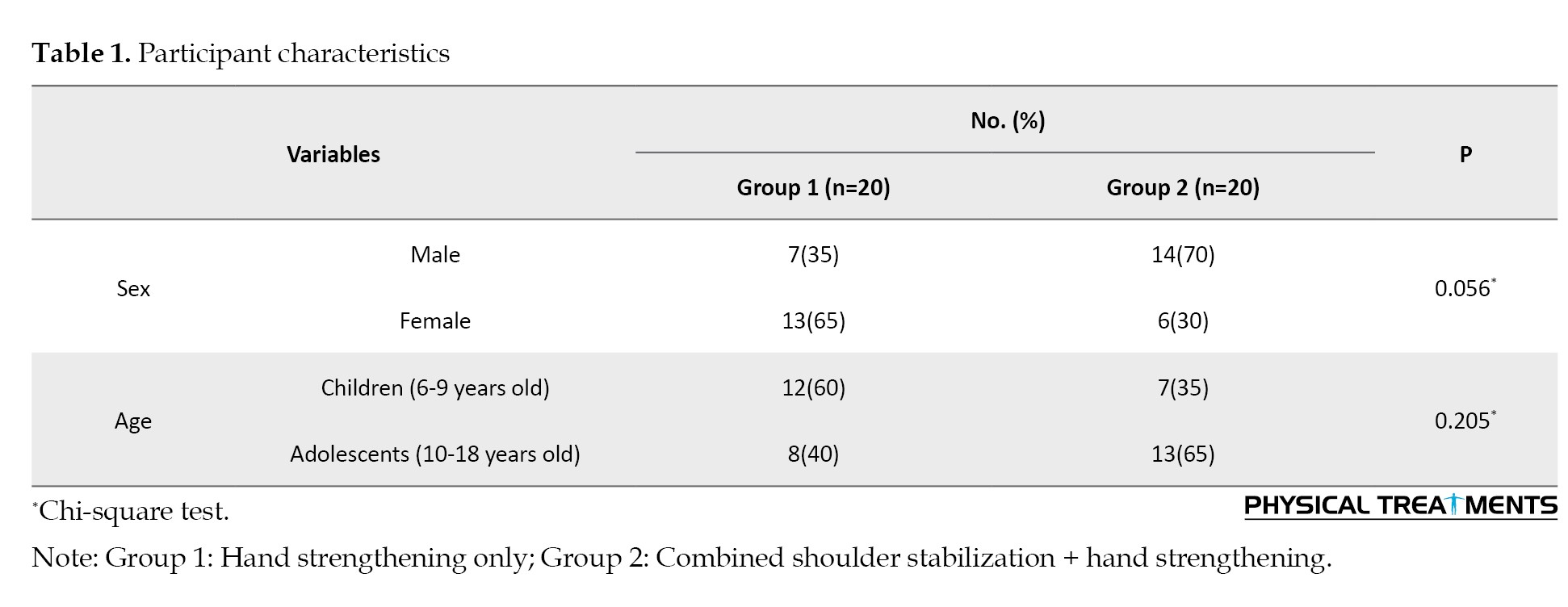
Although the difference did not reach statistical significance, a higher proportion of males was observed in the combined shoulder stabilization plus hand strengthening group compared with the hand strengthening group (70% vs 35%, P=0.056). With respect to age, the distribution of children and adolescents was also not significantly different between groups (P=0.205). Overall, the two groups can be considered comparable in terms of demographic characteristics. Table 2 presents the FDT results for dominant and non-dominant hands at pre-test and post-test.
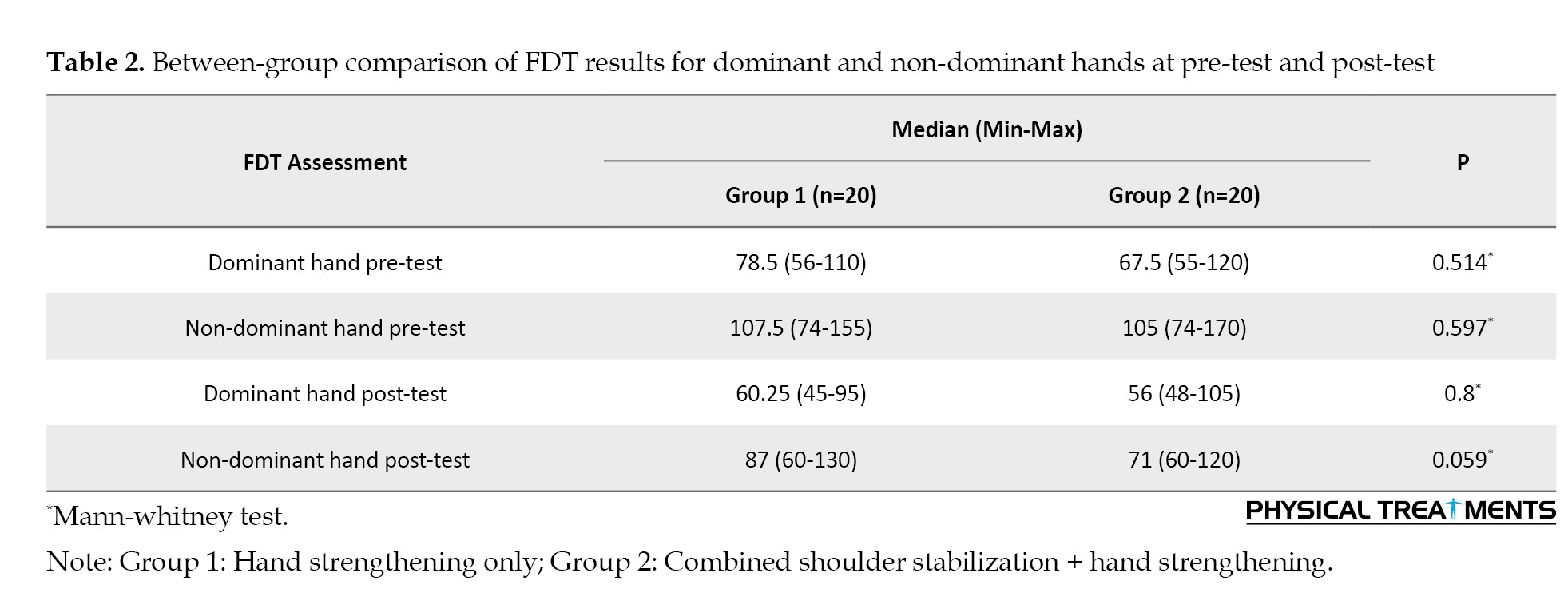
At baseline, both groups showed comparable scores, indicating similar starting conditions. Following the interventions, dexterity improved in both groups as reflected by lower median completion times. No between-group differences were observed post-intervention, suggesting that both hand strengthening alone and the combined program were effective in enhancing fine motor performance.
Tables 3 and 4 present the within-group analyses of FDT performance.
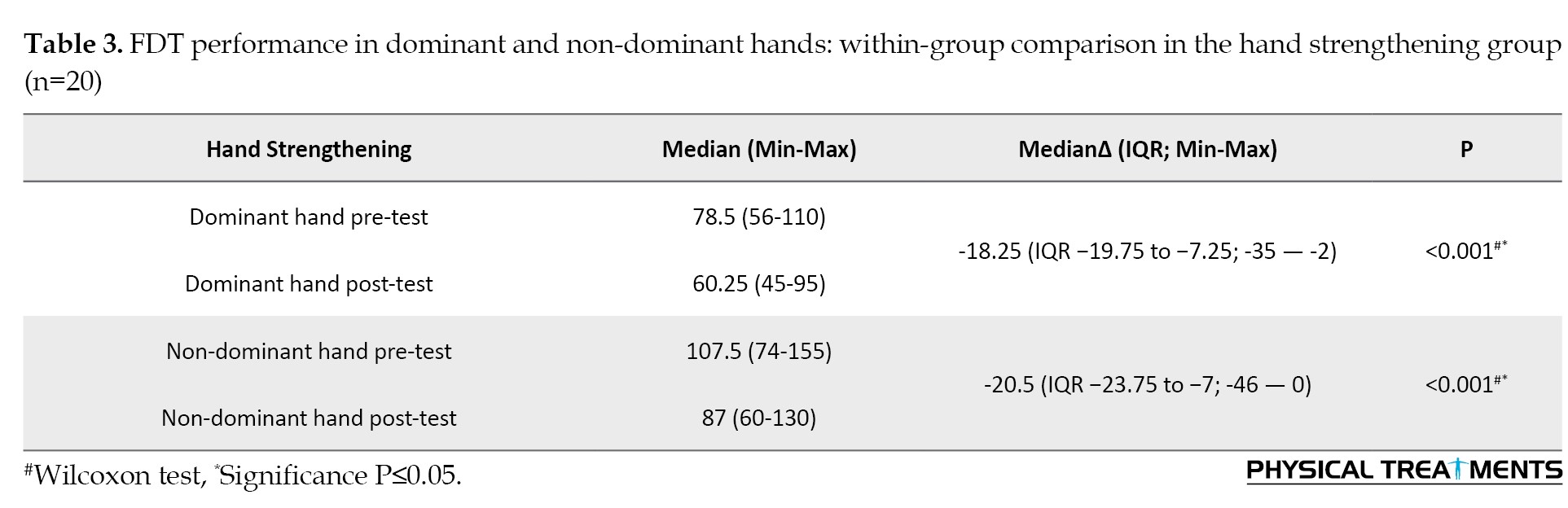
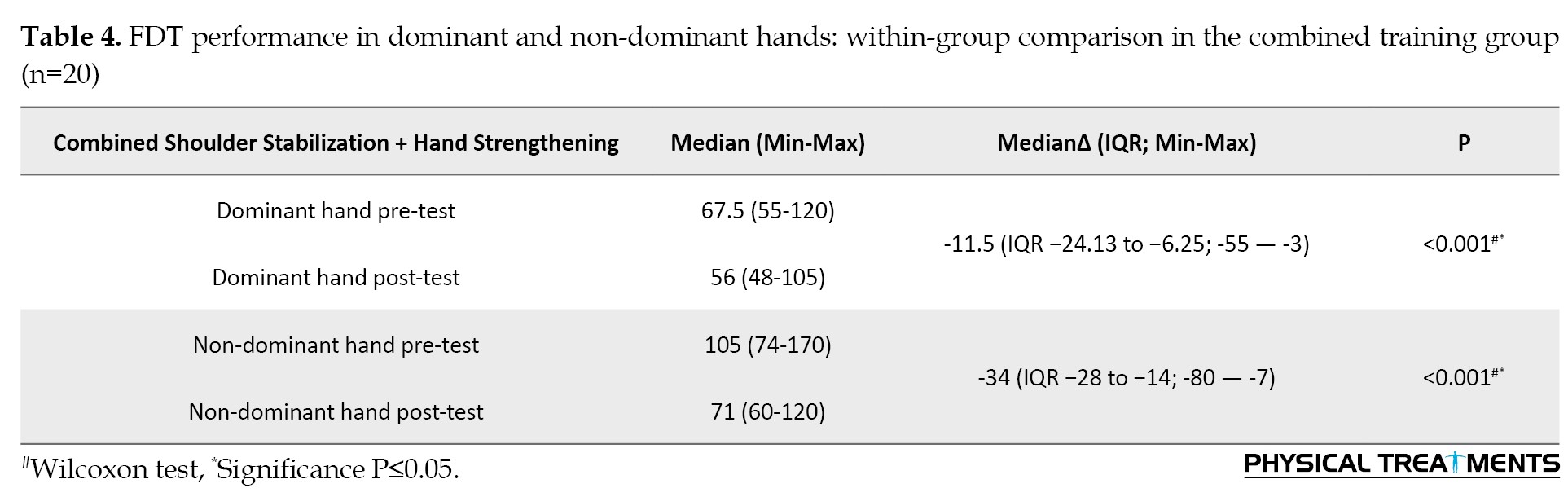
In the hand strengthening group (Table 3), both hands improved significantly. The median time of dominant hand decreased from 78.5 to 60.25 s (Δ–18.25, P<0.001), while the non-dominant hand improved from 107.5 to 87 s (Δ–20.5, P<0.001). In the combined training group (Table 4), the improvements were even greater. The dominant hand decreased from 67.5 to 56 s (Δ–11.5, P<0.001), and the non-dominant hand showed the largest change, from 105 to 71 s (Δ–34, P<0.001). Overall, both interventions enhanced dexterity, but the combined approach produced stronger gains, particularly in the non-dominant hand.
Table 5 presents the distribution of FDT performance categories.
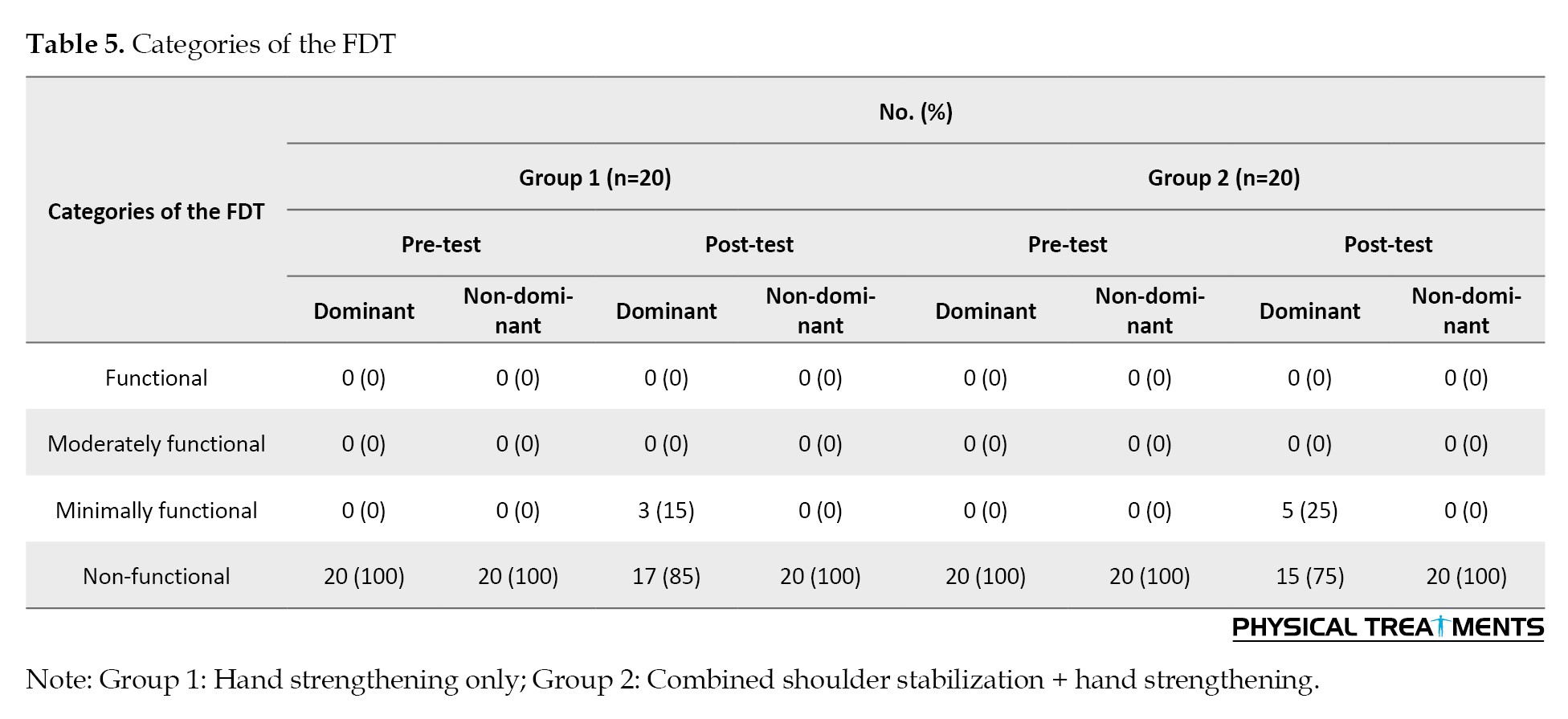
At baseline, all participants in both groups were classified as non-functional for both dominant and non-dominant hands. Following the intervention, a shift was observed in the dominant-hand performance. In the hand strengthening group, three participants (15%) achieved a minimally functional status at post-test, while in the combined training group, five participants (25%) reached the minimally functional category in the dominant hand. No participants in either group reached the minimally functional category in the non-dominant hand at post-test. Although most participants remained classified as non-functional, the combined proximal–distal training resulted in a greater proportion of functional improvement in the dominant hand compared with hand strengthening alone.
Table 6 compares the effectiveness of the two interventions based on changes in FDT scores.
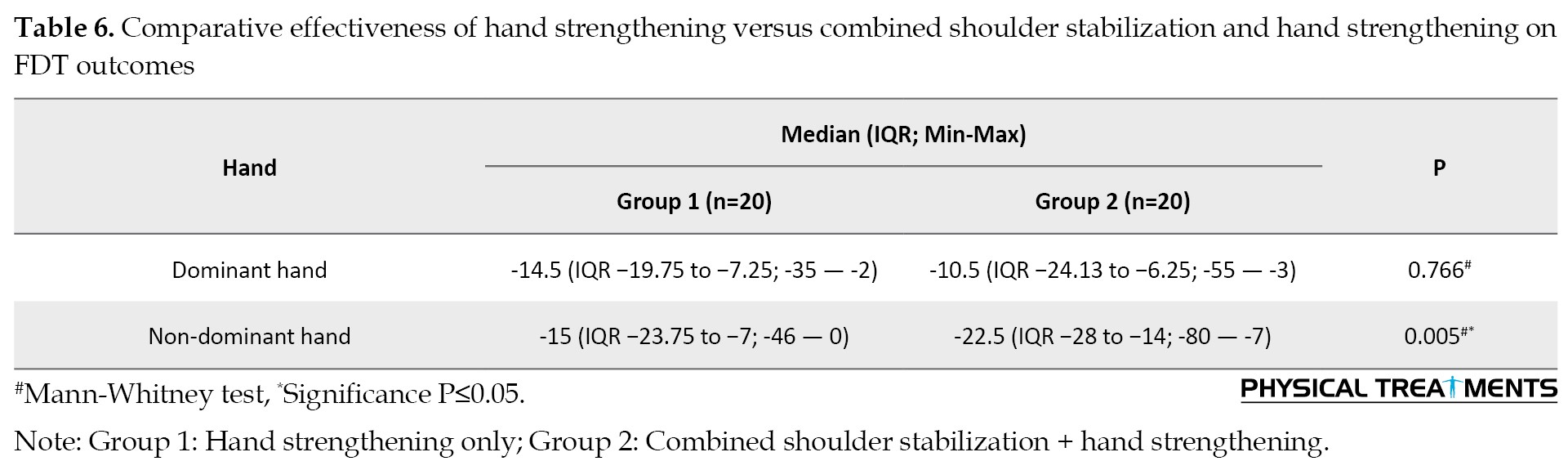
For the dominant hand, improvements were observed in both groups, but no significant difference was found between them (P=0.766). For the non-dominant hand, however, the combined training group showed a greater reduction in completion time (Δ –22.5 seconds) compared with the hand strengthening group (Δ –15 seconds), and this difference was statistically significant (P=0.005). The magnitude of this between-group difference was moderate, as indicated by the effect size (r=0.45). These findings indicate that while both interventions improved dexterity, the combined approach was more effective, particularly for the non-dominant hand.
Discussion
The baseline assessment in this study revealed that all participants were categorized as non-functional on the FDT, reflecting profound deficits in fine motor control widely reported in children with DS. Manual dexterity is a cornerstone of fine motor development, enabling essential daily activities, such as grasping, manipulating objects, assembling components, and writing. However, children with DS consistently demonstrate significant impairments in this domain, as highlighted by systematic reviews documenting markedly lower performance in speed, accuracy, and coordination compared with typically developing peers [12]. These deficits arise not only from neuromuscular factors, such as hypotonia and ligamentous laxity, but also from limitations in cognitive and perceptual–motor integration that reduce movement efficiency. For example, dos Santos et al. (2024) observed that although children with DS can employ grasping patterns, such as tripod and pluridigital grips, their execution is characterized by low efficiency and quality, rendering even simple activities, such as assembling Lego blocks, disproportionately difficult due to weak musculature, visuomotor incoordination, and attentional challenges [13]. Moreover, deficits in executive functions, including impaired working memory, cognitive flexibility, and inhibitory control, further compound difficulties in planning and sequencing fine motor tasks [14]. Biomechanical constraints also play a role, as children with DS typically exhibit up to 60% lower grip strength than peers, in addition to inefficient motor patterns, such as excessive trunk rotation and delayed muscle activation, producing slow, unstable, and imprecise movements [15].
This study demonstrates that hand strengthening exercises can meaningfully enhance manual dexterity in children with DS. The observed dexterity improvements reflect not only increased muscle strength but also neuromuscular adaptations that support the precision, stability, and efficiency of fine motor actions. These findings are consistent with prior evidence showing that structured motor interventions are effective in addressing fine motor deficits in DS, where impairments are driven by a combination of hypotonia, ligamentous laxity, and delayed neuromotor development [10, 16].
The clinical relevance of these improvements lies in their functional implications. Manual dexterity underpins essential daily activities, such as writing, buttoning clothes, and manipulating objects. Even incremental gains, from non-functional to minimally functional performance, represent a shift toward greater independence in daily living for children with DS. Previous studies confirm this trajectory: Ashori et al. (2018) found that structured motor training improved both gross and fine motor abilities, while Raharjo (2023) reported that resistive hand exercises enhanced grip strength substantially. Together, these studies support the premise that strengthening-focused interventions can produce meaningful outcomes in children with developmental disabilities [16, 10].
Physiologically, the efficacy of hand strengthening training is supported by evidence of both biomechanical and neural adaptation. Repetitive resistive activity enhances contractility of intrinsic and extrinsic hand muscles, while also reinforcing proprioceptive input and improving sensorimotor integration [15]. Beyond peripheral adaptations, there is evidence of central contributions: repetitive fine motor training promotes neuroplasticity, strengthening functional connectivity between sensory and motor cortices, which in turn facilitates more efficient planning and execution of fine motor sequences [17]. These changes help compensate for the deficits in frontoparietal networks and executive function domains that have been widely documented in DS [14, 18]. Support for these mechanisms is provided by resistance training studies in individuals with DS, which have demonstrated concurrent improvements in motor performance, executive function, and frontal lobe–related cognitive processes following structured training programs [19].
The findings of this study provide supportive evidence that combining proximal shoulder stabilization with distal hand strengthening yields superior improvements in manual dexterity for children with DS. This approach aligns with the principle that proximal stability forms the biomechanical foundation for distal mobility, whereby enhanced scapular and glenohumeral stability allows for more precise and efficient recruitment of hand muscles during fine motor tasks [20]. Unlike isolated hand training, which primarily targets intrinsic and extrinsic finger muscles, the combined program addresses both proximal and distal components of the kinetic chain, thereby fostering integrative neuromuscular adaptations that extend beyond localized strength gains. However, no significant between-group difference was observed for the dominant hand, suggesting that both interventions were similarly effective in improving dominant hand dexterity. This may be related to higher baseline proficiency of the dominant hand, which could limit the extent of observable between-group differences.
An especially notable result of this study was the more pronounced improvement observed in the non-dominant hand. This finding is clinically relevant because the non-dominant side in children with DS typically exhibits greater deficits in dexterity, coordination, and strength compared to the dominant hand [9]. By engaging proximal stabilizers alongside hand muscles, the intervention may have mitigated asymmetrical compensation strategies, thereby enhancing bilateral motor integration and reducing the performance gap between hands. This finding is consistent with previous reports that targeted proximal stabilization not only augments grip and pinch strength but also improves bilateral motor coordination and fine motor control [9, 21].
The physiological basis for these gains can be attributed to both biomechanical and neural mechanisms. Stabilization training enhances scapular alignment and postural control by activating the serratus anterior, trapezius, and rotator cuff muscles, providing a stable platform for distal hand movements. Concurrently, repetitive resistive hand training strengthens intrinsic muscles, such as the lumbricals and interossei, which are crucial for precision grips. Together, these adaptations improve proprioceptive feedback, optimize motor unit recruitment, and promote cortical reorganization. This process may be particularly relevant for children with DS, who often exhibit delayed neuromotor maturation and impaired frontoparietal connectivity [18].
These findings extend the work of Elserty and Wagdy (2020), who demonstrated significant increases in grip and pinch strength following dynamic neuromuscular shoulder stabilization, and Yadav and Kanase (2025), who reported enhanced hand function after proximal-focused training in neuromuscular disorders. By confirming that proximal–distal synergy translates into functional gains on standardized dexterity measures, such as the FDT, this study underscores the clinical value of integrated motor training [9, 21]. Importantly, even modest shifts from non-functional to minimally functional performance represent meaningful progress for children with DS, as these changes can directly impact independence in activities of daily living.
Compared to isolated hand strengthening, integrating proximal shoulder stabilizer training with distal hand exercises yields superior improvements in fine motor function for children with DS, as it directly addresses the layered motor deficits characteristic of this population. A consistent principle in motor control literature is that proximal stability is a prerequisite for distal precision [22, 23]. By enhancing scapulothoracic alignment and glenohumeral concavity compression, proximal training provides a stable foundation that optimizes recruitment of intrinsic and extrinsic hand muscles, such as the lumbricals, interossei, and flexor digitorum. This synergy enhances grip, pinch, and object manipulation beyond what can be achieved through hand-focused training alone [9, 20].
Beyond biomechanical benefits, the proximal–distal approach activates broader neuromuscular and sensorimotor loops that foster neuroplastic reorganization. Repeated coactivation of proximal and distal segments stimulates cortical premotor and bilateral sensorimotor regions, strengthening the communication between sensory feedback and motor execution [24, 25]. Such integrative training reduces compensatory trunk movements, improves bilateral coordination, and promotes more efficient fine motor control by recalibrating both biomechanical stability and neural efficiency. These neuroplastic adaptations may help explain the disproportionate improvement observed in the non-dominant hand, which likely had greater capacity for neural reorganization due to lower baseline performance and reduced habitual use compared with the dominant hand.
Clinically, the superiority of proximal–distal integration lies in its multidimensional impact: it enhances muscular strength and proprioception, supports postural stability, and facilitates the transfer of skills to functional daily activities, such as writing, dressing, and object assembly. Unlike isolated hand exercises, which may plateau due to limited postural support, the combined strategy addresses hypotonia, ligamentous laxity, and neuromotor inefficiency in an integrated manner. These findings reinforce the view that rehabilitation for children with DS benefits most from interventions that target the proximal–distal continuum, positioning such approaches as robust, evidence-based strategies for occupational therapy and special education.
The observation that the non-dominant hand exhibited greater improvements in manual dexterity following both isolated and combined training highlights an underappreciated adaptive potential in children with DS. Although the non-dominant hand generally demonstrates lower baseline performance due to hemispheric laterality, intensive and structured practice appears to unlock latent neuroplastic mechanisms that facilitate disproportionately larger gains compared to the dominant hand. This phenomenon is consistent with evidence showing that repetitive training of the non-dominant hand can induce cortical reorganization, expand motor representations, and strengthen corticospinal pathways that are typically less efficient [26]. At the peripheral level, repetitive practice optimizes motor unit recruitment, improves intermuscular coordination, and enhances synchronization of intrinsic hand muscles, thereby accelerating fine motor precision and control. Consistent with this interpretation, resistance training studies in individuals with DS have demonstrated concurrent improvements in motor performance and executive function, supporting the role of experience-dependent neuroplastic adaptations in this population [19].
Experimental studies further support these mechanisms. Training with chopsticks, drawing tasks, and computer-mouse manipulation using the non-dominant hand have all been shown to yield significant improvements in speed, accuracy, and fluency of movements, in some cases persisting up to six months post-training [27–29]. Notably, these effects often transfer bilaterally, improving performance of the dominant hand [29]. Electrophysiological evidence corroborates these findings, showing that non-dominant hand training produces greater excitability changes in motor cortices relative to dominant hand training [30], likely reflecting greater neural reserve and responsiveness to structured input. In children with DS, this adaptive plasticity is especially relevant, as their motor challenges stem from a convergence of hypotonia, hyperlaxity, and neuromotor inefficiency that affect both proximal and distal segments [31]. Clinically, these findings suggest that incorporating structured non-dominant hand training into rehabilitation programs for DS may accelerate functional gains, enhance bilateral coordination, and expand fine motor repertoires essential for daily living activities. Rather than being viewed as an inherent limitation, the non-dominant hand should be considered a therapeutic opportunity with high adaptive potential. This reframing aligns with broader neurorehabilitation principles emphasizing early, intensive, and task-specific training as drivers of functional neuroplasticity [26, 32]. Several limitations should be considered when interpreting these findings. First, this study did not include a passive control group receiving usual care; therefore, improvements observed in both intervention groups cannot be attributed exclusively to the training protocols. Second, the gender distribution between groups was uneven and, although not statistically significant, may have influenced motor performance outcomes and should be considered when interpreting the results.
Conclusion
This study highlights that while children with DS exhibit profound baseline deficits in manual dexterity, they possess substantial adaptive potential when exposed to structured motor interventions. Both isolated hand strengthening and proximal–distal integration improved fine motor skills. However, the combined approach demonstrated greater benefits primarily in the non-dominant hand, consistent with the biomechanical principle that proximal stability supports distal precision and engages broader neuromuscular and cortical pathways. Notably, the non-dominant hand showed disproportionately greater gains, underscoring its latent neuroplastic capacity and value as a therapeutic target for reducing functional asymmetry. Taken together, these findings suggest that proximal–distal integrated training may offer specific advantages for improving non-dominant hand dexterity, with potential implications for enhancing independence and participation in daily activities for children with DS in clinical rehabilitation and special education settings.
Ethical Considerations
Compliance with ethical guidelines
This study was approved by the Health Research Ethics Committee of the Faculty of Medicine, Hasanuddin University, and Hasanuddin University Hospital, Makassar, Indonesia (Code: 693/UN4.6.4.5.31/PP.36/2024). All study procedures were conducted in accordance with the ethical principles outlined in the Declaration of Helsinki and its subsequent amendments. Additional ethical safeguards included ensuring voluntary participation, protecting the confidentiality of participants’ data, and maintaining anonymity throughout the study. Written informed consent was obtained from the parents or legal guardians of all participants after providing a detailed explanation of the study’s objectives and procedures
Funding
This research did not receive any grant from funding agencies in the public, commercial, or non-profit sectors.
Authors' contributions
All authors contributed equally to the conception and design of the study, data collection and analysis, interception of the results and drafting of the manuscript. Each author approved the final version of the manuscript for submission.
Conflict of interest
The authors declared no conflict of interest.
Acknowledgments
The authors express their sincere gratitude to the participants and their families for their commitment and cooperation throughout this study. They also extend their appreciation to the staff and therapists of Rumah Komunitas Orang Tua Asuh Down syndrome (KOADS), Wahidin Sudirohusodo Hospital, and Hasanuddin University Hospital for their invaluable support during data collection and intervention sessions.
Down syndrome (DS) is the most common chromosomal disorder and the leading genetic cause of intellectual disability worldwide. With an estimated incidence of one in every 700 to 800 live births, DS affects millions of individuals globally and continues to present substantial challenges for health systems and families [1]. Epidemiological studies indicate that the prevalence of DS ranges between 1.7 and 2.5 per 1,000 live births, with increasing trends reported over time, largely influenced by maternal age and survival improvements [2]. In Europe, estimates show approximately 8,000 annual live births with DS (2011–2015), and approximately 419,000 people living with DS as of 2015 [3]. Globally, the number of prevalent cases has steadily increased over the past three decades, even as mortality rates declined due to advances in care [4].
In Indonesia, national surveys documented a rise in prevalence from 0.12% in 2010 to 0.21% in 2018, underscoring DS as a growing and persistent public health concern [5]. This increasing prevalence underscores the urgent need for targeted therapeutic interventions to enhance motor and functional abilities. Such needs are especially critical in low- and middle-income countries, including Indonesia, where access to specialized rehabilitation and inclusive educational services remains limited.
Individuals with DS exhibit a distinct neurodevelopmental profile characterized by muscle hypotonia, ligamentous laxity, reduced strength, and inadequate postural stability, which collectively compromise motor control and endurance [6, 7]. These neuromusculoskeletal features, compounded by cognitive delays and sensory integration deficits, lead to marked impairments across both gross and fine motor domains. Gross motor difficulties manifest as delays in achieving fundamental milestones, such as sitting, standing, and walking, often accompanied by inefficient compensatory strategies, including widened step width, altered sway, and trunk stiffening to maintain equilibrium during static and dynamic tasks. At the same time, deficits in fine motor competence, including impaired grip strength and finger dexterity, are particularly disabling as they interfere with the performance of essential self-care and school-related activities, such as feeding, dressing, and handwriting, which are fundamental for independence and social participation [6, 7]. Accordingly, effective interventions targeting fine motor skills are a critical priority in pediatric rehabilitation.
Hand manipulation skills, as defined in the occupational therapy practice framework, involve the precise coordination of small muscles in the hands and fingers to manipulate objects effectively. In DS, these skills are often compromised by intrinsic weakness of the hands combined with insufficient proximal stability of the shoulder and trunk. Deficient proximal control undermines distal motor performance and limits functional outcomes. The relationship between proximal stabilization and distal dexterity has been acknowledged conceptually; however, there is limited empirical evidence evaluating how training approaches that combine these domains can optimize motor function [8].
Previous research has shown that shoulder stabilization training based on dynamic neuromuscular stabilization can yield positive outcomes. In children with DS, such programs have been reported to significantly improve grip strength and various types of pinch strength in both dominant and non-dominant hands [9]. Similarly, hand strengthening programs have demonstrated significant benefits for grip strength in children with DS, and these improvements translate into greater independence and participation in daily activities that require manual dexterity [10]. However, most studies have investigated proximal or distal interventions in isolation. As a result, there is insufficient evidence on whether combined proximal and distal training produces superior effects compared to distal strengthening alone. In addition, the potential impact of these interventions on the non-dominant hand, which is often more impaired in children with DS, has received little attention.
To address these gaps, the present study aimed to compare the effects of distal hand strengthening alone with a combined proximal–distal approach incorporating both shoulder stabilization and hand strengthening exercises. By contrasting these two strategies, this study seeks to generate evidence supporting integrated rehabilitation approaches that may enhance manual dexterity, independence, and quality of life in children with DS.
Materials and Methods
In this study, participants were randomly assigned to one of two intervention groups. A total of 40 children with DS, aged 6–12 years, were recruited from Rumah Komunitas Orang Tua Asuh Down Syndrome (KOADS) and the outpatient clinics of Wahidin Sudirohusodo Hospital and Hasanuddin University Hospital, Makassar, Indonesia. Eligibility criteria included the ability to stand and walk independently, normal vision and hearing, and mild to moderate intellectual disability (IQ range 48–60) as assessed using the cognitive scale for DS. Children were excluded if they had sustained an upper-limb injury within the previous three months associated with pain ≥4/10 on the visual analog scale (VAS), had cervical or chest wall disorders limiting upper-limb mobility, or had untreated congenital heart disease. Participants were withdrawn if they missed three or more consecutive sessions, withdrew consent, or experienced acute post-training pain ≥4/10. Prior to enrolment, the study procedures, potential benefits, and risks were explained to the participants and their parents or guardians, and written informed consent was obtained.
Study design and procedures
Participants were randomly assigned to one of two intervention groups: (1) distal hand-strengthening exercises or (2) combined proximal–distal training, which incorporated shoulder stabilization in addition to hand strengthening. Simple random allocation using a randomized number sequence was applied, in which participant identification numbers were randomly ordered and assigned sequentially to the two groups. Both interventions were delivered three times per week for eight consecutive weeks. Manual dexterity was evaluated at baseline and following the intervention using the functional dexterity test (FDT) for both dominant and non-dominant hands.
During the home-based phase, adherence to the exercise program was monitored remotely using social media (WhatsApp). At the beginning of the intervention, the research team conducted in-person sessions to deliver the exercises directly to the children and to train parents or caregivers in the correct exercise techniques. Once parents demonstrated adequate competency to administer the exercises independently, training was continued at home under parental supervision. Adherence was monitored through multiple mechanisms. Parents were reminded to conduct the exercises according to the participant’s mood and tolerance. Each training session was recorded on video and submitted to the research team for review. In addition, parents completed an exercise logbook for every session, and photographs of the completed logbooks were submitted every two weeks. The research team reviewed videos and logbooks biweekly, provided feedback on exercise performance, and addressed any technical issues. Participants and caregivers were encouraged to contact the research team at any time in case of adverse effects, difficulties, or concerns during training. Using this monitoring system, full adherence to the prescribed home-based exercises was achieved in both intervention groups.
Interventions
The intervention protocols comprised proximal and distal training components. Shoulder stabilization training was based on the principles of dynamic neuromuscular stabilization and involved closed-kinetic chain exercises targeting the shoulder stabilizers. Each posture was maintained for 10 seconds and performed in three sets of 10 repetitions, with 3-second rests between repetitions and 1–3 minutes of rest between sets depending on participant fatigue. In parallel, hand strengthening training consisted of active exercises for the intrinsic muscles of the hand, with resistance progressively increased from light to heavy. Each session lasted 15–20 minutes and was performed in three sets, three times per week, over eight weeks.
Outcome measures
FDT, a standardized assessment with established validity and reliability in children [11], was employed as the primary outcome measure of manual dexterity. The test required inserting and turning 16 pegs using one hand, with performance timed in seconds. Functional categories for the dominant hand were defined as functional (16–25 s), moderately functional (26–35 s), minimally functional (36–50 s), and nonfunctional (>50 s); for the non-dominant hand, the corresponding thresholds were 18–27 s, 28–45 s, 46–55 s, and >55 s. Separate functional categories were applied for the dominant and non-dominant hands to account for expected differences in dexterity performance associated with hand dominance. Penalties of 5 seconds were applied if supination occurred or the board was grasped, and 10 seconds if a peg was dropped.
Statistical analysis
Data normality was assessed with the Shapiro–Wilk test. Descriptive statistics are reported as Mean±SD. Within-group differences between baseline and post-test scores were analyzed using the Wilcoxon signed-rank test. Between-group differences were evaluated using the Mann–Whitney U test. All analyses were performed using SPSS Statistics (version 30.0) (IBM Corp., Armonk, NY, USA), with the level of significance set at P≤0.05.
Results
Table 1 presents the demographic characteristics of participants across the two intervention groups.
Although the difference did not reach statistical significance, a higher proportion of males was observed in the combined shoulder stabilization plus hand strengthening group compared with the hand strengthening group (70% vs 35%, P=0.056). With respect to age, the distribution of children and adolescents was also not significantly different between groups (P=0.205). Overall, the two groups can be considered comparable in terms of demographic characteristics. Table 2 presents the FDT results for dominant and non-dominant hands at pre-test and post-test.
At baseline, both groups showed comparable scores, indicating similar starting conditions. Following the interventions, dexterity improved in both groups as reflected by lower median completion times. No between-group differences were observed post-intervention, suggesting that both hand strengthening alone and the combined program were effective in enhancing fine motor performance.
Tables 3 and 4 present the within-group analyses of FDT performance.
In the hand strengthening group (Table 3), both hands improved significantly. The median time of dominant hand decreased from 78.5 to 60.25 s (Δ–18.25, P<0.001), while the non-dominant hand improved from 107.5 to 87 s (Δ–20.5, P<0.001). In the combined training group (Table 4), the improvements were even greater. The dominant hand decreased from 67.5 to 56 s (Δ–11.5, P<0.001), and the non-dominant hand showed the largest change, from 105 to 71 s (Δ–34, P<0.001). Overall, both interventions enhanced dexterity, but the combined approach produced stronger gains, particularly in the non-dominant hand.
Table 5 presents the distribution of FDT performance categories.
At baseline, all participants in both groups were classified as non-functional for both dominant and non-dominant hands. Following the intervention, a shift was observed in the dominant-hand performance. In the hand strengthening group, three participants (15%) achieved a minimally functional status at post-test, while in the combined training group, five participants (25%) reached the minimally functional category in the dominant hand. No participants in either group reached the minimally functional category in the non-dominant hand at post-test. Although most participants remained classified as non-functional, the combined proximal–distal training resulted in a greater proportion of functional improvement in the dominant hand compared with hand strengthening alone.
Table 6 compares the effectiveness of the two interventions based on changes in FDT scores.
For the dominant hand, improvements were observed in both groups, but no significant difference was found between them (P=0.766). For the non-dominant hand, however, the combined training group showed a greater reduction in completion time (Δ –22.5 seconds) compared with the hand strengthening group (Δ –15 seconds), and this difference was statistically significant (P=0.005). The magnitude of this between-group difference was moderate, as indicated by the effect size (r=0.45). These findings indicate that while both interventions improved dexterity, the combined approach was more effective, particularly for the non-dominant hand.
Discussion
The baseline assessment in this study revealed that all participants were categorized as non-functional on the FDT, reflecting profound deficits in fine motor control widely reported in children with DS. Manual dexterity is a cornerstone of fine motor development, enabling essential daily activities, such as grasping, manipulating objects, assembling components, and writing. However, children with DS consistently demonstrate significant impairments in this domain, as highlighted by systematic reviews documenting markedly lower performance in speed, accuracy, and coordination compared with typically developing peers [12]. These deficits arise not only from neuromuscular factors, such as hypotonia and ligamentous laxity, but also from limitations in cognitive and perceptual–motor integration that reduce movement efficiency. For example, dos Santos et al. (2024) observed that although children with DS can employ grasping patterns, such as tripod and pluridigital grips, their execution is characterized by low efficiency and quality, rendering even simple activities, such as assembling Lego blocks, disproportionately difficult due to weak musculature, visuomotor incoordination, and attentional challenges [13]. Moreover, deficits in executive functions, including impaired working memory, cognitive flexibility, and inhibitory control, further compound difficulties in planning and sequencing fine motor tasks [14]. Biomechanical constraints also play a role, as children with DS typically exhibit up to 60% lower grip strength than peers, in addition to inefficient motor patterns, such as excessive trunk rotation and delayed muscle activation, producing slow, unstable, and imprecise movements [15].
This study demonstrates that hand strengthening exercises can meaningfully enhance manual dexterity in children with DS. The observed dexterity improvements reflect not only increased muscle strength but also neuromuscular adaptations that support the precision, stability, and efficiency of fine motor actions. These findings are consistent with prior evidence showing that structured motor interventions are effective in addressing fine motor deficits in DS, where impairments are driven by a combination of hypotonia, ligamentous laxity, and delayed neuromotor development [10, 16].
The clinical relevance of these improvements lies in their functional implications. Manual dexterity underpins essential daily activities, such as writing, buttoning clothes, and manipulating objects. Even incremental gains, from non-functional to minimally functional performance, represent a shift toward greater independence in daily living for children with DS. Previous studies confirm this trajectory: Ashori et al. (2018) found that structured motor training improved both gross and fine motor abilities, while Raharjo (2023) reported that resistive hand exercises enhanced grip strength substantially. Together, these studies support the premise that strengthening-focused interventions can produce meaningful outcomes in children with developmental disabilities [16, 10].
Physiologically, the efficacy of hand strengthening training is supported by evidence of both biomechanical and neural adaptation. Repetitive resistive activity enhances contractility of intrinsic and extrinsic hand muscles, while also reinforcing proprioceptive input and improving sensorimotor integration [15]. Beyond peripheral adaptations, there is evidence of central contributions: repetitive fine motor training promotes neuroplasticity, strengthening functional connectivity between sensory and motor cortices, which in turn facilitates more efficient planning and execution of fine motor sequences [17]. These changes help compensate for the deficits in frontoparietal networks and executive function domains that have been widely documented in DS [14, 18]. Support for these mechanisms is provided by resistance training studies in individuals with DS, which have demonstrated concurrent improvements in motor performance, executive function, and frontal lobe–related cognitive processes following structured training programs [19].
The findings of this study provide supportive evidence that combining proximal shoulder stabilization with distal hand strengthening yields superior improvements in manual dexterity for children with DS. This approach aligns with the principle that proximal stability forms the biomechanical foundation for distal mobility, whereby enhanced scapular and glenohumeral stability allows for more precise and efficient recruitment of hand muscles during fine motor tasks [20]. Unlike isolated hand training, which primarily targets intrinsic and extrinsic finger muscles, the combined program addresses both proximal and distal components of the kinetic chain, thereby fostering integrative neuromuscular adaptations that extend beyond localized strength gains. However, no significant between-group difference was observed for the dominant hand, suggesting that both interventions were similarly effective in improving dominant hand dexterity. This may be related to higher baseline proficiency of the dominant hand, which could limit the extent of observable between-group differences.
An especially notable result of this study was the more pronounced improvement observed in the non-dominant hand. This finding is clinically relevant because the non-dominant side in children with DS typically exhibits greater deficits in dexterity, coordination, and strength compared to the dominant hand [9]. By engaging proximal stabilizers alongside hand muscles, the intervention may have mitigated asymmetrical compensation strategies, thereby enhancing bilateral motor integration and reducing the performance gap between hands. This finding is consistent with previous reports that targeted proximal stabilization not only augments grip and pinch strength but also improves bilateral motor coordination and fine motor control [9, 21].
The physiological basis for these gains can be attributed to both biomechanical and neural mechanisms. Stabilization training enhances scapular alignment and postural control by activating the serratus anterior, trapezius, and rotator cuff muscles, providing a stable platform for distal hand movements. Concurrently, repetitive resistive hand training strengthens intrinsic muscles, such as the lumbricals and interossei, which are crucial for precision grips. Together, these adaptations improve proprioceptive feedback, optimize motor unit recruitment, and promote cortical reorganization. This process may be particularly relevant for children with DS, who often exhibit delayed neuromotor maturation and impaired frontoparietal connectivity [18].
These findings extend the work of Elserty and Wagdy (2020), who demonstrated significant increases in grip and pinch strength following dynamic neuromuscular shoulder stabilization, and Yadav and Kanase (2025), who reported enhanced hand function after proximal-focused training in neuromuscular disorders. By confirming that proximal–distal synergy translates into functional gains on standardized dexterity measures, such as the FDT, this study underscores the clinical value of integrated motor training [9, 21]. Importantly, even modest shifts from non-functional to minimally functional performance represent meaningful progress for children with DS, as these changes can directly impact independence in activities of daily living.
Compared to isolated hand strengthening, integrating proximal shoulder stabilizer training with distal hand exercises yields superior improvements in fine motor function for children with DS, as it directly addresses the layered motor deficits characteristic of this population. A consistent principle in motor control literature is that proximal stability is a prerequisite for distal precision [22, 23]. By enhancing scapulothoracic alignment and glenohumeral concavity compression, proximal training provides a stable foundation that optimizes recruitment of intrinsic and extrinsic hand muscles, such as the lumbricals, interossei, and flexor digitorum. This synergy enhances grip, pinch, and object manipulation beyond what can be achieved through hand-focused training alone [9, 20].
Beyond biomechanical benefits, the proximal–distal approach activates broader neuromuscular and sensorimotor loops that foster neuroplastic reorganization. Repeated coactivation of proximal and distal segments stimulates cortical premotor and bilateral sensorimotor regions, strengthening the communication between sensory feedback and motor execution [24, 25]. Such integrative training reduces compensatory trunk movements, improves bilateral coordination, and promotes more efficient fine motor control by recalibrating both biomechanical stability and neural efficiency. These neuroplastic adaptations may help explain the disproportionate improvement observed in the non-dominant hand, which likely had greater capacity for neural reorganization due to lower baseline performance and reduced habitual use compared with the dominant hand.
Clinically, the superiority of proximal–distal integration lies in its multidimensional impact: it enhances muscular strength and proprioception, supports postural stability, and facilitates the transfer of skills to functional daily activities, such as writing, dressing, and object assembly. Unlike isolated hand exercises, which may plateau due to limited postural support, the combined strategy addresses hypotonia, ligamentous laxity, and neuromotor inefficiency in an integrated manner. These findings reinforce the view that rehabilitation for children with DS benefits most from interventions that target the proximal–distal continuum, positioning such approaches as robust, evidence-based strategies for occupational therapy and special education.
The observation that the non-dominant hand exhibited greater improvements in manual dexterity following both isolated and combined training highlights an underappreciated adaptive potential in children with DS. Although the non-dominant hand generally demonstrates lower baseline performance due to hemispheric laterality, intensive and structured practice appears to unlock latent neuroplastic mechanisms that facilitate disproportionately larger gains compared to the dominant hand. This phenomenon is consistent with evidence showing that repetitive training of the non-dominant hand can induce cortical reorganization, expand motor representations, and strengthen corticospinal pathways that are typically less efficient [26]. At the peripheral level, repetitive practice optimizes motor unit recruitment, improves intermuscular coordination, and enhances synchronization of intrinsic hand muscles, thereby accelerating fine motor precision and control. Consistent with this interpretation, resistance training studies in individuals with DS have demonstrated concurrent improvements in motor performance and executive function, supporting the role of experience-dependent neuroplastic adaptations in this population [19].
Experimental studies further support these mechanisms. Training with chopsticks, drawing tasks, and computer-mouse manipulation using the non-dominant hand have all been shown to yield significant improvements in speed, accuracy, and fluency of movements, in some cases persisting up to six months post-training [27–29]. Notably, these effects often transfer bilaterally, improving performance of the dominant hand [29]. Electrophysiological evidence corroborates these findings, showing that non-dominant hand training produces greater excitability changes in motor cortices relative to dominant hand training [30], likely reflecting greater neural reserve and responsiveness to structured input. In children with DS, this adaptive plasticity is especially relevant, as their motor challenges stem from a convergence of hypotonia, hyperlaxity, and neuromotor inefficiency that affect both proximal and distal segments [31]. Clinically, these findings suggest that incorporating structured non-dominant hand training into rehabilitation programs for DS may accelerate functional gains, enhance bilateral coordination, and expand fine motor repertoires essential for daily living activities. Rather than being viewed as an inherent limitation, the non-dominant hand should be considered a therapeutic opportunity with high adaptive potential. This reframing aligns with broader neurorehabilitation principles emphasizing early, intensive, and task-specific training as drivers of functional neuroplasticity [26, 32]. Several limitations should be considered when interpreting these findings. First, this study did not include a passive control group receiving usual care; therefore, improvements observed in both intervention groups cannot be attributed exclusively to the training protocols. Second, the gender distribution between groups was uneven and, although not statistically significant, may have influenced motor performance outcomes and should be considered when interpreting the results.
Conclusion
This study highlights that while children with DS exhibit profound baseline deficits in manual dexterity, they possess substantial adaptive potential when exposed to structured motor interventions. Both isolated hand strengthening and proximal–distal integration improved fine motor skills. However, the combined approach demonstrated greater benefits primarily in the non-dominant hand, consistent with the biomechanical principle that proximal stability supports distal precision and engages broader neuromuscular and cortical pathways. Notably, the non-dominant hand showed disproportionately greater gains, underscoring its latent neuroplastic capacity and value as a therapeutic target for reducing functional asymmetry. Taken together, these findings suggest that proximal–distal integrated training may offer specific advantages for improving non-dominant hand dexterity, with potential implications for enhancing independence and participation in daily activities for children with DS in clinical rehabilitation and special education settings.
Ethical Considerations
Compliance with ethical guidelines
This study was approved by the Health Research Ethics Committee of the Faculty of Medicine, Hasanuddin University, and Hasanuddin University Hospital, Makassar, Indonesia (Code: 693/UN4.6.4.5.31/PP.36/2024). All study procedures were conducted in accordance with the ethical principles outlined in the Declaration of Helsinki and its subsequent amendments. Additional ethical safeguards included ensuring voluntary participation, protecting the confidentiality of participants’ data, and maintaining anonymity throughout the study. Written informed consent was obtained from the parents or legal guardians of all participants after providing a detailed explanation of the study’s objectives and procedures
Funding
This research did not receive any grant from funding agencies in the public, commercial, or non-profit sectors.
Authors' contributions
All authors contributed equally to the conception and design of the study, data collection and analysis, interception of the results and drafting of the manuscript. Each author approved the final version of the manuscript for submission.
Conflict of interest
The authors declared no conflict of interest.
Acknowledgments
The authors express their sincere gratitude to the participants and their families for their commitment and cooperation throughout this study. They also extend their appreciation to the staff and therapists of Rumah Komunitas Orang Tua Asuh Down syndrome (KOADS), Wahidin Sudirohusodo Hospital, and Hasanuddin University Hospital for their invaluable support during data collection and intervention sessions.
References
- Antonarakis SE, Skotko BG, Rafii MS, Strydom A, Pape SE, Bianchi DW, et al. Down syndrome. Nature Reviews. Disease Primers. 2020; 6 (1):9. [DOI:10.1038/s41572-019-0143-7] [PMID]
- Irving C, Basu A, Richmond S, Burn J, Wren C. Twenty-year trends in prevalence and survival of Down syndrome. European Journal of Human Genetics. 2008; 16 (11):1336-40.[DOI:10.1038/ejhg.2008.122] [PMID]
- de Graaf G, Buckley F, Skotko BG. Estimation of the number of people with Down syndrome in Europe. European Journal of Human Genetics: EJHG. 2021; 29 (3):402-10. [DOI:10.1038/s41431-020-00748-y] [PMID]
- Chen L, Wang L, Wang Y, Hu H, Zhan Y, Zeng Z, et al. Global, Regional, and National Burden and Trends of Down Syndrome From 1990 to 2019. Frontiers in Genetics. 2022; 13:908482. [DOI:10.3389/fgene.2022.908482] [PMID]
- Utari A, Cayami FK, Rahardjo TA, Sabatini SE, Ulvyana V, Winarni TI. Critical issue in the identification of Down syndrome and its problems in Central Java, Indonesia: The fact of needing health care and better management. Intractable & Rare Diseases Research. 2024; 13 (2):121-5. [DOI:10.5582/irdr.2023.01103] [PMID]
- Vandoni M, Giuriato M, Pirazzi A, Zanelli S, Gaboardi F, Carnevale Pellino V, et al. Motor Skills and Executive Functions in Pediatric Patients with Down Syndrome: A Challenge for Tailoring Physical Activity Interventions. Pediatric Reports. 2023; 15 (4):691-706. [DOI:10.3390/pediatric15040062] [PMID]
- Jain PD, Nayak A, Karnad SD, Doctor KN. Gross motor dysfunction and balance impairments in children and adolescents with Down syndrome: A systematic review. Clinical and Experimental Pediatrics. 2022; 65 (3):142-9. [DOI:10.3345/cep.2021.00479] [PMID]
- Case-Smith J, O’Brien JC. Occupational therapy for children and adolescents. Seventh edition. St. Louis, Missouri: Elsevier; 2015. [Link]
- Elserty N, Wagdy E. Influence of shoulder stabilization exercises on hand grip strength in children with Down syndrome: Randomized clinical trial. Bulletin of Faculty of Physical Therapy. 2020; 25:14. [DOI:10.1186/s43161-020-00013-9]
- Raharjo S, Yunus M, Pelana R, Azidin RM. The benefit of a four-week range of motion exercise on hand muscle strength in children with Down Syndrome. Pedagogy of Physical Culture and Sports. 2023; 27 (6):481-6. [DOI:10.15561/26649837.2023.0606]
- Tissue CM, Velleman PF, Stegink-Jansen CW, Aaron DH, Winthrop BG, Gogola GR. Validity and reliability of the Functional Dexterity Test in children. Journal of Hand Therapy. 2017; 30 (4):500-6. [DOI:10.1016/j.jht.2016.08.002] [PMID]
- Oliveira CC, Neto JC, Tudella E. Manual dexterity of children and adolescents with Down Syndrome: Systematic review of the literature. Journal of Genetic Syndromes & Gene Therapy. 2016; 7 (4):1. [DOI: 10.4172/2157-7412.1000305]
- Dos Santos P, Amato CA, Kintschner NR, Blascovi-Assis SM. Evaluation of fine motor skills of children with Down syndrome in the handling of the material LEGO® education. Cadernos de Pós-Graduação Em Distúrbios Do Desenvolvimento. 2024; 24 (1):120-33. [DOI:10.5935/cadernosdisturbios.v24n1p120-133]
- Tungate AS, Conners FA. Executive function in Down syndrome: A meta-analysis. Research in Developmental Disabilities. 2021; 108:103802. [DOI:10.1016/j.ridd.2020.103802] [PMID]
- Padia N, Bose M, Parab S. Determinants of hand function in children and adolescent with Down Syndrome-A scoping review. Journal of Hand Therapy. 2023; 36 (3):622-31. [DOI:10.1016/j.jht.2022.07.010] [PMID]
- Ashori M, Norouzi G, Jalil-Abkenar SS. The effectiveness of motor therapy on motor skills and bilateral coordination of children with Intellectual Disability. Iranian Rehabilitation Journal. 2018; 16 (4):331-8. [DOI:10.32598/irj.16.4.331]
- Melo GLR, Neto IVS, da Fonseca EF, Stone W, Nascimento DDC. Resistance training and down syndrome: A narrative review on considerations for exercise prescription and safety. Frontiers in Physiology. 2022; 13:948439. [DOI:10.3389/fphys.2022.948439] [PMID]
- Vuijk PJ, Hartman E, Scherder E, Visscher C. Motor performance of children with mild intellectual disability and borderline intellectual functioning. Journal of Intellectual Disability Research. 2010; 54 (11):955-65. [DOI:10.1111/j.1365-2788.2010.01318.x] [PMID]
- Post EM, Kraemer WJ, Kackley ML, Caldwell LK, Volek JS, Sanchez BN, et al. The effects of resistance training on physical fitness and neuromotor-cognitive functions in adults with down syndrome. Frontiers in Rehabilitation Sciences. 2022; 3:927629. [DOI:10.3389/fresc.2022.927629] [PMID]
- Kobesova A, Dzvonik J, Kolar P, Sardina A, Andel R. Effects of shoulder girdle dynamic stabilization exercise on hand muscle strength. Isokinetics and Exercise Science. 2015; 23 (1):21-32. [DOI:10.3233/IES-140560]
- Yadav SP, Kanase S. Effect of Shoulder Stability Exercises on Functional Hand Grip in Guillain-Barré Syndrome. Indian Journal of Medical Specialities. 2025; 16 (2):92-6. [DOI:10.4103/injms.injms_37_24]
- Hurov J. Anatomy and Mechanics of the Shoulder: Review of Current Concepts. Journal of Hand Therapy. 2009; 22 (4):328-42; quiz 343. [DOI:10.1016/j.jht.2009.05.002] [PMID]
- Paine R, Voight ML. The Role of Scapula. The International Journal of Sports Physical Therapy. 2013; 8 (5):617-29. [PMID]
- Tin C, Poon CS. Internal Models in Sensorimotor Integration: Perspectives from adaptive control theory. Journal of Neural Engineering. 2005; 2 (3):S147-63. [DOI:10.1088/1741-2560/2/3/s01] [PMID]
- Bizzi E, Ajemian R. From motor planning to execution: A sensorimotor loop perspective. Journal of Neurophysiology. 2020; 124 (6):1815-23. [DOI:10.1152/jn.00715.2019] [PMID]
- Nudo RJ. Recovery after brain injury: Mechanisms and principles. Frontiers in Human Neuroscience. 2013; 7:887.[DOI:10.3389/fnhum.2013.00887] [PMID]
- Philip BA, Frey SH. Increased functional connectivity between cortical hand areas and praxis network associated with training-related improvements in non-dominant hand precision drawing. Neuropsychologia. 2016; 87:157-68. [DOI:10.1016/j.neuropsychologia.2016.05.016] [PMID]
- Sawamura D, Sakuraba S, Yoshida K, Hasegawa N, Suzuki Y, Yoshida S, et al. Chopstick operation training with the left non-dominant hand. Translational Neuroscience. 2021; 12 (1):385-95. [DOI:10.1515/tnsci-2020-0189] [PMID]
- Schweiger D, Stone R, Genschel U. Nondominant hand computer mouse training and the bilateral transfer effect to the dominant hand. Scientific Reports. 2021; 11 (1):4211.[DOI:10.1038/s41598-021-83770-4] [PMID]
- Ridding MC, Flavel SC. Induction of plasticity in the dominant and non-dominant motor cortices of humans. Experimental Brain Research. 2006; 171 (4):551-7. [DOI:10.1007/s00221-005-0309-2] [PMID]
- Forsyth R, Basu A. The promotion of recovery through rehabilitation after acquired brain injury in children. Developmental Medicine and Child Neurology. 2015; 57 (1):16-22.[DOI:10.1111/dmcn.12575] [PMID]
- Stöckel T, Weigelt M. Brain lateralisation and motor learning: Selective effects of dominant and non-dominant hand practice on the early acquisition of throwing skills. Laterality. 2012; 17 (1):18-37. [DOI:10.1080/1357650x.2010.524222] [PMID]
Type of Study: Research |
Subject:
Physical Therapy
Received: 2025/10/15 | Accepted: 2025/12/16 | Published: 2026/06/23
Received: 2025/10/15 | Accepted: 2025/12/16 | Published: 2026/06/23
Send email to the article author
| Rights and permissions | |
 |
This work is licensed under a Creative Commons Attribution-NonCommercial 4.0 International License. |

This is an open access article distributed under the terms of the Creative Commons Attribution-NonCommercial 4.0 (CC-By-NC 4.0), which permits use, distribution, and reproduction in any medium, provided the original work is properly cited and is not used for commercial purposes.
Contact Information