Thu, Oct 8, 2026
Volume 16, Issue 2 (Spring 2026)
PTJ 2026, 16(2): 151-160 |
Back to browse issues page



Download citation:
BibTeX | RIS | EndNote | Medlars | ProCite | Reference Manager | RefWorks
Send citation to:


BibTeX | RIS | EndNote | Medlars | ProCite | Reference Manager | RefWorks
Send citation to:
Mohammadi H, A.Alrahim Al-Rughzai A K. Home-based Eccentric Exercisers for Runners: The Effects on Hamstring Stiffness, Sprint, and Power. PTJ 2026; 16 (2) :151-160
URL: http://ptj.uswr.ac.ir/article-1-785-en.html
URL: http://ptj.uswr.ac.ir/article-1-785-en.html

1- Department of Physical Education and Sports Sciences, Faculty of Humanities Sciences, University of Kurdistan, Sanandaj, Iran.
2- Department of Sports Medicine, Faculty of Physical Education and Sports Sciences, Garmian University, Kalar, Kalar, Iraq.
2- Department of Sports Medicine, Faculty of Physical Education and Sports Sciences, Garmian University, Kalar, Kalar, Iraq.
Keywords: Home-based exercise, Hamstring stiffness, Sprinting, Injury prevention, Eccentric exercise
Full-Text [PDF 502 kb]
(1407 Downloads)
| Abstract (HTML) (2213 Views)
Full-Text: (759 Views)
Introduction
In Olympic track and field, the prevalence of injury is 64% [1, 2]; in track and field, 83%; and in sprinting, 94% of these injuries occur in the lower limb [2]. The most common type of athletic injury is strain, with the highest incidence in sprinting (34%) [1, 2]. Hamstring injuries usually occur during sprinting and eccentric activities [2]. The most common injury in sprints, hurdles, jumps, combined events, and race walking is hamstring strain [3]. In sprinting, almost all injuries occur in the lower limb (92.7%), with about half being muscle injuries (49.0%) and one-third being hamstring strains (33.4%) [4].
Hamstring injuries are caused by multifactorial etiologies. The most crucial modifiable risk factors include increased muscle tension, inadequate warm-up, muscle shortening, strength imbalance in the thigh area, decreased flexibility, muscle tightness, poor posture, history of hamstring or spinal injury, and fatigue. The most important non-modifiable risk factors include race, age, and muscle type [5, 6]. For example, fatigue, by reducing eccentric strength of the knee flexors, leads to a reduced hamstring-to-quadriceps ratio and an increased risk of hamstring injury. Also, a fascicle length shorter than 10.56 cm increases the risk of injury by fourfold, and a previous hamstring injury increases the risk of reinjury by two-to fivefold [6, 7].
Hamstring stiffness is the key risk factor for hamstring injury. A stiffer tendon-muscle unit reduces the ability to produce maximum force and to stretch quickly without injury by changing the length-tension relationship. In the long term, the muscle will exhibit greater resistance to eccentric contractions, which increases the risk of strain [8, 9]. Forty percent of athletes in high-speed sports have hamstring stiffness. High-intensity training, inadequate recovery time, muscle imbalances, and poor flexibility are the main factors contributing to hamstring stiffness. A knee extension angle of less than 160° and a hip flexion of less than 90° is considered hamstring stiffness [9]. Hamstring stiffness can reduce running speed and agility [10], impair thigh muscle efficiency, and increase the risk of hamstring injury in runners [11] and professional ballet dancers [12]. Accordingly, hamstring stiffness is considered a key risk factor for hamstring injury [13].
The two most common mechanisms of hamstring injury are the stretch-type and the sprint-type. The stretch-type occurs during simultaneous intense hip flexion and knee extension, such as when kicking a soccer ball, and the sprint-type occurs during near-maximal sprinting. The stretch-type involves the semimembranosus, and the sprint-type more commonly affects the long head of the biceps femoris [14]. Hamstring strains are often caused by a stretch-type mechanism [15]. However, the most common injury mechanism in sprinting is the sprint-type, and the most common injury site is the long head of the biceps femoris [16]. In sports, the most common isolated injury is to the long head of the biceps femoris (70%), and the most common hamstring injury sites are the distal third (43%), the anterior third (31%), and the central third (26%) [16].
Hamstring strains are common in high-intensity, high-speed sports, such as sprinting [17]. One of the main challenges of this injury is the high reinjury rate (38%) [18]. The amount of absence from an adult athlete per hamstring injury is 17 to 90 days [7], and 21 days in younger athletes [19]. In men’s soccer teams, the annual occurrence of five to six hamstring injuries is estimated to cost $300,000. In the Primers League Baseball, each hamstring injury costs the team $330,000 (based on the average salary of league players and 30 days of absence) [7]. Therefore, prevention of hamstring injuries is essential.
On the one hand, as running speed increases, the biomechanical load from eccentric hamstring contraction also increases. On the other hand, decreased eccentric strength is a key risk factor for hamstring injury. Accordingly, eccentric exercise is an important part of rehabilitation programs, and injury prevention and performance enhancement in speed running sports [20]. Nordic eccentric hamstring training increases eccentric strength and the long head fascicle length of the biceps femoris [21]. Six weeks of eccentric hamstring training improves eccentric strength and passive flexibility [22]. Performing eccentric training, even at a lower volume, has positive effects on strength, hamstring muscle function, and injury prevention, because reduced hamstring stiffness can reduce the risk of hamstring strains during sprinting [23]. Over the last two decades, eccentric exercises have been introduced as an effective intervention for preventing hamstring injuries. However, some sprinters avoid home-based eccentric exercise (HBEE) due to concerns about sports performance impairment, and the effects of HBEE on sprinters with hamstring stiffness remain uninvestigated. Therefore, in the present study, the effect of HBEE on hamstring stiffness and sprinters’ running speed with and without hamstring tightness was investigated.
Materials and Methods
Study design and participants
The present study, which adhered to the guidelines of the Declaration of Helsinki, is considered quasi-experimental research with a pre-test and post-test design. For this reason, examining the effects of an exercise intervention on the problems faced by a specific segment of society is applied research. Based on research background and the results of G*Power sotware, version 3.1 (α=0.05, power [1−β]=0.95, effect size=0.4, groups=2, measurement=6), the sample size was estimated to be 28 subjects. After screening, 32 sprinters were selected from 98 volunteers and randomly divided into two groups of 16 (8 with and 8 without hamstring stiffness). The inclusion criteria for the study included having hamstring stiffness or no stiffness, a normal body mass index (BMI), no history of surgery or serious injury in the past year, no postural abnormalities, such as knee valgus, at least three years of sprinting history, and performing at least three training sessions per week in the past three years. Exclusion criteria included unwillingness to complete the exercise protocol, performing fewer than two exercise sessions per week, missing more than three exercise sessions, and experiencing acute injury during the study.
The exercise group participated in BEE for four weeks, and the control group participated only in the pre-test and post-test. The included sample was relatively homogeneous because only sprinters were recruited. Before measurements, consent forms and a personal information record form were provided. Subjects were fully informed about the study, including the research process, benefits, goals, and potential problems. To minimize assessment bias, assessors were blinded to group allocation.
The pre-test and post-test assessments (described in the assessment tests section) were administered after 21 Dynamic warm-up exercises, and six stretching exercises (gastrocnemius, standing adductor, supine gluteus, lunge rotation or hip flexor, seated hamstring, standing quadriceps) [24]. The order of the tests in both sessions was randomized. To ensure the best accuracy in the assessments, subjects were asked to follow the instructions on the pre-test and post-test day, including: no eating two hours before testing, maintain normal hydration status before and during testing procedures, void completely before the assessment, please wear appropriate clothing for the assessments, no exercise 12 hours before testing, no alcohol consumption 48 hours before testing, no caffeine 12 hours before testing, no diuretic medications seven days before testing.
Assessment tests
Sprint test (100 m, 60 m)
Sprints were assessed using 100 m and 60 m sprint tests. The athlete was instructed to run from the starting line to the finish line at maximum speed and in the shortest possible time. Time was recorded, according to the athlete’s record [25, 26].
Power test (vertical jump)
A vertical jump test was used to assess power. The athletes stood sideways to a wall, raised one arm as high as possible, and touched the wall at its highest point. He then immediately jumped as high as possible and touched the highest point of the wall. The difference between the two points and the best record of three attempts was recorded as the score [27].
Straight leg raise (SLR) test
The athlete was placed in the supine position with the hips and knees straight. The nondominant hip is restrained with a belt to prevent flexion. The athlete slowly flexes and raises the hip of the dominant leg as far as possible, keeping the knee straight and the non-dominant leg straight on the table. The angle of displacement is measured using a standard goniometer [28].
Popliteal angle test
To measure the popliteal angle, bony landmarks of the lateral malleolus, lateral epicondyle, and greater trochanter of the hip were used. The athlete was positioned as in the straight leg raising (SLR) test, with the nondominant leg also restrained. Initially, the dominant leg was passively flexed at the hip and knee at a 90-90 degree angle, and a vertical barrier blocked the hip. Then, the examiner extended the leg until firm resistance was felt or the subjects reported maximum stiffness in the posterior aspect of the hip, without pain. The amount of angle displaced was recorded as the popliteal angle [28].
Perceived stiffness test
Standard visual analogue scale for stiffness. The athlete was asked to mark with a pencil the point corresponding to the perceived level of hamstring stiffness during the SLR test (0=no stiffness and 10=maximum stiffness), and the value was recorded in millimeters [29].
Intervention HBEE
Athletes in the exercise group met with another researcher to familiarize themselves with the intervention program, which they performed unsupervised at home after the pretest. During these four weeks, participants submitted a log of the exercises they performed after each session (Table 1).
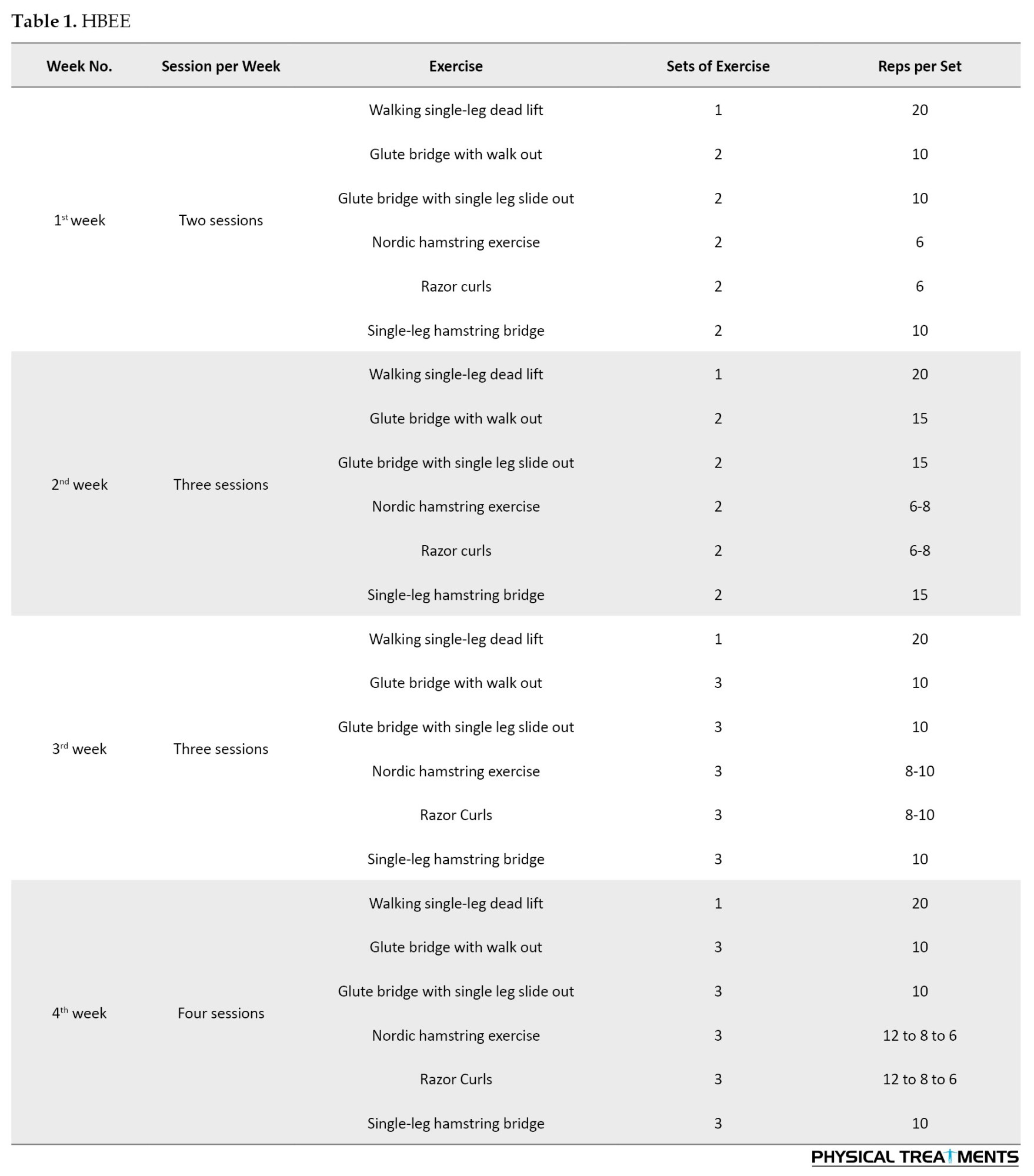
The protocol consisted of six exercises: Walking single-leg deadlift, glute bridge with walk-out, glute bridge with single-leg slide-out, Nordic hamstring exercise, razor curls, and single-leg hamstring bridge. Initially, sets and repetitions were prescribed, which were increased over 4 weeks using the principles of progressive resistance training [30].
Analyzing statistics
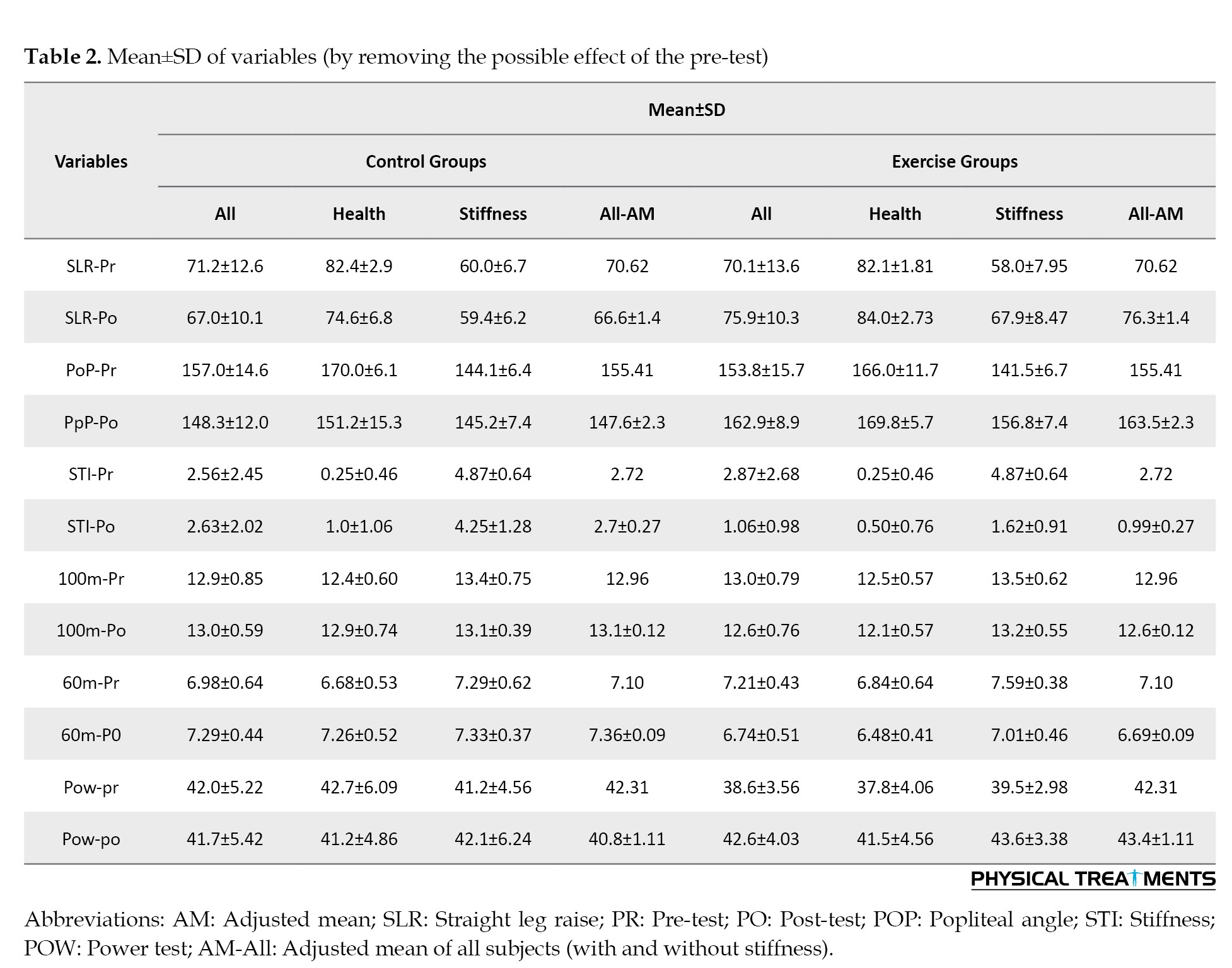
The results of the Shapiro-Wilk test indicated the normality of the data distribution, and the results of Levene’s test indicated the homogeneity of variance of the research variables. To compare the posttest mean changes in the control and exercise groups’ variables, while controlling for the pretest, the analysis of covariance (ANCOVA) was employed (Table 2).
The significance level was set at P=0.05, and statistical analysis was performed using SPSS software, version 26 (SPSS Inc., 2000).
Results
The demographic information for the exercise group included age: 21.50±1.63 years old; height: 176.81±5.54 cm; weight: 70.44±7.54 kg; sprinting background: 6.56±1.51 years; and BMI: 22.51±1.97), and the control group included (age: 22.19±1.68 years old; height: 175.01±6.70 cm; weight: 67.31±7.50 kg; sprinting background: 7.19±1.55 years; and BMI: 21.94±1.74). According to the results of ANCOVA (Table 3), performing four weeks of HBEE by removing the possible effect of the pretest caused a significant improvement (P<0.01), with a large effect size (partial eta squared greater than 0.15), in SLR (from 70.62 to 76.3), popliteal angle (from 155.41 to 163.3), perceived stiffness (from 2.72 to 0.99), 100 m records (from 12.96 to 12.60), and 60 m records (from 7.10 to 6.69), in the training group.
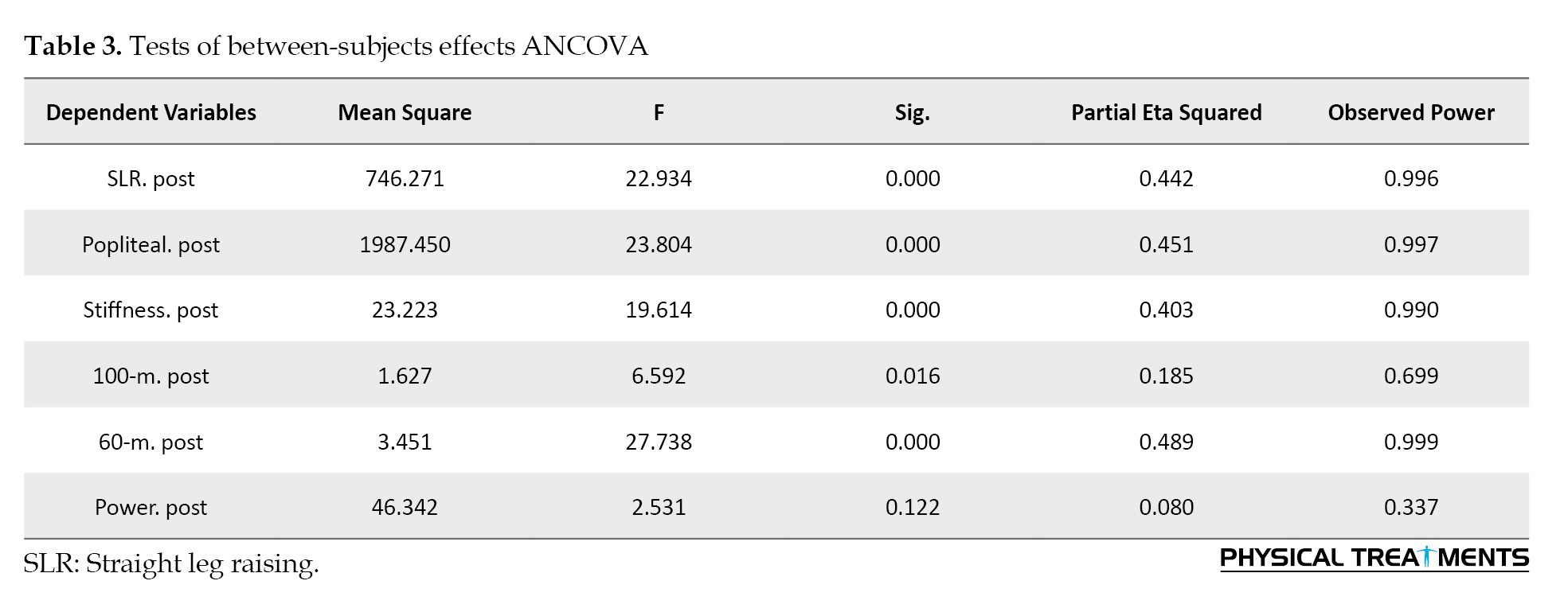
However, due to the non-significance (P=0.122) of the power record changes in the posttest between the two groups (from 42.31 to 43.4), it can be concluded that four weeks of HBEE have no effect on sprinters’ power.
Based on the feasibility results of the HBEE protocol, only one sprinter (international level) was able to perform exercise number five (razor curls). However, both groups (with and without stiffness) were able to perform the other five exercises (Table 4).
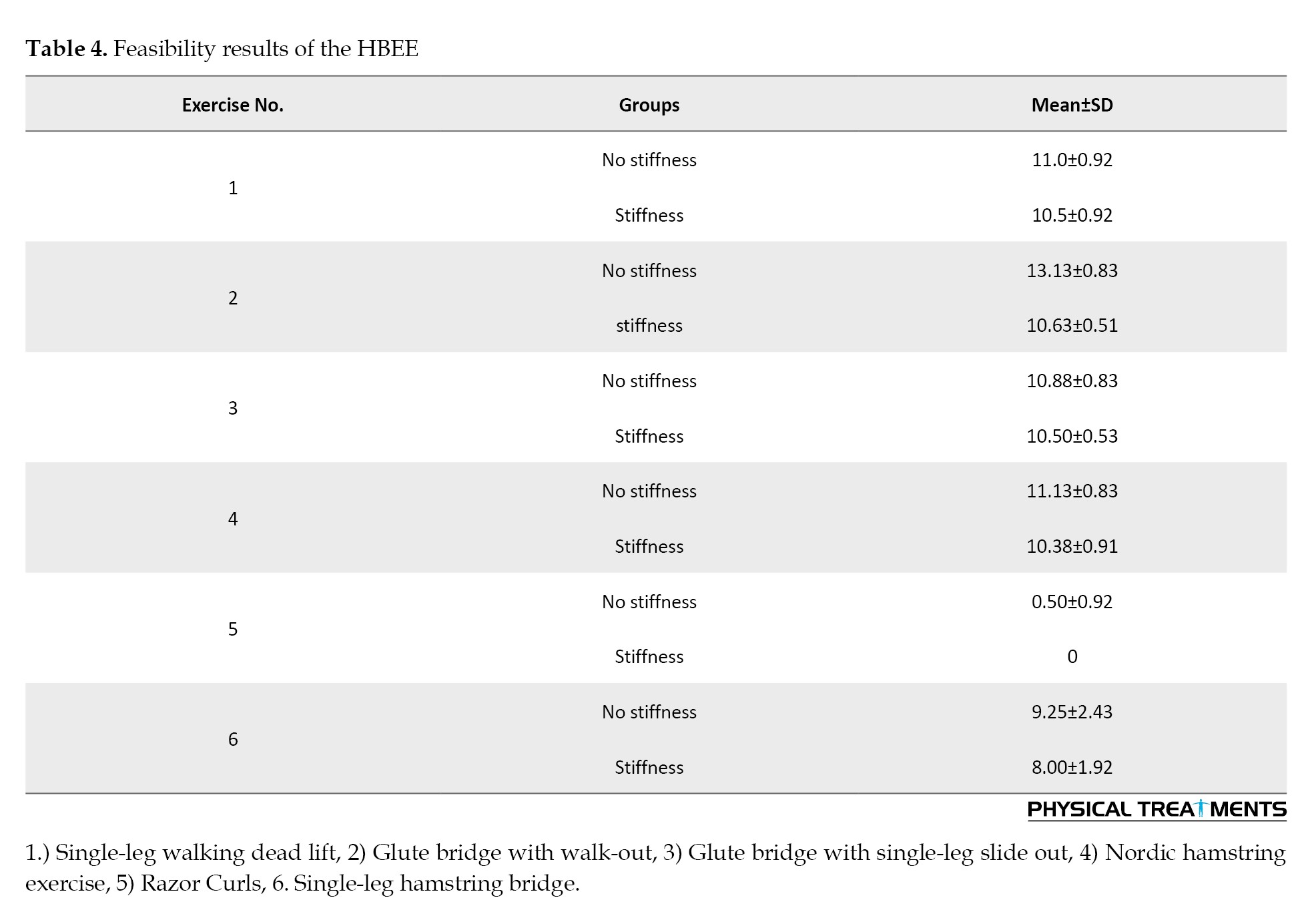
Therefore, it is recommended that the present protocol be modified to include the other five exercises (1-4, 6) for professional and semi-professional sprinters.
Discussion
The research findings showed that, four weeks of HBEE resulted in adjustment of all three risk factors for hamstring injury, that is significant improvement (P<0.01), and 8.37% SLR angle (with stiffness 17.01%, without stiffness 2.28%), 5.93% popliteal angle (with stiffness 9.91%, without stiffness 2.25%), and 63.06% perceived stiffness (with stiffness 69.83%, without stiffness -35.13%). A meta-analysis of 23 randomized controlled trials of 14,721 participants on the effects of eccentric hamstring exercises on injury prevention found that performing these exercises reduced lower limb injuries by 28%, hamstring injuries by 46%, and knee injuries by 34%. The number of sessions performed twice a week was most important, and these exercises were most effective in preventing injuries in elite athletes and adult amateur athletes compared to adolescents [31]. Additionally, a comparison of the effects of eccentric exercise and traditional stretching on hamstring flexibility and strength in healthy young dancers revealed that eccentric exercise significantly enhanced hamstring flexibility and strength, whereas traditional stretching had a more modest effect. Eccentric exercises have greater exercise benefits than traditional stretching exercises [32].
Although there is consensus on the effect of eccentric hamstring exercises on reducing injury risk, previous studies have not examined the effect of HBEE on sprinters, and the participants were healthy and not hamstring-tight. The main objective of the present study was to investigate the effect of four weeks of HBEE on modifying key risk factors for hamstring injury in sprinters with and without hamstring tightness. In the present study, the modifications in SLR and popliteal angle, and perceived stiffness after HBEE training, were attributed to improved range of motion and reduced muscle stiffness in sprinters with hamstring tightness. For example, the significant improvement in SLR was 17.01% in sprinters with tightness, but only 2.28% in sprinters without tightness.
The participants in the present study presented with hamstring tightness and shortness. Shortening of muscle tissue reduces the muscle’s ability to absorb force and increases the risk of injury. It can also contribute to a longer recovery period. In the lower extremities, the hamstring muscles are often tight and short, and this tightness is a key risk factor for hamstring strain [31, 32]. The results of the present study showed that performing eccentric hamstring exercises improved flexibility, range of motion, and hamstring tightness. Stiffness and shortening in the muscle-tendon unit are caused by reduced muscle flexibility and reduced joint range of motion. Eccentric contraction stretches the muscle and gradually creates microtears in the muscle fibers, which are replaced by longer fibers during regeneration, resulting in increased muscle length. It can also help reduce muscle tension and spasms by stimulating blood circulation and releasing trigger points [31, 33]. Performing HBEE can reduce the risk of injury in sprinters by reducing hamstring stiffness and increasing flexibility. Eccentric exercises increase muscle length and reduce muscle tension, thereby increasing joint range of motion [31, 33]. Eccentric exercises increase the number of parallel sarcomeres and, thus, the diameter of the muscle fiber. This increases the total muscle size and the maximum force that the muscle can produce. These exercises cause adaptations in muscle force control by altering the shape of the endomysial collagen fibers at the muscle-tendon junction, thereby reducing the risk of hamstring injury [34].
Another objective of this study was to investigate the effect of 12 HBEE sessions on sprinters’ performance (speed and power) with and without hamstring stiffness. The research findings showed that, despite the lack of a significant effect (P=0.12) on power, four weeks of HBEE significantly improved (P<0.01) the sprint record, 2.77% the 100-meter record (with stiffness 2.29%, without stiffness 3.23%), and 6.51% the 60-meter record (with stiffness 7.64%, without stiffness 5.26%). Therefore, the improvement in sprinting speed following HBEE training is due to the improvement in sprinting speed in both groups of sprinters with and without hamstring tightness. For example, in the significant improvement in the 60-meter running record of the exercise group, the increase in speed for sprinters with stiffness was 7.64%, and without stiffness was 5.26%, and the two were approximately the same. A systematic review of 40 studies on the effects of eccentric training in healthy adults (17 to 35 years old) showed that this exercise improves muscle mechanical function, morphological adaptations, muscle-tendon unit architecture, and is superior to traditional resistance training in improving performance variables related to strength, power, and speed [35]. However, some studies indicate that eccentric exercise does not affect speed or power. For example, performing four weeks (two sessions per week) of eccentric exercises in basketball players had no significant effect on change-of-direction and squat-jump power [36]. The differences between the results of the studies are due to factors, such as sports disciplines, subjects, sport type, sport variables, and measurement methods.
A recent study (2024) found a significant relationship between hamstring flexibility and vertical jump performance among young basketball players. Therefore, the researchers recommended targeted interventions to enhance hamstrings flexibility, improve sports performance and prevent injuries [37]. An investigation of the effect of hamstring stiffness on lower extremity muscle recruitment during jumping maneuvers in 30 male athletes with high and low stiffness showed that the high stiffness group landed with a lower vertical reaction force in the vertical jump [38]. Eccentric exercises primarily target slow-twitch muscle fibers, which play a lesser role in power generation, as power is generated through performing explosive movements in a short time. Eccentric hamstring exercises can improve sprinting performance by enhancing muscle recovery and increasing hip range of motion. Increasing hip range of motion can help increase stride length and, therefore, increase running speed [36]. The vertical jump is a complex movement that requires not only hamstring strength but also coordination and power output from other lower-limb muscles. Performing hamstring exercises alone, without practicing the jumping movement, cannot improve vertical jump performance. To improve vertical jump performance, a comprehensive training program, including various aspects of the movement, such as power output exercises (plyometric jumps and technique improvement exercises), is necessary [37-39]. One of the main factors in increasing force production is the use of the muscle’s shortening cycle to store and release elastic energy. An athlete must be able to fully activate the range of the muscle and use the stretch-shortening cycle for optimal performance; muscle stiffness prevents this mechanism [39]. Overall, the lack of significant effect of these exercises on power requires further investigation, and the nature of the exercises, individual differences, jumping technique, number of training sessions, and the severity of hamstring tightness should be considered. In the present study, four weeks of HBEE resulted in an increase in SLR angle and popliteal angle and a significant decrease in perceived stiffness, especially in sprinters with hamstring stiffness.
Conclusion
Hamstring stiffness is a key risk factor for the most common athletic injury in sprinters (hamstring strain). One of the most effective measures to prevent hamstring strain is eccentric exercise, which reduces the risk by 46%. Based on the results of the present study, performing HBEE for four weeks can reduce hamstring stiffness, especially in sprinters with hamstring stiffness, and improve sprinting performance. These exercises can be performed at home without special sports equipment and can be done as supplementary exercises in the athlete’s free time without overtraining. In addition to reducing hamstring stiffness and improving range of motion, it does not impair athletic performance and even improves sprinting performance. Overall, performing HBEE by targeting the key risk factor for hamstring strain (stiffness and shortness) can be effective in reducing the risk of the most common sports injury in sprinters and minimizing performance impairment and hamstring-related injuries. Given the promising initial findings, coaches and sprinters are recommended to perform HBEE, especially in sprinters with hamstring stiffness.
Study limitations
The small sample size (n=32) limits the generalizability of this study. The subjects of the present study were male sprinters aged 18–25 years. Future research should focus on male sprinters aged 18-25 years. Since 26% of female track and field injuries occur in sprinting, the effect of HBEE on female sprinters should be investigated. Based on a review of the literature, eccentric hamstring exercises reduce the risk of hamstring strain by 46%, and therefore, the long-term effect of HBEE on injury prevention in sprinters should be investigated. Because the present study was short-term (4 weeks), it limits the ability to draw conclusions about injury prevention. Using force plates was difficult for the present authors. However, it is recommended to use a force plate to further understand the effect of HBEE on ground reaction force and lower extremity kinetics. Self-reported adherence to the home program (feasibility Results of the HBEE) may bias results.
Data availability
The responsible author can provide the data used in this article to support the results of the current research, upon request.
Ethical Considerations
Compliance with ethical guidelines
This study was approved by the Ethics Committee of University of Kurdistan, Sanandaj, Iran (Code: IR.UOK.REC.1403.024). In the present study, all ethical principles and rules, such as voluntary participation, anonymity of participants, confidentiality and privacy of information, and the right to participate or withdraw from participation, were observed.
Funding
This article is extracted from master thesis of the Askandar Kakawla A.Alrahim Al-Rughzai, approved by University of Kurdistan.
Authors' contributions
Conceptualization, supervision, methodology, writing the original draft, data analysis, review & editing: Hemn Mohammadi; Data collection and funding administration: Askandar Kakawla A.Alrahim Al-Rughzai; Investigation: All Authors.
Conflict of interest
The authors declared no conflicts of interest.
Acknowledgments
The authors are grateful to all the sprinters who participated as subjects in the present study.
In Olympic track and field, the prevalence of injury is 64% [1, 2]; in track and field, 83%; and in sprinting, 94% of these injuries occur in the lower limb [2]. The most common type of athletic injury is strain, with the highest incidence in sprinting (34%) [1, 2]. Hamstring injuries usually occur during sprinting and eccentric activities [2]. The most common injury in sprints, hurdles, jumps, combined events, and race walking is hamstring strain [3]. In sprinting, almost all injuries occur in the lower limb (92.7%), with about half being muscle injuries (49.0%) and one-third being hamstring strains (33.4%) [4].
Hamstring injuries are caused by multifactorial etiologies. The most crucial modifiable risk factors include increased muscle tension, inadequate warm-up, muscle shortening, strength imbalance in the thigh area, decreased flexibility, muscle tightness, poor posture, history of hamstring or spinal injury, and fatigue. The most important non-modifiable risk factors include race, age, and muscle type [5, 6]. For example, fatigue, by reducing eccentric strength of the knee flexors, leads to a reduced hamstring-to-quadriceps ratio and an increased risk of hamstring injury. Also, a fascicle length shorter than 10.56 cm increases the risk of injury by fourfold, and a previous hamstring injury increases the risk of reinjury by two-to fivefold [6, 7].
Hamstring stiffness is the key risk factor for hamstring injury. A stiffer tendon-muscle unit reduces the ability to produce maximum force and to stretch quickly without injury by changing the length-tension relationship. In the long term, the muscle will exhibit greater resistance to eccentric contractions, which increases the risk of strain [8, 9]. Forty percent of athletes in high-speed sports have hamstring stiffness. High-intensity training, inadequate recovery time, muscle imbalances, and poor flexibility are the main factors contributing to hamstring stiffness. A knee extension angle of less than 160° and a hip flexion of less than 90° is considered hamstring stiffness [9]. Hamstring stiffness can reduce running speed and agility [10], impair thigh muscle efficiency, and increase the risk of hamstring injury in runners [11] and professional ballet dancers [12]. Accordingly, hamstring stiffness is considered a key risk factor for hamstring injury [13].
The two most common mechanisms of hamstring injury are the stretch-type and the sprint-type. The stretch-type occurs during simultaneous intense hip flexion and knee extension, such as when kicking a soccer ball, and the sprint-type occurs during near-maximal sprinting. The stretch-type involves the semimembranosus, and the sprint-type more commonly affects the long head of the biceps femoris [14]. Hamstring strains are often caused by a stretch-type mechanism [15]. However, the most common injury mechanism in sprinting is the sprint-type, and the most common injury site is the long head of the biceps femoris [16]. In sports, the most common isolated injury is to the long head of the biceps femoris (70%), and the most common hamstring injury sites are the distal third (43%), the anterior third (31%), and the central third (26%) [16].
Hamstring strains are common in high-intensity, high-speed sports, such as sprinting [17]. One of the main challenges of this injury is the high reinjury rate (38%) [18]. The amount of absence from an adult athlete per hamstring injury is 17 to 90 days [7], and 21 days in younger athletes [19]. In men’s soccer teams, the annual occurrence of five to six hamstring injuries is estimated to cost $300,000. In the Primers League Baseball, each hamstring injury costs the team $330,000 (based on the average salary of league players and 30 days of absence) [7]. Therefore, prevention of hamstring injuries is essential.
On the one hand, as running speed increases, the biomechanical load from eccentric hamstring contraction also increases. On the other hand, decreased eccentric strength is a key risk factor for hamstring injury. Accordingly, eccentric exercise is an important part of rehabilitation programs, and injury prevention and performance enhancement in speed running sports [20]. Nordic eccentric hamstring training increases eccentric strength and the long head fascicle length of the biceps femoris [21]. Six weeks of eccentric hamstring training improves eccentric strength and passive flexibility [22]. Performing eccentric training, even at a lower volume, has positive effects on strength, hamstring muscle function, and injury prevention, because reduced hamstring stiffness can reduce the risk of hamstring strains during sprinting [23]. Over the last two decades, eccentric exercises have been introduced as an effective intervention for preventing hamstring injuries. However, some sprinters avoid home-based eccentric exercise (HBEE) due to concerns about sports performance impairment, and the effects of HBEE on sprinters with hamstring stiffness remain uninvestigated. Therefore, in the present study, the effect of HBEE on hamstring stiffness and sprinters’ running speed with and without hamstring tightness was investigated.
Materials and Methods
Study design and participants
The present study, which adhered to the guidelines of the Declaration of Helsinki, is considered quasi-experimental research with a pre-test and post-test design. For this reason, examining the effects of an exercise intervention on the problems faced by a specific segment of society is applied research. Based on research background and the results of G*Power sotware, version 3.1 (α=0.05, power [1−β]=0.95, effect size=0.4, groups=2, measurement=6), the sample size was estimated to be 28 subjects. After screening, 32 sprinters were selected from 98 volunteers and randomly divided into two groups of 16 (8 with and 8 without hamstring stiffness). The inclusion criteria for the study included having hamstring stiffness or no stiffness, a normal body mass index (BMI), no history of surgery or serious injury in the past year, no postural abnormalities, such as knee valgus, at least three years of sprinting history, and performing at least three training sessions per week in the past three years. Exclusion criteria included unwillingness to complete the exercise protocol, performing fewer than two exercise sessions per week, missing more than three exercise sessions, and experiencing acute injury during the study.
The exercise group participated in BEE for four weeks, and the control group participated only in the pre-test and post-test. The included sample was relatively homogeneous because only sprinters were recruited. Before measurements, consent forms and a personal information record form were provided. Subjects were fully informed about the study, including the research process, benefits, goals, and potential problems. To minimize assessment bias, assessors were blinded to group allocation.
The pre-test and post-test assessments (described in the assessment tests section) were administered after 21 Dynamic warm-up exercises, and six stretching exercises (gastrocnemius, standing adductor, supine gluteus, lunge rotation or hip flexor, seated hamstring, standing quadriceps) [24]. The order of the tests in both sessions was randomized. To ensure the best accuracy in the assessments, subjects were asked to follow the instructions on the pre-test and post-test day, including: no eating two hours before testing, maintain normal hydration status before and during testing procedures, void completely before the assessment, please wear appropriate clothing for the assessments, no exercise 12 hours before testing, no alcohol consumption 48 hours before testing, no caffeine 12 hours before testing, no diuretic medications seven days before testing.
Assessment tests
Sprint test (100 m, 60 m)
Sprints were assessed using 100 m and 60 m sprint tests. The athlete was instructed to run from the starting line to the finish line at maximum speed and in the shortest possible time. Time was recorded, according to the athlete’s record [25, 26].
Power test (vertical jump)
A vertical jump test was used to assess power. The athletes stood sideways to a wall, raised one arm as high as possible, and touched the wall at its highest point. He then immediately jumped as high as possible and touched the highest point of the wall. The difference between the two points and the best record of three attempts was recorded as the score [27].
Straight leg raise (SLR) test
The athlete was placed in the supine position with the hips and knees straight. The nondominant hip is restrained with a belt to prevent flexion. The athlete slowly flexes and raises the hip of the dominant leg as far as possible, keeping the knee straight and the non-dominant leg straight on the table. The angle of displacement is measured using a standard goniometer [28].
Popliteal angle test
To measure the popliteal angle, bony landmarks of the lateral malleolus, lateral epicondyle, and greater trochanter of the hip were used. The athlete was positioned as in the straight leg raising (SLR) test, with the nondominant leg also restrained. Initially, the dominant leg was passively flexed at the hip and knee at a 90-90 degree angle, and a vertical barrier blocked the hip. Then, the examiner extended the leg until firm resistance was felt or the subjects reported maximum stiffness in the posterior aspect of the hip, without pain. The amount of angle displaced was recorded as the popliteal angle [28].
Perceived stiffness test
Standard visual analogue scale for stiffness. The athlete was asked to mark with a pencil the point corresponding to the perceived level of hamstring stiffness during the SLR test (0=no stiffness and 10=maximum stiffness), and the value was recorded in millimeters [29].
Intervention HBEE
Athletes in the exercise group met with another researcher to familiarize themselves with the intervention program, which they performed unsupervised at home after the pretest. During these four weeks, participants submitted a log of the exercises they performed after each session (Table 1).
The protocol consisted of six exercises: Walking single-leg deadlift, glute bridge with walk-out, glute bridge with single-leg slide-out, Nordic hamstring exercise, razor curls, and single-leg hamstring bridge. Initially, sets and repetitions were prescribed, which were increased over 4 weeks using the principles of progressive resistance training [30].
Analyzing statistics
The results of the Shapiro-Wilk test indicated the normality of the data distribution, and the results of Levene’s test indicated the homogeneity of variance of the research variables. To compare the posttest mean changes in the control and exercise groups’ variables, while controlling for the pretest, the analysis of covariance (ANCOVA) was employed (Table 2).
The significance level was set at P=0.05, and statistical analysis was performed using SPSS software, version 26 (SPSS Inc., 2000).
Results
The demographic information for the exercise group included age: 21.50±1.63 years old; height: 176.81±5.54 cm; weight: 70.44±7.54 kg; sprinting background: 6.56±1.51 years; and BMI: 22.51±1.97), and the control group included (age: 22.19±1.68 years old; height: 175.01±6.70 cm; weight: 67.31±7.50 kg; sprinting background: 7.19±1.55 years; and BMI: 21.94±1.74). According to the results of ANCOVA (Table 3), performing four weeks of HBEE by removing the possible effect of the pretest caused a significant improvement (P<0.01), with a large effect size (partial eta squared greater than 0.15), in SLR (from 70.62 to 76.3), popliteal angle (from 155.41 to 163.3), perceived stiffness (from 2.72 to 0.99), 100 m records (from 12.96 to 12.60), and 60 m records (from 7.10 to 6.69), in the training group.
However, due to the non-significance (P=0.122) of the power record changes in the posttest between the two groups (from 42.31 to 43.4), it can be concluded that four weeks of HBEE have no effect on sprinters’ power.
Based on the feasibility results of the HBEE protocol, only one sprinter (international level) was able to perform exercise number five (razor curls). However, both groups (with and without stiffness) were able to perform the other five exercises (Table 4).
Therefore, it is recommended that the present protocol be modified to include the other five exercises (1-4, 6) for professional and semi-professional sprinters.
Discussion
The research findings showed that, four weeks of HBEE resulted in adjustment of all three risk factors for hamstring injury, that is significant improvement (P<0.01), and 8.37% SLR angle (with stiffness 17.01%, without stiffness 2.28%), 5.93% popliteal angle (with stiffness 9.91%, without stiffness 2.25%), and 63.06% perceived stiffness (with stiffness 69.83%, without stiffness -35.13%). A meta-analysis of 23 randomized controlled trials of 14,721 participants on the effects of eccentric hamstring exercises on injury prevention found that performing these exercises reduced lower limb injuries by 28%, hamstring injuries by 46%, and knee injuries by 34%. The number of sessions performed twice a week was most important, and these exercises were most effective in preventing injuries in elite athletes and adult amateur athletes compared to adolescents [31]. Additionally, a comparison of the effects of eccentric exercise and traditional stretching on hamstring flexibility and strength in healthy young dancers revealed that eccentric exercise significantly enhanced hamstring flexibility and strength, whereas traditional stretching had a more modest effect. Eccentric exercises have greater exercise benefits than traditional stretching exercises [32].
Although there is consensus on the effect of eccentric hamstring exercises on reducing injury risk, previous studies have not examined the effect of HBEE on sprinters, and the participants were healthy and not hamstring-tight. The main objective of the present study was to investigate the effect of four weeks of HBEE on modifying key risk factors for hamstring injury in sprinters with and without hamstring tightness. In the present study, the modifications in SLR and popliteal angle, and perceived stiffness after HBEE training, were attributed to improved range of motion and reduced muscle stiffness in sprinters with hamstring tightness. For example, the significant improvement in SLR was 17.01% in sprinters with tightness, but only 2.28% in sprinters without tightness.
The participants in the present study presented with hamstring tightness and shortness. Shortening of muscle tissue reduces the muscle’s ability to absorb force and increases the risk of injury. It can also contribute to a longer recovery period. In the lower extremities, the hamstring muscles are often tight and short, and this tightness is a key risk factor for hamstring strain [31, 32]. The results of the present study showed that performing eccentric hamstring exercises improved flexibility, range of motion, and hamstring tightness. Stiffness and shortening in the muscle-tendon unit are caused by reduced muscle flexibility and reduced joint range of motion. Eccentric contraction stretches the muscle and gradually creates microtears in the muscle fibers, which are replaced by longer fibers during regeneration, resulting in increased muscle length. It can also help reduce muscle tension and spasms by stimulating blood circulation and releasing trigger points [31, 33]. Performing HBEE can reduce the risk of injury in sprinters by reducing hamstring stiffness and increasing flexibility. Eccentric exercises increase muscle length and reduce muscle tension, thereby increasing joint range of motion [31, 33]. Eccentric exercises increase the number of parallel sarcomeres and, thus, the diameter of the muscle fiber. This increases the total muscle size and the maximum force that the muscle can produce. These exercises cause adaptations in muscle force control by altering the shape of the endomysial collagen fibers at the muscle-tendon junction, thereby reducing the risk of hamstring injury [34].
Another objective of this study was to investigate the effect of 12 HBEE sessions on sprinters’ performance (speed and power) with and without hamstring stiffness. The research findings showed that, despite the lack of a significant effect (P=0.12) on power, four weeks of HBEE significantly improved (P<0.01) the sprint record, 2.77% the 100-meter record (with stiffness 2.29%, without stiffness 3.23%), and 6.51% the 60-meter record (with stiffness 7.64%, without stiffness 5.26%). Therefore, the improvement in sprinting speed following HBEE training is due to the improvement in sprinting speed in both groups of sprinters with and without hamstring tightness. For example, in the significant improvement in the 60-meter running record of the exercise group, the increase in speed for sprinters with stiffness was 7.64%, and without stiffness was 5.26%, and the two were approximately the same. A systematic review of 40 studies on the effects of eccentric training in healthy adults (17 to 35 years old) showed that this exercise improves muscle mechanical function, morphological adaptations, muscle-tendon unit architecture, and is superior to traditional resistance training in improving performance variables related to strength, power, and speed [35]. However, some studies indicate that eccentric exercise does not affect speed or power. For example, performing four weeks (two sessions per week) of eccentric exercises in basketball players had no significant effect on change-of-direction and squat-jump power [36]. The differences between the results of the studies are due to factors, such as sports disciplines, subjects, sport type, sport variables, and measurement methods.
A recent study (2024) found a significant relationship between hamstring flexibility and vertical jump performance among young basketball players. Therefore, the researchers recommended targeted interventions to enhance hamstrings flexibility, improve sports performance and prevent injuries [37]. An investigation of the effect of hamstring stiffness on lower extremity muscle recruitment during jumping maneuvers in 30 male athletes with high and low stiffness showed that the high stiffness group landed with a lower vertical reaction force in the vertical jump [38]. Eccentric exercises primarily target slow-twitch muscle fibers, which play a lesser role in power generation, as power is generated through performing explosive movements in a short time. Eccentric hamstring exercises can improve sprinting performance by enhancing muscle recovery and increasing hip range of motion. Increasing hip range of motion can help increase stride length and, therefore, increase running speed [36]. The vertical jump is a complex movement that requires not only hamstring strength but also coordination and power output from other lower-limb muscles. Performing hamstring exercises alone, without practicing the jumping movement, cannot improve vertical jump performance. To improve vertical jump performance, a comprehensive training program, including various aspects of the movement, such as power output exercises (plyometric jumps and technique improvement exercises), is necessary [37-39]. One of the main factors in increasing force production is the use of the muscle’s shortening cycle to store and release elastic energy. An athlete must be able to fully activate the range of the muscle and use the stretch-shortening cycle for optimal performance; muscle stiffness prevents this mechanism [39]. Overall, the lack of significant effect of these exercises on power requires further investigation, and the nature of the exercises, individual differences, jumping technique, number of training sessions, and the severity of hamstring tightness should be considered. In the present study, four weeks of HBEE resulted in an increase in SLR angle and popliteal angle and a significant decrease in perceived stiffness, especially in sprinters with hamstring stiffness.
Conclusion
Hamstring stiffness is a key risk factor for the most common athletic injury in sprinters (hamstring strain). One of the most effective measures to prevent hamstring strain is eccentric exercise, which reduces the risk by 46%. Based on the results of the present study, performing HBEE for four weeks can reduce hamstring stiffness, especially in sprinters with hamstring stiffness, and improve sprinting performance. These exercises can be performed at home without special sports equipment and can be done as supplementary exercises in the athlete’s free time without overtraining. In addition to reducing hamstring stiffness and improving range of motion, it does not impair athletic performance and even improves sprinting performance. Overall, performing HBEE by targeting the key risk factor for hamstring strain (stiffness and shortness) can be effective in reducing the risk of the most common sports injury in sprinters and minimizing performance impairment and hamstring-related injuries. Given the promising initial findings, coaches and sprinters are recommended to perform HBEE, especially in sprinters with hamstring stiffness.
Study limitations
The small sample size (n=32) limits the generalizability of this study. The subjects of the present study were male sprinters aged 18–25 years. Future research should focus on male sprinters aged 18-25 years. Since 26% of female track and field injuries occur in sprinting, the effect of HBEE on female sprinters should be investigated. Based on a review of the literature, eccentric hamstring exercises reduce the risk of hamstring strain by 46%, and therefore, the long-term effect of HBEE on injury prevention in sprinters should be investigated. Because the present study was short-term (4 weeks), it limits the ability to draw conclusions about injury prevention. Using force plates was difficult for the present authors. However, it is recommended to use a force plate to further understand the effect of HBEE on ground reaction force and lower extremity kinetics. Self-reported adherence to the home program (feasibility Results of the HBEE) may bias results.
Data availability
The responsible author can provide the data used in this article to support the results of the current research, upon request.
Ethical Considerations
Compliance with ethical guidelines
This study was approved by the Ethics Committee of University of Kurdistan, Sanandaj, Iran (Code: IR.UOK.REC.1403.024). In the present study, all ethical principles and rules, such as voluntary participation, anonymity of participants, confidentiality and privacy of information, and the right to participate or withdraw from participation, were observed.
Funding
This article is extracted from master thesis of the Askandar Kakawla A.Alrahim Al-Rughzai, approved by University of Kurdistan.
Authors' contributions
Conceptualization, supervision, methodology, writing the original draft, data analysis, review & editing: Hemn Mohammadi; Data collection and funding administration: Askandar Kakawla A.Alrahim Al-Rughzai; Investigation: All Authors.
Conflict of interest
The authors declared no conflicts of interest.
Acknowledgments
The authors are grateful to all the sprinters who participated as subjects in the present study.
References
- Lambert C, Ritzmann R, Akoto R, Lambert M, Pfeiffer T, Wolfarth B, et al. Epidemiology of injuries in olympic sports. Sportverletz Sportschaden. 2024; 38(1):18-26. [DOI:10.1055/a-2036-8166] [PMID]
- Lambert C, Reinert N, Stahl L, Pfeiffer T, Wolfarth B, Lachmann D, Shafizadeh S, Ritzmann R. Epidemiology of injuries in track and field athletes: A cross-sectional study of specific injuries based on time loss and reduction in sporting level. Physician and Sportsmedicine. 2022; 50(1):20-29. [DOI:10.1080/00913847.2020.1858701] [PMID]
- Edouard P, Navarro L, Branco P, Gremeaux V, Timpka T, Junge A. Injury frequency and characteristics (location, type, cause and severity) differed significantly among athletics ('track and field') disciplines during 14 international championships (2007-2018): Implications for medical service planning. British Journal of Sports Medicine. 2020; 54(3):159-67. [DOI:10.1136/bjsports-2019-100717] [PMID]
- Edouard P. Epidemiology of injury complaints in elite sprinting athletes in athletics (track and field). Applied Sciences. 2023; 13(14):8105. [DOI:10.3390/app13148105]
- Liu, H, Garrett WE, Moorman CT,Yu B. Injury rate, mechanism, and risk factors of hamstring strain injuries in sports: A review of the literature. Journal of Sport and Health Science. 2012; 1(2):92-101. [DOI:10.1016/j.jshs.2012.07.003]
- Wing C, Bishop C. Hamstring strain injuries: Incidence, mechanisms, risk factors, and training recommendations. Strength & Conditioning Journal. 2020. 42(3):40-57. [DOI:10.1519/SSC.0000000000000538]
- Silvers-Granelli HJ, Cohen M, Espregueira-Mendes J, Mandelbaum B. Hamstring muscle injury in the athlete: state of the art. Journal of ISAKOS. 2021; 6(3):170-81. [DOI:10.1136/jisakos-2017-000145] [PMID]
- Clark RA. Hamstring injuries: risk assessment and injury prevention. Annals Academy of Medicine Singapore. 2008; 37(4):341. [DOI:10.47102/annals-acadmedsg.V37N4p341]
- Imtiaz R. Association of hamstring tightness with lower extremity injuries in athletes (analytical cross-sectional study). Pakistan Journal of Medical & Health Sciences. 2023; 17(05):575-575. [DOI:10.53350/pjmhs2023175575]
- Encarnación-Martínez A, García-Gallart A, Pérez-Soriano P, Catalá-Vilaplana I, Rizo-Albero J, Sanchis-Sanchis R. Effect of hamstring tightness and fatigue on dynamic stability and agility in physically active young men. Sensors. 2023; 23(3):1633. [DOI:10.3390/s23031633] [PMID]
- Maniar N, Carmichael DS, Hickey JT, Timmins RG, San Jose AJ, Dickson J, et al. Incidence and prevalence of hamstring injuries in field-based team sports: A systematic review and meta-analysis of 5952 injuries from over 7 million exposure hours. British Journal of Sports Medicine. 2023; 57(2):109-16. [DOI:10.1136/bjsports-2021-104936] [PMID]
- Sobrino FJ, Guillén P. Overuse injuries in professional ballet: Influence of age and years of professional practice. Orthopaedic Journal of sports medicine. 2017; 5(6):2325967117712704. [DOI:10.1177/2325967117712704] [PMID]
- Freckleton G, Pizzari T. Risk factors for hamstring muscle strain injury in sport: A systematic review and meta-analysis. British Journal of Sports Medicine. 2013; 47(6):351-8. [DOI:10.1136/bjsports-2011-090664] [PMID]
- Huygaerts S, Cos F, Cohen DD, Calleja-González J, Guitart M, Blazevich AJ, et al. Mechanisms of hamstring strain injury: Interactions between fatigue, muscle activation and function. Sports. 2020; 8(5):65. [DOI:10.3390/sports8050065] [PMID]
- Mendiguchia J, Alentorn-Geli E, Brughelli M. Hamstring strain injuries: Are we heading in the right direction? British Journal of Sports Medicine. 2012; 46(2):81-5. [DOI:10.1136/bjsm.2010.081695] [PMID]
- Pollock N, Kelly S, Lee J, Stone B, Giakoumis M, Polglass G, et al. A 4-year study of hamstring injury outcomes in elite track and field using the British Athletics rehabilitation approach. British Journal of Sports Medicine. 2022; 56(5):257-63. [DOI:10.1136/bjsports-2020-103791] [PMID]
- Agopyan A. Hamstring flexibility is not correlated with isokinetic knee muscle strength in female modern dancers. Medical Problems of Performing Artists. 2018; 33(2):95-101. [DOI:10.21091/mppa.2018.2016] [PMID]
- Shamji R, James SLJ, Botchu R, Khurniawan KA, Bhogal G, Rushton A. Association of the British Athletic Muscle Injury Classification and anatomic location with return to full training and reinjury following hamstring injury in elite football. BMj Open Sport & Exercise Medicine. 2021; 7(2):e001010. [DOI:10.1136/bmjsem-2020-001010] [PMID]
- Poudel B, Pandey S. Hamstring injury. Treasure Island: StatPearls Publishing; 2025. [Link]
- Giakoumis M, Pollock N, Mias E, McAleer S, Kelly S, Brown F, et al. Eccentric hamstring strength in elite track and field athletes on the British Athletics world class performance program. Physical Therapy in Sport. 2020; 43:217-23. [DOI:10.1016/j.ptsp.2020.03.008] [PMID]
- Medeiros DM, Marchiori C, Baroni BM. Effect of nordic hamstring exercise training on knee flexors eccentric strength and fascicle length: A systematic review and meta-analysis. Journal of Sport Rehabilitation. 2020; 30(3):482-91. [DOI:10.1123/jsr.2019-0388] [PMID]
- Delvaux F, Schwartz C, Decréquy T, Devalckeneer T, Paulus J, Bornheim S, et al. Influence of a field hamstring eccentric training on muscle strength and flexibility. International Journal of Sports Medicine. 2020; 41(4):233-41. [DOI:10.1055/a-1073-7809] [PMID]
- Cuthbert M, Ripley N, McMahon JJ, Evans M, Haff GG, Comfort P. Reply to: "Comment on: The effect of nordic hamstring exercise intervention volume on eccentric strength and muscle architecture adaptations: A systematic review and meta-analyses. Sports Medicine. 2020; 50(1):223-5. [DOI:10.1007/s40279-019-01245-z] [PMID]
- Biener E. The effect of different warm-up protocols on speed and agility [master thesis]. Chapel Hill: University of North Carolina; 2007. [Link]
- Purwanto P, Lumintuarso R, Burhaein E. Impact of running techniques through the sprint ability in athletes during the COVID-19 pandemic. International Journal of Human Movement and Sports Sciences. 2021; 9(4):717-24. [DOI:10.13189/saj.2021.090416]
- Washif JA, Kok LY. Relationships between vertical jump metrics and sprint performance, and qualities that distinguish between faster and slower sprinters. Journal of Science in Sport and Exercise. 2022; 4(2):135-44. [DOI:10.1007/s42978-021-00122-4]
- Nieto-Acevedo R. Exploring the Relationship between vertical jump and short sprint performance in female basketball players. Applied Sciences. 2025; 15(9):4868. [DOI:10.3390/app15094868]
- Liu H, Shen Y, Xiong Y, Zhou H, Mao Y, Shen Q, et al. Psychometric properties of four common clinical tests for assessing hamstring flexibility in young adults. Frontiers in Physiology. 2022; 13:911240. [DOI:10.3389/fphys.2022.911240] [PMID]
- Fereydounnia S, Shadmehr A, Salemi P, Amiri S. Comparison of ROM, perceived tightness, and kinetic variables during balance, walking, and running tasks in athletes with and without hamstring tightness using sensor insoles. Sport Sciences for Health. 2022; 18:897–903. [DOI:10.1007/s11332-021-00873-1]
- Anderson ML. Efficacy and feasibility of an eccentric biased home exercise program on hamstring strength [master thesis]. Toledo: University of Toledo; 2022. [Link]
- Hu C, Du Z, Tao M, Song Y. Effects of different hamstring eccentric exercise programs on preventing lower extremity injuries: A systematic review and meta-analysis. International Journal of Environmental Research and Public Health, 2023. 20(3):2057. [DOI:10.3390/ijerph20032057] [PMID]
- Liang F, Hongfeng H, Ying Z. The effects of eccentric training on hamstring flexibility and strength in young dance students. Scientific Reports. 2024; 14(1):3692. [DOI:10.1038/s41598-024-53987-0] [PMID]
- Rudisill SS, Varady NH, Kucharik MP, Eberlin CT, Martin SD. Evidence-based hamstring injury prevention and risk factor management: A systematic review and meta-analysis of randomized controlled trials. The American Journal of Sports Medicine. 2023; 51(7):1927-42. [DOI:10.1177/03635465221083998] [PMID]
- Seagrave RA 3rd, Perez L, McQueeney S, Toby EB, Key V, Nelson JD. Preventive effects of eccentric training on acute hamstring muscle injury in professional baseball. Orthopaedic Journal of Sports Medicine. 2014; 2(6):2325967114535351. [DOI:10.1177/2325967114535351] [PMID]
- Douglas J, Pearson S, Ross A, McGuigan M. Chronic adaptations to eccentric training: A systematic review. Sports Medicine. 2017; 47(5):91741. [DOI:10.1007/s40279-016-0628-4] [PMID]
- Brien J, Browne D, Earls D. The effects of different types of eccentric overload training on strength, speed, power and change of direction in female basketball players. Journal of Functional Morphology and Kinesiology. 2020; 5(3):50. [DOI:10.3390/jfmk5030050] [PMID]
- Genç H, Demircioğlu G. The effect of hamstring shortness on vertical jump and balance performance in youth amateur basketball players. Sport Sciences for Health. 2024; 20(4):1263-9. [DOI:10.1007/s11332-024-01202-y]
- Jankaew A, Jan YK, Hwang IS, Kuo LC, Lin CF. Hamstring muscle stiffness affects lower extremity muscle recruitment and landing forces during double-legs vertical jump. Sports Biomechanics. 2025; 24(4):1096-114. [DOI:10.1080/14763141.2023.2219670] [PMID]
- Bazett-Jones DM, Gibson MH, McBride JM. Sprint and vertical jump performances are not affected by six weeks of static hamstring stretching. Journal of Strength and Conditioning Research. 2008; 22(1):25-31. [DOI:10.1519/JSC.0b013e31815f99a4] [PMID]
Type of Study: Research |
Subject:
Sport injury and corrective exercises
Received: 2025/06/12 | Accepted: 2025/10/7 | Published: 2026/04/1
Received: 2025/06/12 | Accepted: 2025/10/7 | Published: 2026/04/1
Send email to the article author
| Rights and permissions | |
 |
This work is licensed under a Creative Commons Attribution-NonCommercial 4.0 International License. |

This is an open access article distributed under the terms of the Creative Commons Attribution-NonCommercial 4.0 (CC-By-NC 4.0), which permits use, distribution, and reproduction in any medium, provided the original work is properly cited and is not used for commercial purposes.
Contact Information