Tue, Sep 29, 2026
Volume 16, Issue 2 (Spring 2026)
PTJ 2026, 16(2): 173-180 |
Back to browse issues page



Download citation:
BibTeX | RIS | EndNote | Medlars | ProCite | Reference Manager | RefWorks
Send citation to:


BibTeX | RIS | EndNote | Medlars | ProCite | Reference Manager | RefWorks
Send citation to:
Karimi S, Sahebozamani M. Online-supervised Corrective and Core Stability Exercises in Taekwondo Athletes With Low Back Pain. PTJ 2026; 16 (2) :173-180
URL: http://ptj.uswr.ac.ir/article-1-721-en.html
URL: http://ptj.uswr.ac.ir/article-1-721-en.html

1- Department of Sport Sciences, Kish International Campus, University of Tehran, Kish, Iran.
2- Department of Sports Pathology and Corrective Movements, Faculty of Physical Education and Sports Sciences, Bahonar University of Kerman, Kerman, Iran.
2- Department of Sports Pathology and Corrective Movements, Faculty of Physical Education and Sports Sciences, Bahonar University of Kerman, Kerman, Iran.
Keywords: Core stability exercises, Trunk muscle endurance, Physical therapy, Exercise therapy, Pain management
Full-Text [PDF 486 kb]
(930 Downloads)
| Abstract (HTML) (2474 Views)
References
Full-Text: (428 Views)
Introduction
Chronic non-specific low back pain (CNSLBP) remains one of the most common musculoskeletal issues globally, impacting individuals’ daily lives and physical functionality [1]. Athletes experience low back pain at different rates, ranging from 1% to 94% [2]. This condition can significantly affect athletes by increasing pain levels. Athletes with low back pain often report significant functional impairment and reduced quality of life [3]. Additionally, low back pain is associated with diminished trunk muscle strength, endurance, and flexibility, which may inhibit athletic performance, elevate the risk of injury, and prolong recovery times [4, 5]. Low back pain can significantly increase pain, provoke fear of movement, and reduce athletic performance [6]. This condition is primarily caused by core muscular imbalance and neurological dysfunction, resulting in decreased proprioception and impaired control [7, 8].
Among various treatment options, exercise therapy is considered one of the most effective and widely used methods [2, 9]. Coulombe et al. (2017) found that core stability exercises led to more significant improvements in pain levels, disability scores, and trunk muscle endurance compared to general exercises in participants with chronic low back pain over the 6-week period [10]. According to previous studies, improving core strength and stability can lower pain severity and improve performance in athletes with low back pain [11-13]. While several studies suggest that core stability exercises positively impact pain and performance, few have specifically examined their effects in Taekwondo athletes.
The National academy of sports medicine (NASM) emphasizes corrective exercises for muscle imbalances and movement dysfunctions [14]. The NASM method includes stability exercises focusing on deep core muscles to maintain spinal stability and reduce pain by improving core muscle strength and neuromuscular control [15]. Lee et al. (2021) [16] found that NASM core exercises enhanced activation of distal upper and lower extremity muscles, which could potentially reduce injury risk and improve performance. Moreover, a study comparing the effectiveness of NASM and postural restoration institute exercises in males with low back pain discovered significant enhancements in both pain levels and functional impairment among all the groups; however, no particular method was considered to be superior [17].
Although NASM-based corrective exercise programs and stability exercises demonstrate potential for managing chronic low back pain in athletes, there is limited research specifically examining their impact on pain management, fear of movement, and athletic performance in Taekwondo athletes with chronic low back pain. This underscores the necessity for further exploration in this field. Additionally, the global COVID-19 pandemic has highlighted the need for remote training and rehabilitation. Online supervision of exercise programs ensures proper technique, adherence, and personalized adjustments through remote guidance from experts [3, 18, 19].
Research on the effectiveness of core stability and NASM-based exercises under online supervision to treat CNSLBP in elite Taekwondo players holds potential for the area of sports medicine. By successfully addressing biomechanical demands and controlling pain, this research has the potential to establish novel guidelines for athlete-specific rehabilitation. The primary objective of this study was to evaluate the effectiveness of core stability exercises compared to selected NASM exercises with online supervision on pain, fear of movement, and functional performance in elite taekwondo athletes with persistent musculoskeletal discomfort in the lower back. These findings suggest that integrating core stability training into rehabilitation programs may enhance recovery outcomes and performance in athletes dealing with low back pain.
Materials and Methods
This study employed a quasi-experimental, pre-test-post-test design to evaluate the effectiveness of stability exercises and NASM-based exercises on movement performance, fear of movement, and pain in elite taekwondo athletes with CNSLBP. A total of 30 participants were randomly assigned to either an online-supervised NASM exercise group (n=15) or a core stability exercise group (n=15). The participants were elite Taekwondo athletes from Alborz Province, Iran, each diagnosed with CNSLBP. From a population of approximately 58,000 Taekwondo practitioners in Alborz Province, thirty eligible elite athletes were selected.
The inclusion criteria included a clinical diagnosis of CNSLBP lasting more than 3 months, confirmed by a physician [20], black belt status with more than 3 years of sports experience, ages between 20–30 years, a pain score of ≥4 on the visual analogue scale (VAS), and no history of spinal surgery, fractures, or neurological, inflammatory, or congenital disorders [20, 21]. The exclusion criteria included specific low back pain or any identifiable pain on MRI, underlying medical conditions, history of any spinal surgery, expressed unwillingness to continue participation in the study, a history of irregular training participation [20].
Intervention groups
Participants were divided into two groups: NASM intervention and [2] core stability intervention. This group performed NASM-based corrective exercises designed to address muscle imbalances and improve core stability. The program followed NASM’s four-stage approach: Inhibition, lengthening, activation, and integration [14, 17]. The program consisted of three sessions per week, each lasting 60 minutes, over an 8-week period. Sessions were conducted online with real-time supervision to ensure proper technique and adherence.
Online supervised stability exercises group: This group engaged in stability exercises aimed at strengthening the core and improving trunk muscle endurance. The exercise protocol aims to improve core stability and muscle strength through targeted exercises, including knee-flexion crunches, side planks, superman exercises, knee-bent lifts, supine bridges, full body planks, isometric extensions, squat exercises, and stability drills on a Swiss ball [22]. The stability training protocol also consisted three 45-minute sessions per week for eight weeks. All sessions were conducted online using the platform Jitsi Meet and were supervised in real-time by a trained instructor. After completing this 8-week program, a post-test was administered to all participants, followed by a follow-up test after 3 months of no training (under conditions similar to the pre-test), and the results were recorded.
Outcome measures
Severity of discomfort was determined using the VAS, a validated tool for assessing pain severity on a scale from 0 (no pain) to 10 (worst possible pain). The VAS is highly reliable and valid for pain assessment, with intraclass correlation coefficients (ICC) often exceeding 0.9 [23].
The tampa scale for kinesiophobia (TSK), an 11-item questionnaire used to evaluate fear of movement, was used to quantify fear of movement. Scores ranged from 11 to 44, where higher scores denoted greater anxiety. The ICC for the TSK is 0.90, indicating remarkable test-re-test reliability [24, 25].
Athletic performance was evaluated using the functional movement screen (FMS), which includes seven functional movement tests scored from 0 to 3 (maximum total score of 21, higher scores indicating better movement quality). This test demonstrates acceptable inter-rater and intra-rater reliability coefficients ranging from 0.93 to 0.99 [26]. Specific taekwondo performance tests, including kick accuracy and speed, were measured. Inter-rater reliability for these tests was evaluated implementing statistical approaches, including Cohen’s kappa and ICC. High ICC values (e.g. >0.75) indicate strong agreement among raters, supporting the reliability of the assessments [27].
Data collection methods and instruments
Data collection occurred at two time points: baseline (pre-intervention) and following the completion of the 8-week intervention (post-intervention). Evaluations were conducted using a range of standardized measures, including the VAS pain assessment, the Tampa kinesiophobia questionnaire, and the FMS. These assessments were administered by certified assessors who were blinded to the participants’ group assignments to minimize bias. Additionally, performance in Taekwondo was assessed through tests measuring kick accuracy and speed, quantified using time-based metrics with digital timing tools.
Statistical analysis plan
Data were analyzed using SPSS software, version 26.0. Data characteristics were generated for each variable. Prior to conducting parametric tests, normality of the data was checked via the Shapiro–Wilk test. Changes within each group from pre- to post-training assessments were examined using paired-sample t-tests. To compare mean differences across groups over time, repeated measures analysis of variance (ANOVA) was applied, followed by post-hoc analyses to identify specific between-group contrasts. The effect size of the intervention was estimated with Cohen’s d to interpret the strength of the outcomes. A significance level of P<0.05 was used as the criterion to define statistical significance across all statistical procedures.
Results
A total of thirty elite taekwondo athletes, aged 20–30 years, reporting CNSLBP, were enrolled in the study. Participants were randomly divided into two equal groups: One group performed online supervised NASM exercises (n=15), while the other engaged in online supervised core stability training (n=15). The baseline demographic and clinical profiles, including age, height, weight, pain intensity, and fear of movement, were not significantly different between the groups (Table 1).
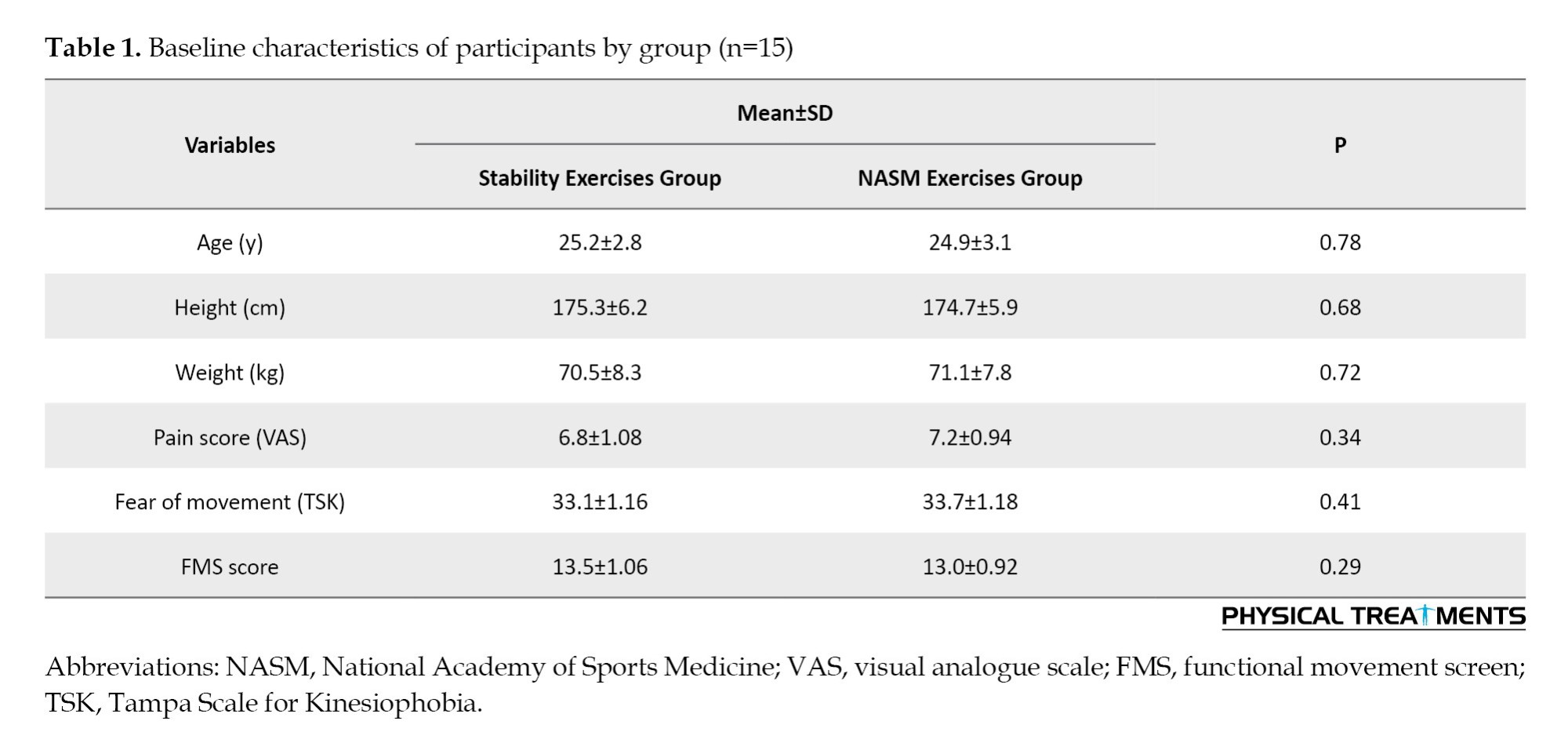
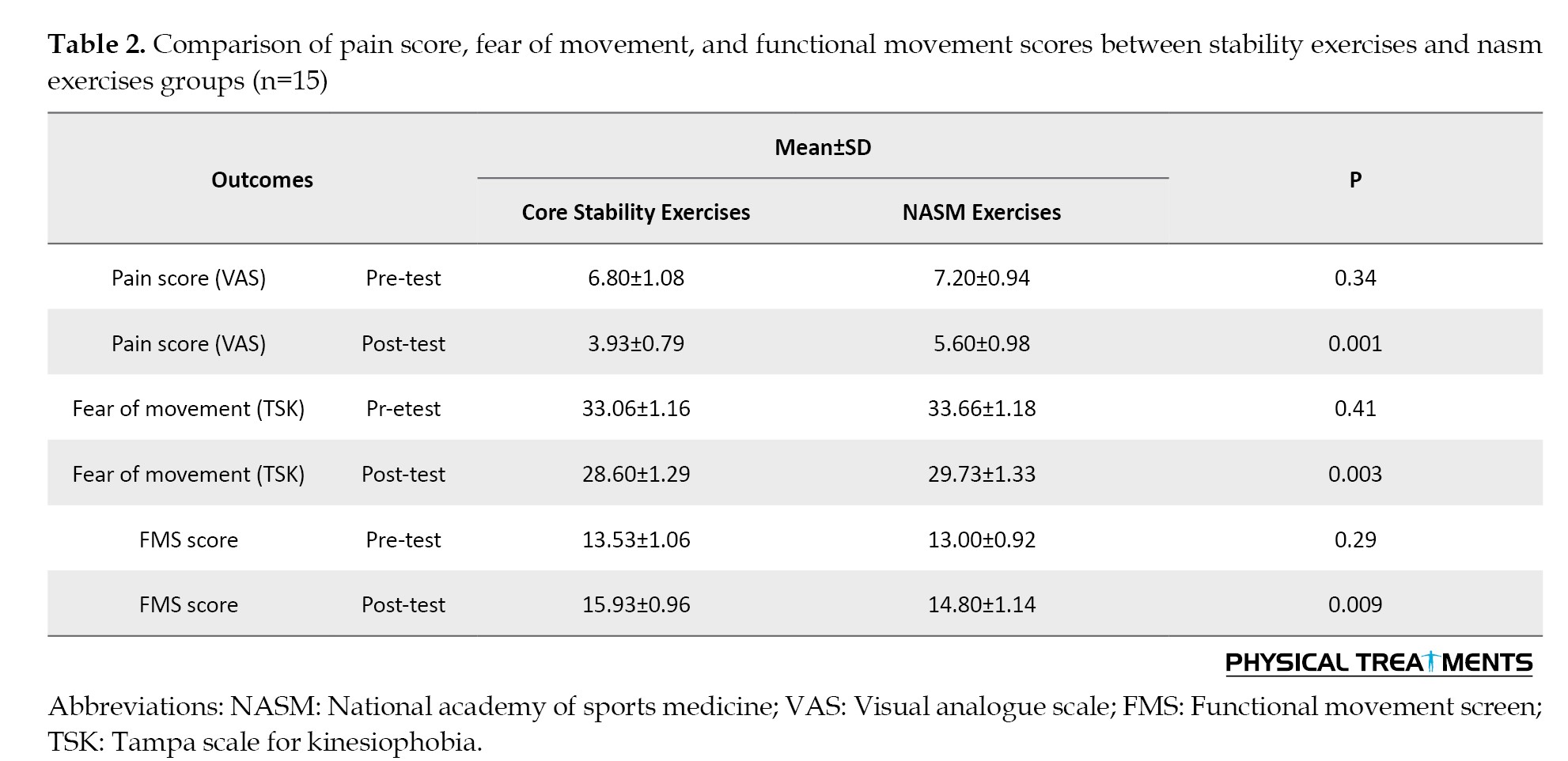
Table 2 presents the descriptive statistics of the pain score, fear of movement, and FMS scores for both the core stability and NASM groups across pre-test and post-test assessments.
Preliminary statistical analysis included assessing data distribution normality with the Shapiro-Wilk test, and the equality of variances was examined using Levene’s test, with both tests indicating no violations of assumptions (P>0.05).
As shown in Table 2, significant improvements were observed in all variables from pre-test to post-test in both groups. However, the improvements were more pronounced in the core stability group compared to the NASM group.
Table 3 presents the statistical findings regarding pain, fear of movement, and functional movement scores.
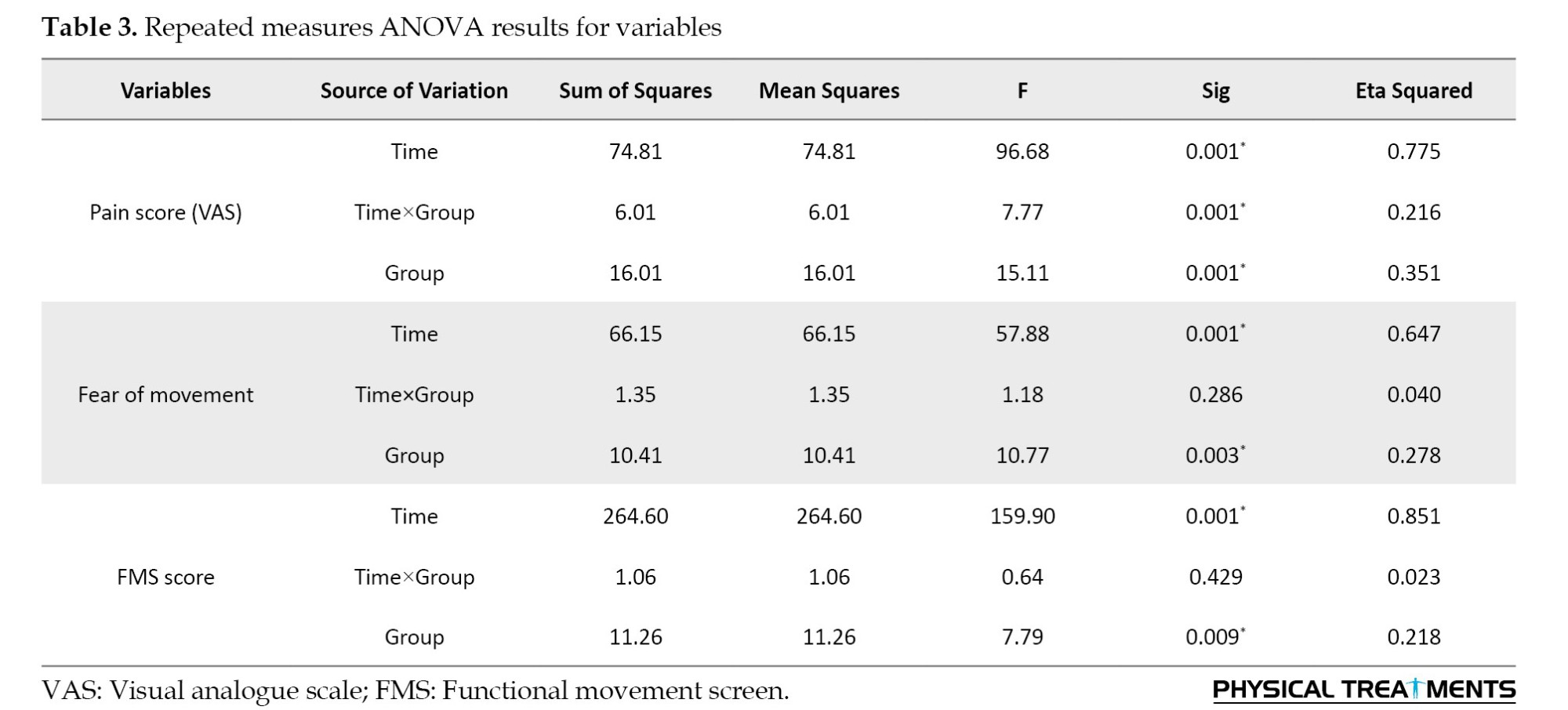
Before analyzing the data, the assumptions required for the statistical analysis were assessed. Box’s test results confirmed the equality of covariance matrices for pain score (P=0.220), fear of movement (P=0.187), and FMS score (P=0.334), indicating that the data met the necessary criteria. The analysis revealed a significant effect of time (P<0.001, η²=0.775), indicating notable changes in pain levels across the study duration. Furthermore, a significant group effect was observed (P<0.001, η²=0.351), showing that participants in the core stability group consistently reported lower pain levels compared to those in the NASM group. However, the interaction effect between time and group was not significant (P=0.286, η²=0.040), suggesting that both groups followed similar trajectories in pain reduction over time.
Main Effect of Time: This effect examines whether dependent variables (e.g. pain, movement performance, fear of movement) change significantly over measurement times.
Main Effect of Group: This assesses differences between the two exercise groups in the dependent variables, averaged over all measurement times. Time×Group Interaction: This examines whether the changes in the dependent variables over time differ between the two exercise groups.
Discussion
This study compared the effects of online-supervised core stability exercises and NASM exercises on pain, fear of movement, and functional performance among elite Taekwondo athletes with CNSLBP. Both interventions significantly improved pain (VAS), fear of movement (TSK), and functional movement (FMS) scores, with greater improvements observed in the core stability group. The improvements in severity of discomfort in low back scores were greater in the core stability group (M=14.93) compared to the NASM group (M=14.06).
The reduction in fear of movement scores in both groups, especially in the practicing core exercise group, highlights the psychological benefits of these exercises. The greater reduction observed in the core stabilization group aligns with findings from Main (2023), who emphasized the importance of addressing psychological factors in pain rehabilitation [28]. Core stability exercises can help athletes overcome their fear of movement, leading to better engagement in training and improved outcomes [29]. The improvements in functional movement scores underscore the role of core stability in enhancing overall functionality. The results indicate that core stability exercises effectively improve these capabilities. A study by Rabiei et al. (2017) has shown similar benefits, supporting the integration of these exercises into training programs for athletes [30].
Additionally, the study revealed that both groups demonstrated reduced pain scores, with the core stability group achieving a greater reduction. This highlights the efficacy of core stability exercises in addressing lower back discomfort (CNSLBP), in line with earlier research by Coulombe et al. (2017) and Stuber et al. (2014) [10, 12]. These data are aligned with the findings of studies conducted Owen et al. (2020) [31], Kanas et al. (2018) [32], Bayattork & Khaledi [33], Eom et al. (2013) [34], which highlighted the beneficial effects of core stability exercises in enhancing movement performance among individuals suffering CNSLBP.
The enhancements in pain levels, functional movement scores, and fear of movement observed in this study primarily stem from the activation of the multifidus, transversus abdominis, and oblique abdominal muscles through core stabilization exercises [35, 36]. These muscles play a vital role in controlling joint movement but can become dysfunctional in individuals with low back pain, resulting in joint impairments and functional disabilities [37]. Retraining these muscles improves proprioception, muscle strength, coordination, and stability, leading to enhanced movement performance in Taekwondo athletes [29, 38-41].
A substantial strength of this research is its focus on elite Taekwondo athletes, addressing a gap in sport-specific rehabilitation research. Its randomized controlled design further adds rigor to the findings. However, the limited sample size may constrain the generalizability of results, and reliance on self-reported measures introduces potential bias. Additionally, while online supervision was practical during the COVID-19 pandemic, it may not fully replicate in-person guidance, potentially impacting technique and adherence. Future efforts should aim to minimize these limitations by increasing the size of sampled populations, employing objective assessments for pain and function, and exploring the long-term impacts of these interventions through longitudinal studies. The findings highlight the effectiveness of both NASM and core stability exercises, particularly under online supervision, as viable strategies for managing CNSLBP in Taekwondo athletes. This underscores the potential of remote training as a flexible and accessible alternative for athletes and coaches, offering expert guidance to support rehabilitation and performance.
Conclusion
This study demonstrates that core stability exercises, particularly under online supervision, effectively alleviate pain, reduce fear of movement, and improve movement performance in elite Taekwondo athletes with CNSLBP. Incorporating these exercises into rehabilitation programs can help manage clinical symptoms and enhance athletic performance.
Ethical Considerations
Compliance with ethical guidelines
Due to COVID-19 restrictions at the time of data collection, formal institutional ethical approval was not obtained; however, all procedures strictly aligned with the ethical framework of the Declaration of Helsinki. Prior to participation, detailed written and verbal information regarding the study’s aims, methods, possible risks, and benefits was communicated to all participants, who subsequently gave written informed consent. Confidentiality was protected, and participants could withdraw at any time without consequences.
Funding
This research was conducted within the framework of a doctoral dissertation at the University of Tehran and without monetary support from any public, commercial, or non-profit funding bodies.This study was undertaken as part of a doctoral study authorized by the Department of Sport Sciences, University of Tehran, Iran.
Authors' contributions
Research design, data collection and analysis, and manuscript draft: Somayeh Karimi; Study design, research process, and critically reviewed and revised the research document: Mansoor Sahebozamani; Final approval: All authors.
Conflict of interest
The authors declared no conflicts of interest.
Acknowledgments
The authors express their profound gratitude for the invaluable guidance and support provided by our late supervisor, Mahdieh Akoochakian, who passed away during the preparation of this manuscript. Her significant influence on our work is evident in the scientific outcomes presented herein. We honor her memory through this research, which stands as a testament to her contributions and mentorship throughout the research and writing process.
Chronic non-specific low back pain (CNSLBP) remains one of the most common musculoskeletal issues globally, impacting individuals’ daily lives and physical functionality [1]. Athletes experience low back pain at different rates, ranging from 1% to 94% [2]. This condition can significantly affect athletes by increasing pain levels. Athletes with low back pain often report significant functional impairment and reduced quality of life [3]. Additionally, low back pain is associated with diminished trunk muscle strength, endurance, and flexibility, which may inhibit athletic performance, elevate the risk of injury, and prolong recovery times [4, 5]. Low back pain can significantly increase pain, provoke fear of movement, and reduce athletic performance [6]. This condition is primarily caused by core muscular imbalance and neurological dysfunction, resulting in decreased proprioception and impaired control [7, 8].
Among various treatment options, exercise therapy is considered one of the most effective and widely used methods [2, 9]. Coulombe et al. (2017) found that core stability exercises led to more significant improvements in pain levels, disability scores, and trunk muscle endurance compared to general exercises in participants with chronic low back pain over the 6-week period [10]. According to previous studies, improving core strength and stability can lower pain severity and improve performance in athletes with low back pain [11-13]. While several studies suggest that core stability exercises positively impact pain and performance, few have specifically examined their effects in Taekwondo athletes.
The National academy of sports medicine (NASM) emphasizes corrective exercises for muscle imbalances and movement dysfunctions [14]. The NASM method includes stability exercises focusing on deep core muscles to maintain spinal stability and reduce pain by improving core muscle strength and neuromuscular control [15]. Lee et al. (2021) [16] found that NASM core exercises enhanced activation of distal upper and lower extremity muscles, which could potentially reduce injury risk and improve performance. Moreover, a study comparing the effectiveness of NASM and postural restoration institute exercises in males with low back pain discovered significant enhancements in both pain levels and functional impairment among all the groups; however, no particular method was considered to be superior [17].
Although NASM-based corrective exercise programs and stability exercises demonstrate potential for managing chronic low back pain in athletes, there is limited research specifically examining their impact on pain management, fear of movement, and athletic performance in Taekwondo athletes with chronic low back pain. This underscores the necessity for further exploration in this field. Additionally, the global COVID-19 pandemic has highlighted the need for remote training and rehabilitation. Online supervision of exercise programs ensures proper technique, adherence, and personalized adjustments through remote guidance from experts [3, 18, 19].
Research on the effectiveness of core stability and NASM-based exercises under online supervision to treat CNSLBP in elite Taekwondo players holds potential for the area of sports medicine. By successfully addressing biomechanical demands and controlling pain, this research has the potential to establish novel guidelines for athlete-specific rehabilitation. The primary objective of this study was to evaluate the effectiveness of core stability exercises compared to selected NASM exercises with online supervision on pain, fear of movement, and functional performance in elite taekwondo athletes with persistent musculoskeletal discomfort in the lower back. These findings suggest that integrating core stability training into rehabilitation programs may enhance recovery outcomes and performance in athletes dealing with low back pain.
Materials and Methods
This study employed a quasi-experimental, pre-test-post-test design to evaluate the effectiveness of stability exercises and NASM-based exercises on movement performance, fear of movement, and pain in elite taekwondo athletes with CNSLBP. A total of 30 participants were randomly assigned to either an online-supervised NASM exercise group (n=15) or a core stability exercise group (n=15). The participants were elite Taekwondo athletes from Alborz Province, Iran, each diagnosed with CNSLBP. From a population of approximately 58,000 Taekwondo practitioners in Alborz Province, thirty eligible elite athletes were selected.
The inclusion criteria included a clinical diagnosis of CNSLBP lasting more than 3 months, confirmed by a physician [20], black belt status with more than 3 years of sports experience, ages between 20–30 years, a pain score of ≥4 on the visual analogue scale (VAS), and no history of spinal surgery, fractures, or neurological, inflammatory, or congenital disorders [20, 21]. The exclusion criteria included specific low back pain or any identifiable pain on MRI, underlying medical conditions, history of any spinal surgery, expressed unwillingness to continue participation in the study, a history of irregular training participation [20].
Intervention groups
Participants were divided into two groups: NASM intervention and [2] core stability intervention. This group performed NASM-based corrective exercises designed to address muscle imbalances and improve core stability. The program followed NASM’s four-stage approach: Inhibition, lengthening, activation, and integration [14, 17]. The program consisted of three sessions per week, each lasting 60 minutes, over an 8-week period. Sessions were conducted online with real-time supervision to ensure proper technique and adherence.
Online supervised stability exercises group: This group engaged in stability exercises aimed at strengthening the core and improving trunk muscle endurance. The exercise protocol aims to improve core stability and muscle strength through targeted exercises, including knee-flexion crunches, side planks, superman exercises, knee-bent lifts, supine bridges, full body planks, isometric extensions, squat exercises, and stability drills on a Swiss ball [22]. The stability training protocol also consisted three 45-minute sessions per week for eight weeks. All sessions were conducted online using the platform Jitsi Meet and were supervised in real-time by a trained instructor. After completing this 8-week program, a post-test was administered to all participants, followed by a follow-up test after 3 months of no training (under conditions similar to the pre-test), and the results were recorded.
Outcome measures
Severity of discomfort was determined using the VAS, a validated tool for assessing pain severity on a scale from 0 (no pain) to 10 (worst possible pain). The VAS is highly reliable and valid for pain assessment, with intraclass correlation coefficients (ICC) often exceeding 0.9 [23].
The tampa scale for kinesiophobia (TSK), an 11-item questionnaire used to evaluate fear of movement, was used to quantify fear of movement. Scores ranged from 11 to 44, where higher scores denoted greater anxiety. The ICC for the TSK is 0.90, indicating remarkable test-re-test reliability [24, 25].
Athletic performance was evaluated using the functional movement screen (FMS), which includes seven functional movement tests scored from 0 to 3 (maximum total score of 21, higher scores indicating better movement quality). This test demonstrates acceptable inter-rater and intra-rater reliability coefficients ranging from 0.93 to 0.99 [26]. Specific taekwondo performance tests, including kick accuracy and speed, were measured. Inter-rater reliability for these tests was evaluated implementing statistical approaches, including Cohen’s kappa and ICC. High ICC values (e.g. >0.75) indicate strong agreement among raters, supporting the reliability of the assessments [27].
Data collection methods and instruments
Data collection occurred at two time points: baseline (pre-intervention) and following the completion of the 8-week intervention (post-intervention). Evaluations were conducted using a range of standardized measures, including the VAS pain assessment, the Tampa kinesiophobia questionnaire, and the FMS. These assessments were administered by certified assessors who were blinded to the participants’ group assignments to minimize bias. Additionally, performance in Taekwondo was assessed through tests measuring kick accuracy and speed, quantified using time-based metrics with digital timing tools.
Statistical analysis plan
Data were analyzed using SPSS software, version 26.0. Data characteristics were generated for each variable. Prior to conducting parametric tests, normality of the data was checked via the Shapiro–Wilk test. Changes within each group from pre- to post-training assessments were examined using paired-sample t-tests. To compare mean differences across groups over time, repeated measures analysis of variance (ANOVA) was applied, followed by post-hoc analyses to identify specific between-group contrasts. The effect size of the intervention was estimated with Cohen’s d to interpret the strength of the outcomes. A significance level of P<0.05 was used as the criterion to define statistical significance across all statistical procedures.
Results
A total of thirty elite taekwondo athletes, aged 20–30 years, reporting CNSLBP, were enrolled in the study. Participants were randomly divided into two equal groups: One group performed online supervised NASM exercises (n=15), while the other engaged in online supervised core stability training (n=15). The baseline demographic and clinical profiles, including age, height, weight, pain intensity, and fear of movement, were not significantly different between the groups (Table 1).
Table 2 presents the descriptive statistics of the pain score, fear of movement, and FMS scores for both the core stability and NASM groups across pre-test and post-test assessments.
Preliminary statistical analysis included assessing data distribution normality with the Shapiro-Wilk test, and the equality of variances was examined using Levene’s test, with both tests indicating no violations of assumptions (P>0.05).
As shown in Table 2, significant improvements were observed in all variables from pre-test to post-test in both groups. However, the improvements were more pronounced in the core stability group compared to the NASM group.
Table 3 presents the statistical findings regarding pain, fear of movement, and functional movement scores.
Before analyzing the data, the assumptions required for the statistical analysis were assessed. Box’s test results confirmed the equality of covariance matrices for pain score (P=0.220), fear of movement (P=0.187), and FMS score (P=0.334), indicating that the data met the necessary criteria. The analysis revealed a significant effect of time (P<0.001, η²=0.775), indicating notable changes in pain levels across the study duration. Furthermore, a significant group effect was observed (P<0.001, η²=0.351), showing that participants in the core stability group consistently reported lower pain levels compared to those in the NASM group. However, the interaction effect between time and group was not significant (P=0.286, η²=0.040), suggesting that both groups followed similar trajectories in pain reduction over time.
Main Effect of Time: This effect examines whether dependent variables (e.g. pain, movement performance, fear of movement) change significantly over measurement times.
Main Effect of Group: This assesses differences between the two exercise groups in the dependent variables, averaged over all measurement times. Time×Group Interaction: This examines whether the changes in the dependent variables over time differ between the two exercise groups.
Discussion
This study compared the effects of online-supervised core stability exercises and NASM exercises on pain, fear of movement, and functional performance among elite Taekwondo athletes with CNSLBP. Both interventions significantly improved pain (VAS), fear of movement (TSK), and functional movement (FMS) scores, with greater improvements observed in the core stability group. The improvements in severity of discomfort in low back scores were greater in the core stability group (M=14.93) compared to the NASM group (M=14.06).
The reduction in fear of movement scores in both groups, especially in the practicing core exercise group, highlights the psychological benefits of these exercises. The greater reduction observed in the core stabilization group aligns with findings from Main (2023), who emphasized the importance of addressing psychological factors in pain rehabilitation [28]. Core stability exercises can help athletes overcome their fear of movement, leading to better engagement in training and improved outcomes [29]. The improvements in functional movement scores underscore the role of core stability in enhancing overall functionality. The results indicate that core stability exercises effectively improve these capabilities. A study by Rabiei et al. (2017) has shown similar benefits, supporting the integration of these exercises into training programs for athletes [30].
Additionally, the study revealed that both groups demonstrated reduced pain scores, with the core stability group achieving a greater reduction. This highlights the efficacy of core stability exercises in addressing lower back discomfort (CNSLBP), in line with earlier research by Coulombe et al. (2017) and Stuber et al. (2014) [10, 12]. These data are aligned with the findings of studies conducted Owen et al. (2020) [31], Kanas et al. (2018) [32], Bayattork & Khaledi [33], Eom et al. (2013) [34], which highlighted the beneficial effects of core stability exercises in enhancing movement performance among individuals suffering CNSLBP.
The enhancements in pain levels, functional movement scores, and fear of movement observed in this study primarily stem from the activation of the multifidus, transversus abdominis, and oblique abdominal muscles through core stabilization exercises [35, 36]. These muscles play a vital role in controlling joint movement but can become dysfunctional in individuals with low back pain, resulting in joint impairments and functional disabilities [37]. Retraining these muscles improves proprioception, muscle strength, coordination, and stability, leading to enhanced movement performance in Taekwondo athletes [29, 38-41].
A substantial strength of this research is its focus on elite Taekwondo athletes, addressing a gap in sport-specific rehabilitation research. Its randomized controlled design further adds rigor to the findings. However, the limited sample size may constrain the generalizability of results, and reliance on self-reported measures introduces potential bias. Additionally, while online supervision was practical during the COVID-19 pandemic, it may not fully replicate in-person guidance, potentially impacting technique and adherence. Future efforts should aim to minimize these limitations by increasing the size of sampled populations, employing objective assessments for pain and function, and exploring the long-term impacts of these interventions through longitudinal studies. The findings highlight the effectiveness of both NASM and core stability exercises, particularly under online supervision, as viable strategies for managing CNSLBP in Taekwondo athletes. This underscores the potential of remote training as a flexible and accessible alternative for athletes and coaches, offering expert guidance to support rehabilitation and performance.
Conclusion
This study demonstrates that core stability exercises, particularly under online supervision, effectively alleviate pain, reduce fear of movement, and improve movement performance in elite Taekwondo athletes with CNSLBP. Incorporating these exercises into rehabilitation programs can help manage clinical symptoms and enhance athletic performance.
Ethical Considerations
Compliance with ethical guidelines
Due to COVID-19 restrictions at the time of data collection, formal institutional ethical approval was not obtained; however, all procedures strictly aligned with the ethical framework of the Declaration of Helsinki. Prior to participation, detailed written and verbal information regarding the study’s aims, methods, possible risks, and benefits was communicated to all participants, who subsequently gave written informed consent. Confidentiality was protected, and participants could withdraw at any time without consequences.
Funding
This research was conducted within the framework of a doctoral dissertation at the University of Tehran and without monetary support from any public, commercial, or non-profit funding bodies.This study was undertaken as part of a doctoral study authorized by the Department of Sport Sciences, University of Tehran, Iran.
Authors' contributions
Research design, data collection and analysis, and manuscript draft: Somayeh Karimi; Study design, research process, and critically reviewed and revised the research document: Mansoor Sahebozamani; Final approval: All authors.
Conflict of interest
The authors declared no conflicts of interest.
Acknowledgments
The authors express their profound gratitude for the invaluable guidance and support provided by our late supervisor, Mahdieh Akoochakian, who passed away during the preparation of this manuscript. Her significant influence on our work is evident in the scientific outcomes presented herein. We honor her memory through this research, which stands as a testament to her contributions and mentorship throughout the research and writing process.
References
- Hoy D, Bain C, Williams G, March L, Brooks P, Blyth F, et al. A systematic review of the global prevalence of low back pain. Arthritis and Rheumatism. 2012; 64(6):2028-37. [DOI:10.1002/art.34347] [PMID]
- van Middelkoop M, Rubinstein SM, Verhagen AP, Ostelo RW, Koes BW, van Tulder MW. Exercise therapy for chronic nonspecific low-back pain. Best Practice & Research Clinical Rheumatology. 2010; 24(2):193-204. [DOI:10.1016/j.berh.2010.01.002] [PMID]
- Zamani E, Kordi R, Nourian R, Noorian N, Memari AH, Shariati M. Low back pain functional disability in athletes; conceptualization and initial development of a questionnaire. Asian Journal of Sports Medicine. 2014; 5(4):e24281. [DOI:10.5812/asjsm.24281] [PMID]
- Azevedo VD, Silva RMF, Borges SCC, Fernandes M, Miñana-Signes V, Monfort-Pañego M, et al. Evaluation instruments for assessing back pain in athletes: A systematic review protocol. Healthcare. 2020; 8(4):574. [DOI:10.3390/healthcare8040574] [PMID]
- Lamoth CJ, Meijer OG, Daffertshofer A, Wuisman PI, Beek PJ. Effects of chronic low back pain on trunk coordination and back muscle activity during walking: Changes in motor control. European Spine Journal. 2006; 15(1):23-40. [DOI:10.1007/s00586-004-0825-y] [PMID]
- Mueller S, Mueller J, Stoll J, Cassel M, Hirschmüller A, Mayer F. Back pain in adolescent athletes: Results of a biomechanical screening. Sports Medicine International Open. 2017; 1(1):E16-e22. [DOI:10.1055/s-0042-122713] [PMID]
- Van Tiggelen D, Wickes S, Stevens V, Roosen P, Witvrouw E. Effective prevention of sports injuries: a model integrating efficacy, efficiency, compliance and risk-taking behaviour. British Journal of Sports Medicine. 2008; 42(8):648-52. [DOI:10.1136/bjsm.2008.046441] [PMID]
- Smith BE, Littlewood C, May S. An update of stabilisation exercises for low back pain: A systematic review with meta-analysis. BMC Musculoskeletal Disorders. 2014; 15(1):416. [DOI: 10.1186/1471-2474-15-416] [PMID]
- Kahere M, Hlongwa M, Ginindza TG. A scoping review on the epidemiology of chronic low back pain among adults in Sub-Saharan Africa. International Journal of Environmental Research and Public Health. 2022; 19(5):2964. [DOI:10.3390/ijerph19052964] [PMID]
- Coulombe BJ, Games KE, Neil ER, Eberman LE. Core stability exercise versus general exercise for chronic low back pain. J Athl Train. 2017; 52(1):71-2. [DOI:10.4085/1062-6050-51.11.16] [PMID]
- Brumagne S, Cordo P, Lysens R, Verschueren S, Swinnen S. The role of paraspinal muscle spindles in lumbosacral position sense in individuals with and without low back pain. Spine. 2000; 25(8):989-94. [DOI:10.1097/00007632-200004150-00015] [PMID]
- Stuber KJ, Bruno P, Sajko S, Hayden JA. Core stability exercises for low back pain in athletes: A systematic review of the literature. Clinical Journal of Sport Medicine. 2014; 24(6):448-56. [DOI:10.1097/JSM.0000000000000081] [PMID]
- Wang XQ, Zheng JJ, Yu ZW, Bi X, Lou SJ, Liu J, et al. A meta-analysis of core stability exercise versus general exercise for chronic low back pain. Plos One. 2012; 7(12):e52082. [DOI:10.1371/journal.pone.0052082] [PMID]
- Clark M, Lucett S. NASM essentials of corrective exercise training. Philadelphia: Lippincott Williams & Wilkins; 2010. [Link]
- Lusk CB. The impact of stability exercises on core muscle imbalances and subsequent low back pain. Auburn: Auburn University; 2021. [Link]
- Lee B, McGill S. The effect of core training on distal limb performance during ballistic strike manoeuvres. Journal of Sports Sciences. 2017; 35(18):1-13. [DOI:10.1080/02640414.2016.1236207] [PMID]
- Fazel F, Zolaktaf V, Nezhadian SL. The effect of exercise programs on pain management and motor control in patients with nonspecific chronic low back pain: A randomized matched subjects trial. International Journal of Preventive Medicine. 2021; 12:164. [DOI:10.4103/ijpvm.IJPVM_423_20] [PMID]
- Vincent F, Deluche E, Bonis J, Leobon S, Antonini M-T, Laval C, et al. Home-based physical activity in patients with breast cancer: During and/or after chemotherapy? Impact on cardiorespiratory fitness. A 3-arm randomized controlled trial (APAC). Integrative Cancer Therapies. 2020; 19:1534735420969818. [DOI:10.1177/1534735420969818] [PMID]
- Andrioti A, Papadopetraki A, Maridaki M, Philippou A. The effect of a home-based tele-exercise training program on the quality of life and physical performance in breast cancer survivors. Sports. 2023; 11(5):102. [DOI:10.3390/sports11050102] [PMID]
- Amundsen PA, Evans DW, Rajendran D, Bright P, Bjørkli T, Eldridge S, et al. Inclusion and exclusion criteria used in non-specific low back pain trials: A review of randomised controlled trials published between 2006 and 2012. BMC Musculoskeletal Disorders. 2018; 19:1-13. [DOI:10.1186/s12891-018-2034-6] [PMID]
- Zhai J, Liu AF, Yu W, Guo T. Baduanjin exercise for chronic non-specific low back pain: Protocol for a series of N-of-1 trials. BMJ Open. 2023; 13(11):e070703. [DOI:10.1136/bmjopen-2022-070703]
- Gheitasi M, Khaledi A, Daneshjoo A. The effect of combined core stability and sensory-motor exercises on pain, performance and movement fear in retired male athletes with non-specific chronic low back pain. Journal of Anesthesiology and Pain. 2020; 11(1):38-48. [Link]
- Khaledi A, Gheitasi M. Isometric vs isotonic core stabilization exercises to improve pain and disability in patients with non-specific chronic low back pain: A randomized controlled trial. Anesthesia and Pain Medicine. 2024; 14(1):e144046. [DOI:10.5812/aapm-144046]
- Huang H, Nagao M, Arita H, Shiozawa J, Nishio H, Kobayashi Y, et al. Reproducibility, responsiveness and validation of the Tampa Scale for Kinesiophobia in patients with ACL injuries. Health and Quality of Life Outcomes. 2019; 17:1-8. [PMID]
- Mendes LP, Fidelis-de-Paula-Gomes CA, Pontes-Silva A, Barreto FS, Pinheiro JS, da Silva ACB, et al. Tampa scale for kinesiophobia in chronic neck pain patients (TSK-neck): Structural and construct validity and reliability in a Brazilian population. BMC Musculoskeletal Disorders. 2024; 25(1):151. [PMID]
- Asgari M, Alizadeh S, Sendt A, Jaitner T. Evaluation of the Functional Movement Screen (FMS) in identifying active females who are prone to injury. A systematic review. Sports Medicine-Open. 2021; 7:1-10. [DOI:10.1186/s40798-021-00380-0] [PMID]
- Aloui A, Tayech A, Mejri MA, Makhlouf I, Clark CCT, Granacher U, et al. Reliability and validity of a new taekwondo-specific change-of-direction speed test with striking techniques in elite taekwondo athletes: A pilot study. Frontiers in Physiology. 2022; 13:774546. [DOI:10.3389/fphys.2022.774546] [PMID]
- Main CJ, Ballengee LA, George SZ, Beneciuk JM, Greco CM, Simon CB. Psychologically informed practice: The importance of communication in clinical implementation. Physical Therapy. 2023; 103(7):1. [DOI:10.1093/ptj/pzad047] [PMID]
- Huxel Bliven KC, Anderson BE. Core stability training for injury prevention. Sports Health. 2013; 5(6):514-22. [DOI:10.1177/1941738113481200] [PMID]
- Rabiei P, Namin BG, Nasermelli MH, Marjomaki O, Mazloum V. The effects of functional training on pain, function, and performance in taekwondo players with mechanical low back pain. Health. 2017; 9(8):1176-89. [DOI:10.4236/health.2017.98085]
- Owen PJ, Miller CT, Mundell NL, Verswijveren S, Tagliaferri SD, Brisby H, et al. Which specific modes of exercise training are most effective for treating low back pain? Network meta-analysis. British Journal of Sports Medicine. 2020; 54(21):1279-87. [DOI:10.1136/bjsports-2019-100886] [PMID]
- Kanas M, Faria RS, Salles LG, Sorpreso ICE, Martins DE, Cunha RAD, et al. Home-based exercise therapy for treating non-specific chronic low back pain. Revista da Associação Médica Brasileira. 2018; 64(9):824-31. [DOI:10.1590/1806-9282.64.09.824] [PMID]
- Bayattork M, Khaledi A. Is online exercise at home more effective than hydrotherapy and physiotherapy in patients with non-specific chronic low back pain? A randomized clinical trial. PTJ. 2022; 12(1):51-60. [DOI:10.32598/ptj.12.1.517.1]
- Eom MY, Chung SH, Ko TS. Effects of bridging exercise on different support surfaces on the transverse abdominis. The Journal of Physical Therapy Science. 2013; 25(10):1343-6. [DOI:10.1589/jpts.25.1343] [PMID]
- Akhtar MW, Karimi H, Gilani SA. Effectiveness of core stabilization exercises and routine exercise therapy in management of pain in chronic non-specific low back pain: A randomized controlled clinical trial. Pakistan Journal of Medical Sciences. 2017; 33(4):1002-6. [DOI:10.12669/pjms.334.12664] [PMID]
- Huang L, Liu H, Zhao L, Peng L. The effect of exercise intervention based upon the selective functional movement assessment in an athlete with non-specific low back pain: A case report and pilot study. Frontiers in Psychology. 2020; 11:2010. [DOI:10.3389/fpsyg.2020.02010] [PMID]
- Lynders C. The critical role of development of the transversus abdominis in the prevention and treatment of low back pain. HSS Journal. 2019; 15(3):214-20. [DOI:10.1007/s11420-019-09717-8] [PMID]
- Gorji SM, Mohammadi Nia Samakosh H, Watt P, Henrique Marchetti P, Oliveira R. Pain neuroscience education and motor control exercises versus core stability exercises on pain, disability, and balance in women with chronic low back pain. International Journal of Environmental Research and Public Health. 2022; 19(5):1. [DOI:10.3390/ijerph19052694] [PMID]
- Matheve T, Hodges P, Danneels L. The role of back muscle dysfunctions in chronic low back pain: State-of-the-art and clinical implications. Journal of Clinical Medicine. 2023; 12(17):1. [DOI:10.3390/jcm12175510] [PMID]
- Alkhathami K, Alshehre Y, Brizzolara K, Weber M, Wang-Price S. Effectiveness of spinal stabilization exercises on movement performance in adults with chronic low back pain. International Journal of Sports Physical Therapy. 2023; 18(1):169-72. [DOI:10.26603/001c.68024] [PMID]
- Hlaing SS, Puntumetakul R, Khine EE, Boucaut R. Effects of core stabilization exercise and strengthening exercise on proprioception, balance, muscle thickness and pain related outcomes in patients with subacute nonspecific low back pain: A randomized controlled trial. BMC Musculoskeletal Disorders. 2021; 22:1-13. [DOI:10.1186/s12891-021-04858-6] [PMID]
Type of Study: Research |
Subject:
General
Received: 2025/01/7 | Accepted: 2025/09/6 | Published: 2026/04/1
Received: 2025/01/7 | Accepted: 2025/09/6 | Published: 2026/04/1
Send email to the article author
| Rights and permissions | |
 |
This work is licensed under a Creative Commons Attribution-NonCommercial 4.0 International License. |

This is an open access article distributed under the terms of the Creative Commons Attribution-NonCommercial 4.0 (CC-By-NC 4.0), which permits use, distribution, and reproduction in any medium, provided the original work is properly cited and is not used for commercial purposes.
Contact Information