Mon, Oct 26, 2026
Volume 16, Issue 4 ( Autumn 2026)
PTJ 2026, 16(4): 373-382 |
Back to browse issues page



Download citation:
BibTeX | RIS | EndNote | Medlars | ProCite | Reference Manager | RefWorks
Send citation to:


BibTeX | RIS | EndNote | Medlars | ProCite | Reference Manager | RefWorks
Send citation to:
Yousefian Molla R, Ardigò L P, Fatahi A, Khezri D, Pardos E M, Nobari H. Phase Characteristics of Rate of Force Development in Vertical Jump Performance: A Regression-based Analysis. PTJ 2026; 16 (4) :373-382
URL: http://ptj.uswr.ac.ir/article-1-828-en.html
URL: http://ptj.uswr.ac.ir/article-1-828-en.html
Razieh Yousefian Molla1  , Luca Paolo Ardigò2 , Ali Fatahi *1 , Davood Khezri3 , Elena Mainer Pardos4 , Hadi Nobari5
1- Department of Physical Education and Sport Science, CT.C., Islamic Azad University, Tehran, Iran.
2- Department of Physical Education and Sport Sciences, NLA University College, Oslo, Norway.
3- Department of Sport Biomechanics and Technology, Sport Sciences Research Institute, Tehran, Iran.
4- Department of Physical Activity and Sport Sciences, Faculty of Health Sciences, Universidad San Jorge, Zaragoza, Spain.
5- Department of Health and Human Performance, Faculty of Physical Activity and Sport Science, Universidad Politécnica de Madrid, Madrid, Spain.
Full-Text [PDF 526 kb]
(1170 Downloads)
| Abstract (HTML) (1729 Views)
Full-Text: (5 Views)
Introduction
The rate of force development (RFD) refers to how quickly contractile force escalates at the beginning of a muscle contraction [1]. This indicates the capability to exert maximal force in the shortest time frame. It is commonly utilized as a measure of explosive strength [2, 3]. RFD seems to have a stronger correlation with performance specific to sports, is more adept at identifying both acute and chronic alterations in neuromuscular function, and can be influenced by unique physiological processes.
One of the most widely utilized methods for assessing explosive strength is the countermovement jump (CMJ), in which the RFD plays a critical role [4, 5]. Jump height is influenced by many criteria, such as the maximal muscle force, the force-time curve slope, and body segment inter-coordination [5, 6]. The CMJ is often used to evaluate explosive performance in athletes involved in sports that require significant power, such as football, rugby, basketball, Olympic weightlifting, and volleyball [7].
Researchers have explored the link between RFD and CMJ performance in various studies [2, 5]. While some researchers have identified RFD as a key variable in explosive actions, such as the CMJ [8-12], others have reported little to no significant correlation [13, 14]. For instance, Marcora and Miller (2000) [15] found no significant relationship between RFD and CMJ performance during isometric testing in a horizontal squat position. However, the joint angles used in that study (90° and 120°) may have compromised the external validity of the strength assessments. Therefore, isometric strength should be assessed at various angles, allowing participants to adopt more natural and comfortable positions during testing.
Similarly, Kawamori et al. (2006) [16] reported a non-significant association between RFD and CMJ height. However, CMJ height has been widely used as a proxy for evaluating maximal force and power [1, 17, 18]. The validity of this approach has also been questioned [19-23]. Even though earlier efforts have sought to investigate the connection between explosive strength, as measured by RFD, and vertical jump height, there remains limited understanding of how RFD and power fluctuate over time throughout the downward and upward phases of the CMJ—both of which are essential for jump performance. During jumping, the eccentric phase refers to the time starting from the initiation of the downward motion of the center of mass until the hip reaches its lowest position [24].
Methodological constraints in some studies might account for their non-significant findings, such as evaluating RFD and CMJ performance in separate tests, using small sample sizes, or mixing male and female participants—despite their anatomical differences potentially influencing outcomes. Training status may also impact an athlete’s ability to generate high RFD values, with more experienced athletes typically performing better.
Other performance-influencing factors include joint kinetics, countermovement depth, pre-activation, and jumping techniques [25]. For example, greater shoulder flexion at takeoff, increased ankle plantarflexion, or differing involvement of hip versus knee extensors may all play significant roles in CMJ outcomes. Furthermore, Schenau (1989) [26] noted that some athletes may struggle to effectively convert rotational forces generated at the joints into translational forces during the jump, which could negatively affect jump performance. Given the critical importance of jump capacity in various athletic disciplines [27], further investigation is warranted to assess the behavior of RFD and power variables across different phases of jumping and determine whether they significantly correlate with performance. Such insights could help identify the phases and mechanical factors that should be emphasized in training programs aimed at improving jump ability.
No prior research has investigated the association between RFD and CMJ height from the biomechanical viewpoint in the eccentric and concentric phases, utilizing regression-based statistical techniques. Therefore, the purpose of this study was to investigate the relationship between phase-specific RFD and CMJ height during the eccentric and concentric phases of the CMJ. We hypothesized that higher RFD in the eccentric and concentric phases would be positively and phase-dependently associated with CMJ height.
Materials and Methods
This cross-sectional study was conducted in the laboratory of the National Olympic Committee. The study involved 15 male volleyball players (age: 16.0±1.4 years, body mass: 60.5±8.4 kg, height: 1.72±0.06 m), who were all right-leg dominant, as determined by their preferred leg for single-leg takeoff in sport-specific tasks. Leg dominance was used as an inclusion criterion to standardize the tested limb and reduce inter-individual variability; therefore, dominance was not included as a separate factor in the statistical analyses. However, restricting the sample to right-leg dominant athletes may limit the generalizability of our findings to left-leg dominant populations. The number of participants was calculated using G*Power software, version 3.1.9.7 with a statistical power of 0.80, an effect size of 0.80, and a significance level of 0.05 [11]. A large effect size was chosen because previous studies examining the relationships between mechanical variables (e.g. force- and power-related measures) and CMJ performance have typically reported large associations. Therefore, we anticipated a similarly strong relationship between RFD and CMJ height. The participants were recruited via convenience sampling from members of a local national volleyball league team in Iran. All testing sessions were performed on Monday mornings during the summer season to minimize diurnal and seasonal variability.
Participants exhibited robust health without any record of major leg injuries or persistent discomfort. During their research phase, they participated regularly in intensive three-session/week practice, alongside major nationwide events. Participants abstained from strenuous exercise for at least 72 h before testing. They were instructed to maintain their habitual diet and normal hydration status during this period.
Countermovement jump
Participants performed the CMJ on a 1000 Hz Kistler® force plate. Testing was conducted during the pre-season in the same laboratory. Participants stood with feet parallel, heels in contact with the force plate, body aligned parallel to the wall. One arm was extended vertically to mark the highest-reachable point on the wall. Three maximal vertical jumps were performed, with two-minute rest intervals between attempts. Participants performed three CMJs, and only the highest jump height was used for analysis, as an indicator of maximal performance capacity.
Participants underwent a standardized warm-up before testing, which included 10 minutes of self-paced cycling on a cycle ergometer and 5 minutes of dynamic stretching (e.g. hip circles, leg swings, high knees). A separate familiarization session was also completed by participants four days before the testing commenced. Permanent monitoring of appropriate execution of jumping techniques as well as equality of anthropometric parameters was considered through task performance by an experienced volleyball coach.
The force-time data were used to compute the variables for the analysis that followed [16]: Average power (AP), peak power (PP), time to peak power (TPP), maximum rate of force development (MRFD), average RFD (ARFD), and peak RFD (PRFD). Power for each time frame was calculated using the Equation 1 [16]:
1. Pj=Fj×Vj
Where Pi is power, Fi is force, and Vi is velocity.
1) AP (W/kg): Mean power output during each phase, normalized to body mass. 2) PP (W/kg): Maximum power attained during each phase, normalized to body mass. 3) TPP (ms): Time elapsed from phase onset to peak power. 4) MRFD (N/ms/kg): Peak force divided by time from phase onset to peak force, normalized to body mass. 5) ARFD (N/kg/s): Average rate of force development (ARFD) across consecutive time frames within each phase, normalized to body mass. 6) PRFD (N/ms/kg): PRFD within each phase, normalized to body mass.
Force signal analysis
Vertical ground reaction force data were baseline-corrected by subtracting the mean force recorded during a quiet standing period prior to each jump, and then low-pass filtered using a fourth-order zero-lag Butterworth filter (cut-off frequency: 10 Hz). Net vertical force was calculated by subtracting body weight from the filtered signal and dividing by body mass to obtain center of mass acceleration, which was integrated over time using the trapezoidal method to obtain velocity [28]. The force-time signal during the CMJ was segmented into three phases based on the vertical center-of-mass velocity profile, in line with previous CMJ analyses [29-31].
Initiation phase (IP): From the start of movement until the instant of minimum (most negative) vertical velocity, representing the onset of downward motion and initial braking.
Eccentric phase: From the end of the IP (minimum velocity) until velocity returns to zero, corresponding to the remainder of the downward movement in which the musculotendinous system stores elastic energy.
Concentric phase: From the instant velocity becomes positive until takeoff (force
This velocity-based segmentation was chosen because it provides a mechanically meaningful separation of braking and propulsive actions, and has been widely adopted to characterize CMJ phase-specific performance [29-31].
Force and power variables (PRFD, ARFD, MRFD, TPP, PP, and AP) were calculated within each phase. Jump height was estimated using the Equation 2:
2. Jump height=(1/8)×g×ft2.
where g is gravitational acceleration and ft is flight time [32, 33].
Statistical analysis
Pearson product–moment correlation coefficients were calculated to examine the relationships between kinetic and temporal variables (RFD, power, and time) in the eccentric and concentric phases of the CMJ. Simple linear regression analyses were then performed to evaluate the functional relationships between force-related variables and CMJ height. Statistical significance was set at P<0.05. All analyses were conducted using SPSS software, version 23.0 (IBM Corp., Armonk, NY, USA)
Results
Table 1 presents the Pearson correlation coefficients of RFD, power, and time variables.
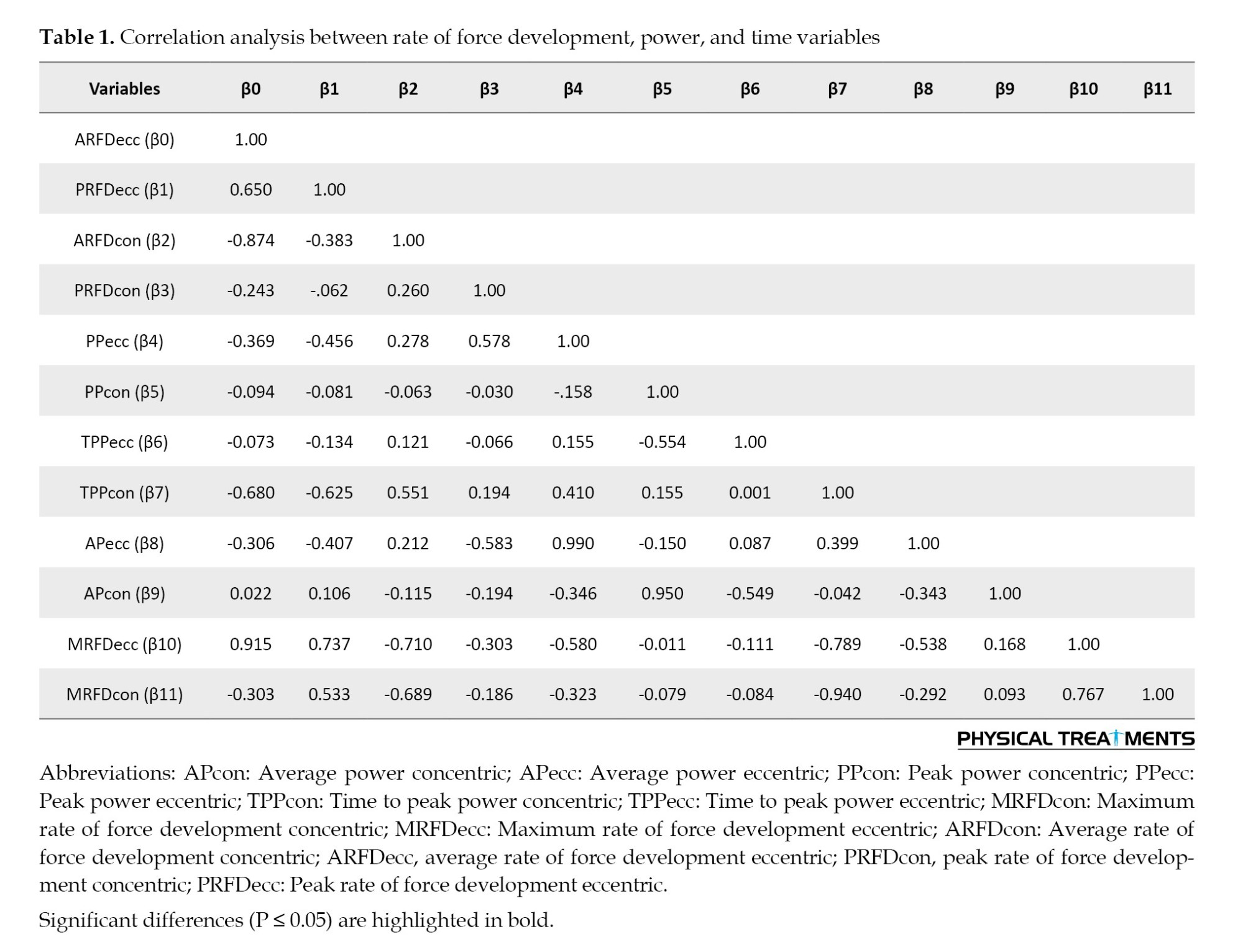
Significant positive correlations were observed between average RFD in the eccentric phase (ARFDecc) and peak RFD eccentric (PRFDecc), as well as between ARFDecc and maximum RFD eccentric (MRFDecc). Conversely, ARFDecc showed a significant negative correlation with average RFD concentric (ARFDcon) and TPP eccentric (TPPecc). PRFDecc was significantly correlated with peak power eccentric (PPecc), TPP concentric (TPPcon), MRFDecc, and maximum RFD concentric (MRFDcon). Additionally, ARFDcon demonstrated significant correlations with TPPcon, MRFDecc, and MRFDcon. Significant associations were also found between PRFDcon and PPecc, as well as between PP eccentric and AP eccentric. TPP concentric showed strong negative correlations with MRFDecc and MRFDcon. Finally, MRFDecc and MRFDcon were positively correlated.
Table 2 presents the results of regression analyses of the relationship between jump height and RFD, power, and timing variables in both eccentric and concentric phases.
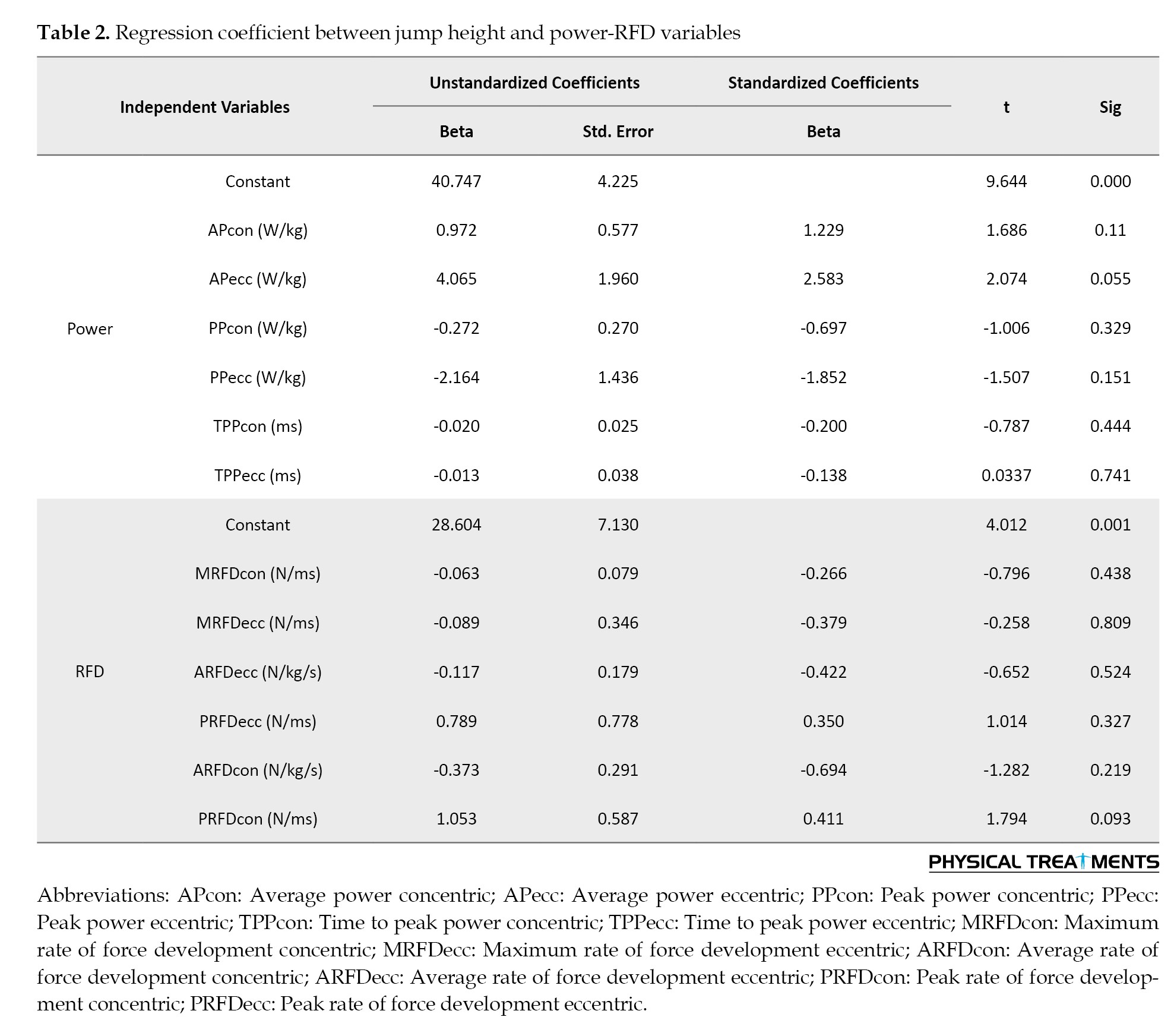
No significant relationships were observed between jump height and any of the force or power variables at the 0.05 significance level. The highest, although non-significant, correlation with jump height was observed for AP during the eccentric phase, while PP during the concentric phase showed the lowest correlation. Regarding RFD variables, peak RFD during the concentric phase showed the strongest association with jump height, whereas average RFD demonstrated the weakest correlation.
Discussion
This study explored the association between RFD and CMJ height in the eccentric and concentric phases of the CMJ. The results showed no significant correlation between force-related variables, including RFD, and jump height in either phase. This finding suggests that RFD alone may not be a reliable indicator of explosive power in athletes. Therefore, RFD data should be interpreted with caution when assessing performance.
Strong correlations were found between several RFD and power variables. For instance, average RFD in the eccentric phase (ARFDecc) correlated significantly with peak PRFDecc, ARFDcon, TPP eccentric (TPPecc), and MRFDecc. Similarly, PRFDecc showed significant correlations with PPecc, TPPcon, MRFDecc, and maximal RFD concentric (MRFDcon). ARFDcon was strongly associated with TPPcon, MRFDecc, and MRFDcon. Additional significant correlations were observed between other power and RFD parameters, indicating complex interrelations among these variables.
Three distinct phases characterize the stretch-shortening cycle (SSC): Eccentric (muscle lengthening), amortization (brief transition), and concentric (muscle shortening) [34]. The eccentric phase reflects an athlete’s ability to transition effectively to concentric action and the stretch experienced by the musculotendinous unit following the countermovement [35, 36]. Power training has been shown to alter this force-time curve component, highlighting its importance for performance monitoring and impulsive ability or “explosiveness” [37, 38].
Despite the crucial role of the eccentric phase in generating explosive muscular contractions, no significant correlations were found between RFD variables and jumping height during this phase in the present study. However, these findings should be interpreted with caution due to the relatively small sample size and narrow age range of the participants, which may limit the statistical power and generalizability of the results. Within these constraints, our observations are consistent with previous research reporting weak or non-significant relationships between RFD and CMJ performance in similar contexts [15, 16, 39]. Kawamori et al. (2006) [16] suggested that the lack of correlation may stem from the tests measuring different abilities and utilizing different contraction types. Likewise, McErlain-Naylor et al. (2014) [25] noted that biomechanical and anthropometric factors—such as peak knee power, takeoff shoulder angle, and peak ankle power—may more strongly influence CMJ performance than RFD. Dowling and Vamos (1993) [39] further argued that some individuals, despite generating high peak forces, may not effectively apply this strength to optimize CMJ performance due to force application patterns. Marcora and Miller (2000) [15] attributed the lack of correlation partly to the joint angle used during CMJ execution.
Several factors may help to explain why RFD did not show a clear association with CMJ height in this cohort. First, CMJ height is strongly influenced by jump technique and intersegmental coordination, and technical proficiency may vary considerably between youth players even when their mechanical capacities are similar. Such between-subject differences in technique could obscure potential relationships between RFD and performance. Second, the participants were mid-adolescent athletes, a developmental stage characterized by rapid growth and maturation-related changes in neuromuscular function. Possible mismatches between neural and morphological development may decouple the association between isolated RFD measures and jump performance. Third, volleyball-specific training in this group may prioritize jump frequency, timing, and tactical execution over maximizing RFD in the specific test condition used here, leading to sport-specific adaptations that do not necessarily translate directly to the RFD metrics obtained in our protocol.
Given these factors, significant correlations between RFD and CMJ performance may only be evident under specific conditions. Thus, RFD might be necessary but insufficient for optimal CMJ performance. Athletes aiming to improve jump ability should complement maximal strength training with exercises targeting the stretch-shortening cycle (SSC).
Anthropometric variables also play a role in vertical jump performance. Previous studies identified weight, shank length, calf circumference, seated height, torso circumference, and thigh length as important predictors in elite male volleyball players [40, 41]. Similarly, Davis et al. (2003) [42] presented significant relationships between jump height and variables, such as foot length, fat percentage, and joint circumferences in amateur athletes. Joint angles further contribute to jump height.
In contrast, several investigations have identified substantial relationships between RFD and CMJ performance. Kochanowicz et al. (2016) and McLellan et al. (2011) [5, 43] demonstrated that both peak RFD and peak force are relevant to CMJ performance. However, McLellan et al. (2011) [5] caution that these findings should be interpreted carefully due to low retest reliability.
In summary, the current findings indicate no significant association between force variables, including RFD, and vertical jump height during CMJ. This suggests that CMJ performance is not solely dependent on contractile force characteristics. Consequently, RFD should not be used as a standalone measure of explosive jump ability in athletes involved in sports requiring high levels of power.
The limitations of this study include the inability to control for extraneous factors, such as athletes’ psychological and nutritional status, which may have influenced the results. Future research should include larger, more diverse samples, considering different age groups and skill levels to enhance external validity. Also, we acknowledge that restricting the sample to right-leg dominant athletes may limit the generalizability of our findings to left-leg dominant populations.
We recommend that future studies explore additional biomechanical parameters associated with CMJ performance in volleyball players, including various jump types, age ranges, and competitive levels, with higher data sampling rates to improve measurement precision.
Conclusion
This study found no significant correlations between force-related variables (RFD, AP, and PP) and jump height in the eccentric and concentric phases of the CMJ in male adolescent volleyball players. Within this specific cohort, these findings suggest that contractile force alone may not be the primary determinant of vertical jump height at the initial phase of muscle action. Instead, non-contractile factors—including anthropometric and biomechanical characteristics—may play a more prominent role in influencing CMJ performance in this population. Accordingly, caution is warranted when using RFD as a sole predictor of explosive power in CMJ among adolescent volleyball players. Furthermore, the small sample size and narrow age range limit the generalizability of these results, underscoring the need for further studies with larger and more diverse athletic populations.
Practical implication
For coaches working with male adolescent volleyball players, the present findings suggest that improving CMJ performance should not focus solely on increasing force-related measures such as RFD, AP, or PP. Instead, training programs may benefit from emphasizing technical and biomechanical aspects of the jump. In practice, this could include targeted work on countermovement depth, timing and coordination of hip–knee–ankle extension, and consistent landing and takeoff positions. Given the limited association between RFD and CMJ height in this cohort, routine monitoring of CMJ performance using simple jump height measures may be more informative for day-to-day decision-making than relying on detailed RFD metrics, especially in youth settings with restricted access to advanced equipment.
Ethical Considerations
Compliance with ethical guidelines
The study was approved by the Ethics Committee of Sport Sciences Research Institute, Tehran, Iran (Code: IR.SSRC.REC.1404.078). Written informed consent was obtained from all participants and their legal guardians in accordance with the Declaration of Helsinki.
Funding
This research did not receive any grant from funding agencies in the public, commercial, or non-profit sectors.
Authors' contributions
Conceptualization: Razieh Yousefian Molla and Ali Fatahi; Methodology: Razieh Yousefian Molla, Ali Fatahi, and Davood Khezri; Analysis: Razieh Yousefian Molla, Ali Fatahi, Luca Paolo Ardigò, Elena Mainer Pardos, Hadi Nobari; Investigation: Razieh Yousefian Molla, Ali Fatahi, and Hadi Nobari; Writing: Razieh Yousefian Molla, Ali Fatahi, Davood Khezri, Luca Paolo Ardigò, Elena Mainer Pardos; Supervision: Razieh Yousefian Molla, Ali Fatahi, Hadi Nobari.
Conflict of interest
The authors declared no conflicts of interest.
Force and power variables (PRFD, ARFD, MRFD, TPP, PP, and AP) were calculated within each phase. Jump height was estimated using the Equation 2:
2. Jump height=(1/8)×g×ft2.
where g is gravitational acceleration and ft is flight time [32, 33].
Statistical analysis
Pearson product–moment correlation coefficients were calculated to examine the relationships between kinetic and temporal variables (RFD, power, and time) in the eccentric and concentric phases of the CMJ. Simple linear regression analyses were then performed to evaluate the functional relationships between force-related variables and CMJ height. Statistical significance was set at P<0.05. All analyses were conducted using SPSS software, version 23.0 (IBM Corp., Armonk, NY, USA)
Results
Table 1 presents the Pearson correlation coefficients of RFD, power, and time variables.
Significant positive correlations were observed between average RFD in the eccentric phase (ARFDecc) and peak RFD eccentric (PRFDecc), as well as between ARFDecc and maximum RFD eccentric (MRFDecc). Conversely, ARFDecc showed a significant negative correlation with average RFD concentric (ARFDcon) and TPP eccentric (TPPecc). PRFDecc was significantly correlated with peak power eccentric (PPecc), TPP concentric (TPPcon), MRFDecc, and maximum RFD concentric (MRFDcon). Additionally, ARFDcon demonstrated significant correlations with TPPcon, MRFDecc, and MRFDcon. Significant associations were also found between PRFDcon and PPecc, as well as between PP eccentric and AP eccentric. TPP concentric showed strong negative correlations with MRFDecc and MRFDcon. Finally, MRFDecc and MRFDcon were positively correlated.
Table 2 presents the results of regression analyses of the relationship between jump height and RFD, power, and timing variables in both eccentric and concentric phases.
No significant relationships were observed between jump height and any of the force or power variables at the 0.05 significance level. The highest, although non-significant, correlation with jump height was observed for AP during the eccentric phase, while PP during the concentric phase showed the lowest correlation. Regarding RFD variables, peak RFD during the concentric phase showed the strongest association with jump height, whereas average RFD demonstrated the weakest correlation.
Discussion
This study explored the association between RFD and CMJ height in the eccentric and concentric phases of the CMJ. The results showed no significant correlation between force-related variables, including RFD, and jump height in either phase. This finding suggests that RFD alone may not be a reliable indicator of explosive power in athletes. Therefore, RFD data should be interpreted with caution when assessing performance.
Strong correlations were found between several RFD and power variables. For instance, average RFD in the eccentric phase (ARFDecc) correlated significantly with peak PRFDecc, ARFDcon, TPP eccentric (TPPecc), and MRFDecc. Similarly, PRFDecc showed significant correlations with PPecc, TPPcon, MRFDecc, and maximal RFD concentric (MRFDcon). ARFDcon was strongly associated with TPPcon, MRFDecc, and MRFDcon. Additional significant correlations were observed between other power and RFD parameters, indicating complex interrelations among these variables.
Three distinct phases characterize the stretch-shortening cycle (SSC): Eccentric (muscle lengthening), amortization (brief transition), and concentric (muscle shortening) [34]. The eccentric phase reflects an athlete’s ability to transition effectively to concentric action and the stretch experienced by the musculotendinous unit following the countermovement [35, 36]. Power training has been shown to alter this force-time curve component, highlighting its importance for performance monitoring and impulsive ability or “explosiveness” [37, 38].
Despite the crucial role of the eccentric phase in generating explosive muscular contractions, no significant correlations were found between RFD variables and jumping height during this phase in the present study. However, these findings should be interpreted with caution due to the relatively small sample size and narrow age range of the participants, which may limit the statistical power and generalizability of the results. Within these constraints, our observations are consistent with previous research reporting weak or non-significant relationships between RFD and CMJ performance in similar contexts [15, 16, 39]. Kawamori et al. (2006) [16] suggested that the lack of correlation may stem from the tests measuring different abilities and utilizing different contraction types. Likewise, McErlain-Naylor et al. (2014) [25] noted that biomechanical and anthropometric factors—such as peak knee power, takeoff shoulder angle, and peak ankle power—may more strongly influence CMJ performance than RFD. Dowling and Vamos (1993) [39] further argued that some individuals, despite generating high peak forces, may not effectively apply this strength to optimize CMJ performance due to force application patterns. Marcora and Miller (2000) [15] attributed the lack of correlation partly to the joint angle used during CMJ execution.
Several factors may help to explain why RFD did not show a clear association with CMJ height in this cohort. First, CMJ height is strongly influenced by jump technique and intersegmental coordination, and technical proficiency may vary considerably between youth players even when their mechanical capacities are similar. Such between-subject differences in technique could obscure potential relationships between RFD and performance. Second, the participants were mid-adolescent athletes, a developmental stage characterized by rapid growth and maturation-related changes in neuromuscular function. Possible mismatches between neural and morphological development may decouple the association between isolated RFD measures and jump performance. Third, volleyball-specific training in this group may prioritize jump frequency, timing, and tactical execution over maximizing RFD in the specific test condition used here, leading to sport-specific adaptations that do not necessarily translate directly to the RFD metrics obtained in our protocol.
Given these factors, significant correlations between RFD and CMJ performance may only be evident under specific conditions. Thus, RFD might be necessary but insufficient for optimal CMJ performance. Athletes aiming to improve jump ability should complement maximal strength training with exercises targeting the stretch-shortening cycle (SSC).
Anthropometric variables also play a role in vertical jump performance. Previous studies identified weight, shank length, calf circumference, seated height, torso circumference, and thigh length as important predictors in elite male volleyball players [40, 41]. Similarly, Davis et al. (2003) [42] presented significant relationships between jump height and variables, such as foot length, fat percentage, and joint circumferences in amateur athletes. Joint angles further contribute to jump height.
In contrast, several investigations have identified substantial relationships between RFD and CMJ performance. Kochanowicz et al. (2016) and McLellan et al. (2011) [5, 43] demonstrated that both peak RFD and peak force are relevant to CMJ performance. However, McLellan et al. (2011) [5] caution that these findings should be interpreted carefully due to low retest reliability.
In summary, the current findings indicate no significant association between force variables, including RFD, and vertical jump height during CMJ. This suggests that CMJ performance is not solely dependent on contractile force characteristics. Consequently, RFD should not be used as a standalone measure of explosive jump ability in athletes involved in sports requiring high levels of power.
The limitations of this study include the inability to control for extraneous factors, such as athletes’ psychological and nutritional status, which may have influenced the results. Future research should include larger, more diverse samples, considering different age groups and skill levels to enhance external validity. Also, we acknowledge that restricting the sample to right-leg dominant athletes may limit the generalizability of our findings to left-leg dominant populations.
We recommend that future studies explore additional biomechanical parameters associated with CMJ performance in volleyball players, including various jump types, age ranges, and competitive levels, with higher data sampling rates to improve measurement precision.
Conclusion
This study found no significant correlations between force-related variables (RFD, AP, and PP) and jump height in the eccentric and concentric phases of the CMJ in male adolescent volleyball players. Within this specific cohort, these findings suggest that contractile force alone may not be the primary determinant of vertical jump height at the initial phase of muscle action. Instead, non-contractile factors—including anthropometric and biomechanical characteristics—may play a more prominent role in influencing CMJ performance in this population. Accordingly, caution is warranted when using RFD as a sole predictor of explosive power in CMJ among adolescent volleyball players. Furthermore, the small sample size and narrow age range limit the generalizability of these results, underscoring the need for further studies with larger and more diverse athletic populations.
Practical implication
For coaches working with male adolescent volleyball players, the present findings suggest that improving CMJ performance should not focus solely on increasing force-related measures such as RFD, AP, or PP. Instead, training programs may benefit from emphasizing technical and biomechanical aspects of the jump. In practice, this could include targeted work on countermovement depth, timing and coordination of hip–knee–ankle extension, and consistent landing and takeoff positions. Given the limited association between RFD and CMJ height in this cohort, routine monitoring of CMJ performance using simple jump height measures may be more informative for day-to-day decision-making than relying on detailed RFD metrics, especially in youth settings with restricted access to advanced equipment.
Ethical Considerations
Compliance with ethical guidelines
The study was approved by the Ethics Committee of Sport Sciences Research Institute, Tehran, Iran (Code: IR.SSRC.REC.1404.078). Written informed consent was obtained from all participants and their legal guardians in accordance with the Declaration of Helsinki.
Funding
This research did not receive any grant from funding agencies in the public, commercial, or non-profit sectors.
Authors' contributions
Conceptualization: Razieh Yousefian Molla and Ali Fatahi; Methodology: Razieh Yousefian Molla, Ali Fatahi, and Davood Khezri; Analysis: Razieh Yousefian Molla, Ali Fatahi, Luca Paolo Ardigò, Elena Mainer Pardos, Hadi Nobari; Investigation: Razieh Yousefian Molla, Ali Fatahi, and Hadi Nobari; Writing: Razieh Yousefian Molla, Ali Fatahi, Davood Khezri, Luca Paolo Ardigò, Elena Mainer Pardos; Supervision: Razieh Yousefian Molla, Ali Fatahi, Hadi Nobari.
Conflict of interest
The authors declared no conflicts of interest.
References
- Aagaard P, Simonsen EB, Andersen JL, Magnusson P, Dyhre-Poulsen P. Increased rate of force development and neural drive of human skeletal muscle following resistance training. Journal of Applied Physiology. 2002; 93(4):1318-26. [DOI:10.1152/japplphysiol.00283.2002] [PMID]
- Yu B, Gabriel D, Noble L, An K-N. Estimate of the optimum cutoff frequency for the Butterworth low-pass digital filter. Journal of Applied Biomechanics. 1999; 15(3):318-29. [DOI:10.1123/jab.15.3.318]
- Zhao H, Liu X, Dan L, Xu D, Li J. Biomechanic differences between anticipated and unanticipated volleyball block jump: Implications for lower limb injury risk. Life. 2024; 14(11):1357. [DOI:10.3390/life14111357] [PMID] [PMCID]
- Barker LA, Harry JR, Mercer JA. Relationships between countermovement jump ground reaction forces and jump height, reactive strength index, and jump time. The Journal of Strength & Conditioning Research. 2018; 32(1):248-54. [DOI:10.1519/JSC.0000000000002160] [PMID]
- McLellan CP, Lovell DI, Gass GC. The role of rate of force development on vertical jump performance. The Journal of Strength & Conditioning Research. 2011; 25(2):379-85. [DOI:10.1519/JSC.0b013e3181be305c] [PMID]
- Mercado-Palomino E, Richards J, Molina-Molina A, Benitez JM, Espa AU. Can kinematic and kinetic differences between planned and unplanned volleyball block jump-landings be associated with injury risk factors? Gait & Posture. 2020; 79:71-9. [DOI:10.1016/j.gaitpost.2020.04.005] [PMID]
- Kawai M, Maeda N, Kobayashi T, Gao F, Tsutsumi S, Ishihara H, et al. Effect of ball positions on trunk, hip, knee, and ankle joint kinematics and kinetics during a spike jump in volleyball. Gait & Posture. 2024; 113:419-26. [DOI:10.1016/j.gaitpost.2024.06.014] [PMID]
- Cronin J, Sleivert G. Challenges in understanding the influence of maximal power training on improving athletic performance. Sports Medicine. 2005; 35:213-34. [DOI:10.2165/00007256-200535030-00003] [PMID]
- Haff GG, Carlock JM, Hartman MJ, Kilgore JL, Kawamori N, Jackson JR, et al. Force--time curve characteristics of dynamic and isometric muscle actions of elite women olympic weightlifters. The Journal of Strength & Conditioning Research. 2005; 19(4):741-8. [DOI:10.1519/00124278-200511000-00004] [PMID]
- Wilson GJ, Lyttle AD, Ostrowski KJ, Murphy AJ. Assessing dynamic performance: A comparison of rate of force development tests. The Journal of Strength & Conditioning Research. 1995; 9(3):176-81. [DOI:10.1519/1533-4287(1995)0092.3.CO;2]
- Vanezis A, Lees A. A biomechanical analysis of good and poor performers of the vertical jump. Ergonomics. 2005; 48(11-14):1594-603. [DOI:10.1080/00140130500101262] [PMID]
- Cappa D, Morales E, Ramos M, Aquistapace E, Nodari L, del Amo JLL, et al. Neuromuscular response of young athletes during plyometric and sprint exercises. Sustainability and Sports Science Journal. 2024; 2(4):198-210. [DOI:10.55860/XLLX9133]
- Lees A, Vanrenterghem J, De Clercq D. Understanding how an arm swing enhances performance in the vertical jump. Journal of Biomechanics. 2004; 37(12):1929-40. [DOI:10.1016/j.jbiomech.2004.02.021] [PMID]
- Stone MH, O’bryant HS, McCoy L, Coglianese R, Lehmkuhl M, Schilling B. Power and maximum strength relationships during performance of dynamic and static weighted jumps. The Journal of Strength & Conditioning Research. 2003; 17(1):140-7. [DOI:10.1519/1533-4287(2003)0172.0.CO;2]
- Marcora S, Miller MK. The effect of knee angle on the external validity of isometric measures of lower body neuromuscular function. Journal of Sports Sciences. 2000; 18(5):313-9. [DOI:10.1080/026404100402377] [PMID]
- Kawamori N, Rossi SJ, Justice BD, Haff EE, Pistilli EE, O’BRYANT HS, et al. Peak force and rate of force development during isometric and dynamic mid-thigh clean pulls performed at various intensities. The Journal of Strength & Conditioning Research. 2006; 20(3):483-91. [DOI:10.1519/00124278-200608000-00005] [PMID]
- Hara M, Shibayama A, Takeshita D, Fukashiro S. The effect of arm swing on lower extremities in vertical jumping. Journal of Biomechanics. 2006; 39(13):2503-11. [DOI:10.1016/j.jbiomech.2005.07.030] [PMID]
- Sargent DA. The physical test of a man. American Physical Education Review. 1921; 26(4):188-94. [DOI:10.1080/23267224.1921.10650486]
- Arteaga R, Dorado C, Calbet JCJ. Reliability of jumping performance in active men and women under different stretch loading conditions. Journal of Sports Medicine and Physical Fitness. 2000; 40(1):26. [Link]
- Carlock JM, Smith SL, Hartman MJ, Morris RT, Ciroslan DA, Pierce KC, et al. The relationship between vertical jump power estimates and weightlifting ability: A field-test approach. The Journal of Strength & Conditioning Research. 2004; 18(3):534-9. [DOI:10.1519/00124278-200408000-00025] [PMID]
- Garhammer J. A review of power output studies of Olympic and powerlifting: Methodology, performance prediction, and evaluation tests. The Journal of Strength & Conditioning Research. 1993; 7(2):76-89. [DOI:10.1519/00124278-199305000-00002]
- Soriano MA, Flores FJ, Lama-Arenales J, Fernández-del-Olmo M, Comfort P. Neuromuscular capabilities in top-level weightlifters and their association with weightlifting performance. Applied Sciences. 2024; 14(9):3762. [DOI:10.3390/app14093762]
- Arampatzis A, Kharazi M, Theodorakis C, Mersmann F, Bohm S. Biarticular mechanisms of the gastrocnemii muscles enhance ankle mechanical power and work during running. Royal Society Open Science. 2023; 10(8):230007. [DOI:10.1098/rsos.230007] [PMID] [PMCID]
- Hunter JP, Marshall RN. Effects of power and flexibility training on vertical jump technique. Medicine and Science in Sports and Exercise. 2002; 34(3):478-86. [DOI:10.1097/00005768-200203000-00015] [PMID]
- McErlain-Naylor S, King M, Pain MTG. Determinants of countermovement jump performance: A kinetic and kinematic analysis. Journal of Sports Sciences. 2014; 32(19):1805-12. [DOI:10.1080/02640414.2014.924055] [PMID]
- Schenau GJVI. From rotation to translation: Constraints on multi-joint movements and the unique action of bi-articular muscles. Human Movement Science. 1989; 8(4):301-37. [DOI:10.1016/0167-9457(89)90037-7]
- Karatrantou K, Gerodimos V, Voutselas V, Manouras N, Famisis K, Ioakimidis P. Can sport-specific training affect vertical jumping ability during puberty? Biology of sport. 2019; 36(3):217-24. [DOI:10.5114/biolsport.2019.85455] [PMID] [PMCID]
- Ficklin T, Lund R, Schipper M. A comparison of jump height, takeoff velocities, and blocking coverage in the swing and traditional volleyball blocking techniques. Journal of Sports Science & Medicine. 2014; 13(1):78. [PMID]
- Bagheri J, van den Berg-Emons RJ, Pel JJ, Horemans HL, Stam HJ. Acute effects of whole-body vibration on jump force and jump rate of force development: a comparative study of different devices. The Journal of Strength & Conditioning Research. 2012; 26(3):691-6. [DOI:10.1519/JSC.0b013e31822a5d27] [PMID]
- Güçlüöver A, Gülü M. Developing a new muscle power prediction equation through vertical jump power output in adolescent women. Medicine. 2020; 99(25):e20882. [DOI:10.1097/MD.0000000000020882] [PMID] [PMCID]
- Setuain I, Martinikorena J, Gonzalez-Izal M, Martinez-Ramirez A, Gómez M, Alfaro-Adrian J, et al. Vertical jumping biomechanical evaluation through the use of an inertial sensor-based technology. Journal of Sports Sciences. 2016; 34(9):843-51. [DOI:10.1080/02640414.2015.1075057] [PMID]
- Hughes JD, Massiah RG, Clarke RD. The potentiating effect of an accentuated eccentric load on countermovement jump performance. The Journal of Strength & Conditioning Research. 2016; 30(12):3450-5. [DOI:10.1519/JSC.0000000000001455] [PMID]
- Moura T, Okazaki V. Kinematic and kinetic variable determinants on vertical jump performance: A review. MOJ Sports Medicine. 2022; 5:25-33. [DOI:10.15406/mojsm.2022.05.00113]
- Baechle TR, Earle RW. Essentials of strength training and conditioning. Champaign: Human kinetics; 2008. [Link]
- Kibele A. Possibilities and limitations in the biomechanical analysis of countermovement jumps: A methodological study. Journal of Applied Biomechanics. 1998; 14(1):105-17. [DOI:10.1123/jab.14.1.105]
- Hu M, Kobayashi T, Zhou J, Lam W-K. Current application of continuous relative phase in running and jumping studies: A systematic review. Gait & Posture. 2021; 90:215-33. [DOI:10.1016/j.gaitpost.2021.08.014] [PMID]
- Cormie P, McBride JM, McCaulley GO. Power-time, force-time, and velocity-time curve analysis of the countermovement jump: Impact of training. The Journal of Strength & Conditioning Research. 2009; 23(1):177-86. [DOI:10.1519/JSC.0b013e3181889324] [PMID]
- Winter EM, Abt G, Brookes FC, Challis JH, Fowler NE, Knudson DV, et al. Misuse of “power” and other mechanical terms in sport and exercise science research. The Journal of Strength & Conditioning Research. 2016; 30(1):292-300. [DOI:10.1519/JSC.0000000000001101] [PMID] [PMCID]
- Dowling JJ, Vamos L. Identification of kinetic and temporal factors related to vertical jump performance. Journal of Applied Biomechanics. 1993; 9(2):95-110. [DOI:10.1123/jab.9.2.95]
- Abidin NZ, Adam MB. Prediction of vertical jump height from anthropometric factors in male and female martial arts athletes. The Malaysian Journal of Medical Sciences. 2013; 20(1):39. [PMID]
- Sheppard JM, Cronin JB, Gabbett TJ, McGuigan MR, Etxebarria N, Newton RU. Relative importance of strength, power, and anthropometric measures to jump performance of elite volleyball players. The Journal of Strength & Conditioning Research. 2008; 22(3):758-65. [DOI:10.1519/JSC.0b013e31816a8440] [PMID]
- Davis DS, Briscoe DA, Markowski CT, Saville SE, Taylor CJ. Physical characteristics that predict vertical jump performance in recreational male athletes. Physical therapy in Sport. 2003; 4(4):167-74. [DOI:10.1016/S1466-853X(03)00037-3]
- Kochanowicz A, Niespodzinski B, Mieszkowski J, Kochanowicz K, Zasada M. Vertical jump peak power estimation in young male gymnasts. Baltic Journal of Health and Physical Activity. 2016; 8(1):3. [DOI:10.29359/BJHPA.08.1.03]
Type of Study: Research |
Subject:
Sports biomechanics
Received: 2025/09/17 | Accepted: 2025/12/7 | Published: 2026/10/18
Received: 2025/09/17 | Accepted: 2025/12/7 | Published: 2026/10/18
Send email to the article author
| Rights and permissions | |
 |
This work is licensed under a Creative Commons Attribution-NonCommercial 4.0 International License. |

This is an open access article distributed under the terms of the Creative Commons Attribution-NonCommercial 4.0 (CC-By-NC 4.0), which permits use, distribution, and reproduction in any medium, provided the original work is properly cited and is not used for commercial purposes.
Contact Information